1. How to Use the APY Calculator
The APY Calculator determines the real, annualized return on cash deposits and interest-bearing instruments after factoring in intra-year compounding cycles. Follow this operating workflow:
- Select Analysis Direction & Currency: Choose the Interest Rate → APY tab to convert a contractual nominal rate into effective yield, or use the APY → Interest Rate tab to reverse-engineer advertised bank yields. Select your currency (USD, EUR, GBP, CAD, or AUD) via the top right dropdown.
- Enter Deposit Capital: Input your initial deposit principal balance ($P$) into the designated currency field.
- Specify Interest Rate or Quoted APY: Input the nominal annual percentage rate or quoted APY percentage.
- Designate Compounding Frequency: Select your banking compounding schedule (Daily, Weekly, Monthly, Quarterly, Semi-Annually, or Annually).
- Set Time Horizon: Designate your holding duration in years to project total nominal terminal wealth and unbundle the compounding premium in real time.
2. How It Works & Core Mathematical Formulas
Contractual interest rates (nominal APR) measure uncompounded annual interest. However, when banks calculate interest more frequently than once per year, reinvested yields generate incremental gains. The Annual Percentage Yield (APY) reflects this true effective return.
Standard APY Calculation Formula
To convert a nominal interest rate ($r$) into its effective economic APY, institutional banking models apply the standard formula mandated under Regulation DD:
Where:
• APY = Effective Annual Percentage Yield (in decimal format)
• r = Nominal contractual interest rate (e.g., 5.15% = 0.0515)
• n = Number of compounding intervals per year (e.g., 365 for daily, 12 for monthly)
Reverse Rate Formula (APY to Nominal Rate)
When financial institutions advertise APY and you require the nominal rate to configure lending amortization or cash flow models, the equation reverses:
Compounding Lift / Premium Equation
The exact dollar value created purely through intra-year recapitalization over baseline linear interest is isolated via:
3. Fully Worked Numerical Example
High-Yield Treasury Reserve Allocation
A corporate cash management team places surplus operating capital into a commercial depository facility with the following specifications:
- Deposit Balance ($P$): $25,000
- Contractual Nominal Interest Rate ($r$): 5.15% (0.0515)
- Compounding Interval ($n$): Daily ($n = 365$)
- Holding Horizon ($t$): 1.0 Year
Step 1: Calculate Effective Annual Percentage Yield (APY)
APY = (1 + 0.0515 / 365)^365 - 1
APY = (1 + 0.000141096)^365 - 1
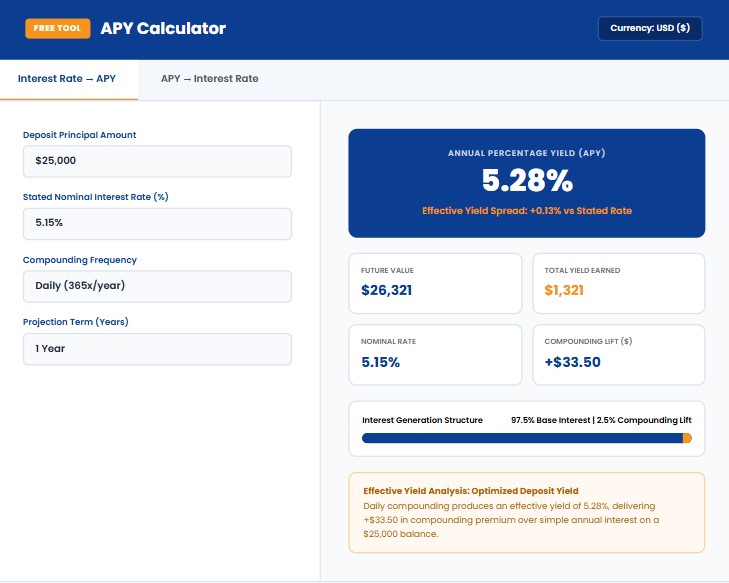
APY = (1.052843) - 1 = 0.052843 → 5.28%
Step 2: Calculate Future Terminal Value ($FV$)
FV = $25,000 × (1 + 0.0515 / 365)^(365 × 1)
FV = $25,000 × 1.052843 = $26,321.08 (≈ $26,321)
Step 3: Unbundle Total Yield and Compounding Premium
Total Interest Earned = $26,321.08 - $25,000.00 = $1,321.08
Base Simple Interest = $25,000 × 0.0515 × 1 = $1,287.50
Compounding Lift = $1,321.08 - $1,287.50 = +$33.58 (≈ +$33.50)
Summary: Daily recapitalization enhances yield by 13 basis points (+0.13%), generating $33.58 of pure compounding surplus on a $25,000 corporate liquidity allocation over 12 months.
4. Calculator Interface & Effective Yield Structure
5. Compounding Frequency Impact on a 5.00% Nominal Rate
The table below demonstrates how varying compounding frequencies impact effective yield on a standard 5.00% nominal contractual interest rate across a $100,000 institutional cash deposit:
| Compounding Schedule | Annual Cycles ($n$) | Effective APY | 1-Year Yield ($100k) | Incremental Compounding Lift |
|---|---|---|---|---|
| Annually | 1 | 5.000% | $5,000.00 | $0.00 (Baseline) |
| Semi-Annually | 2 | 5.063% | $5,062.50 | +$62.50 |
| Quarterly | 4 | 5.095% | $5,094.53 | +$94.53 |
| Monthly | 12 | 5.116% | $5,116.19 | +$116.19 |
| Weekly | 52 | 5.125% | $5,124.58 | +$124.58 |
| Daily | 365 | 5.127% | $5,126.75 | +$126.75 |
| Continuous ($e^{rt}$) | ∞ | 5.127% | $5,127.11 | +$127.11 |
6. Where to Find Your Numbers
To ensure valid benchmarking between competing banking products, extract your inputs from official depository disclosures:
- Nominal Rate vs. APY: Review the Truth in Savings Act (TISA) schedule on deposit agreements. Commercial banks must disclose both nominal interest and APY. If comparing loans instead of deposits, calculate obligations using our Business Loan Calculator.
- Compounding Interval ($n$): Look under the "Interest Calculation" section of your deposit account agreement. Most high-yield accounts accrue interest daily and credit it to the balance monthly.
- Operating Liquidity Needs: Before locking capital into high-yield certificates of deposit (CDs), evaluate required short-term cash reserves via the Working Capital Calculator.
- Multi-Year Reinvestment Projections: To project multi-decade accumulation with recurring cash infusions, transition your analysis into our Compound Interest Calculator.
7. What This Calculator Can and Cannot Tell You
What It Can Tell You
- The precise mathematical conversion between nominal borrowing/savings rates and true effective APY.
- The dollar surplus produced solely by increasing compounding cycles from annual to daily.
- Exact nominal contractual rates hidden behind marketing-driven APY quotations.
- Clean holding horizon returns on lump-sum depository instruments.
What It Cannot Tell You
- Tax Liabilities: Tax form 1099-INT treats interest as ordinary taxable income; this model displays pre-tax returns.
- Variable Rate Adjustments: High-yield savings rates float with Federal Reserve policy adjustments and do not remain fixed permanently.
- Early Withdrawal Penalties: CD forfeitures (e.g., 90 days of simple interest) are not automatically deducted.
- Deposit Account Maintenance Fees: Monthly servicing fees can erode the effective yield if minimum balance thresholds are missed.
8. Related Business & Financial Calculators
Expand your financial liquidity and yield analysis across complementary Fox Business Markets tools:
Compound Interest Calculator
Model multi-year portfolio accumulation with recurring monthly contributions and capital split charts.
Simple Interest Calculator
Calculate linear, non-compounding interest rates on bridge facilities and short-term debt notes.
Working Capital Calculator
Measure operating balance sheet health before locking cash reserves into long-term CDs.
Burn Rate Calculator
Analyze monthly operational cash outflows to determine available balances for interest-bearing accounts.
9. Frequently Asked Questions (FAQ)
What is the primary difference between APR and APY?
APR (Annual Percentage Rate) reflects the nominal annualized interest rate without accounting for intra-year compounding. In contrast, APY (Annual Percentage Yield) incorporates compounding effects. Consequently, for any deposit account with intra-year compounding, APY is consistently higher than APR.
Why do financial institutions advertise APY for savings but APR for loans?
Banking marketing conventions leverage psychological positioning: APY highlights the higher figure (attractive to savers seeking yield), whereas APR shows the lower baseline rate (attractive to borrowers seeking low borrowing costs). Regulatory bodies require standardized disclosures for both across contract documents.
Does daily compounding generate significantly more return than monthly compounding?
The mathematical curve experiences diminishing returns. While the difference between annual and monthly compounding is notable, the jump from monthly to daily compounding yields only a slight increase (typically 1 to 2 basis points), as compounding rapidly converges toward continuous theoretical limits.
How is APY affected if I withdraw interest earnings periodically?
If accrued interest is withdrawn rather than left to compound, you only realize the nominal interest rate ($r$), not the full APY. Achieving the quoted APY requires total reinvestment of all generated interest throughout the full 12-month cycle.
Can APY be negative?
In nominal terms, bank deposit APYs cannot fall below 0.00%. However, in real terms, if the inflation rate exceeds the deposit APY, your purchasing power experiences a negative net return.
10. The Bottom Line & Authoritative References
Annual Percentage Yield provides the true metric of economic return on cash holdings. By standardizing diverse compounding frequencies into an annualized figure, APY enables direct comparisons between high-yield savings accounts, money market funds, and fixed-term CDs. Optimizing corporate reserves and personal savings requires looking past nominal rates to capture the true compound velocity of capital.
Authoritative References & Academic Reading:
- Federal Reserve Board (Regulation DD – Truth in Savings): Official mathematical guidelines and statutory requirements for annual percentage yield calculation and disclosure.
- Federal Deposit Insurance Corporation (FDIC): National depository rate benchmarks, insurance thresholds, and consumer yield calculation rules.
- Consumer Financial Protection Bureau (CFPB): Guidance on comparing savings account yields, certificate of deposit early termination rules, and APR vs. APY consumer education.
- Fabozzi, Frank J. (Handbook of Fixed Income Securities): Foundational literature on effective annual yield conversions, day-count conventions, and intra-year interest compounding mechanics.