Quick answer: Steve Blank is a Silicon Valley entrepreneur turned educator who created the customer development method, the foundation of the lean startup movement. His core idea is that a startup searches for a business model rather than executing a plan, so founders should test assumptions with real customers before spending heavily on building and selling.
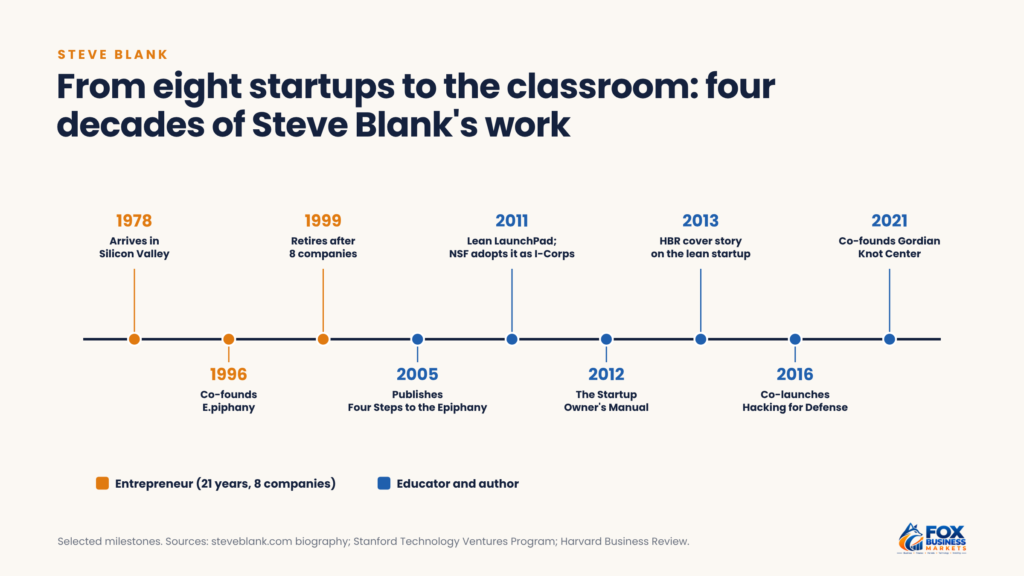
Steve Blank spent 21 years at eight technology companies before retiring in 1999, according to his official biography. Two of those companies, by his own account, were “large craters.” The lessons from those wins and losses became a class, then a book, then a National Science Foundation program now taught at 98 universities.
Most first-time founders still start the other way around. They write a business plan, raise money, build the product, and only then find out whether anyone wants it. Blank argued that this process works for established companies with known customers but breaks down for startups, where almost everything in the plan is a guess.
This guide covers who Steve Blank is, how his customer development method works, how it led to the lean startup, which of his books to read first, and how to apply his ideas to your own business in the next 30 days.
Who Is Steve Blank?
| Quick facts | |
| Known for | Creating the customer development method |
| Career | Eight technology companies over 21 years, retired in 1999 |
| Best-known company | E.piphany, co-founded in his living room in 1996 |
| Books | The Four Steps to the Epiphany; The Startup Owner’s Manual (with Bob Dorf) |
| Classes | Created Lean LaunchPad; co-created Hacking for Defense and Hacking for Diplomacy |
| Teaching | Stanford, U.C. Berkeley, Columbia, NYU, UCSF, and Imperial College London |
| Government programs | Lean LaunchPad became the National Science Foundation’s I-Corps curriculum in 2011 |
| Current roles | Adjunct professor, Stanford Department of Management Science and Engineering; Professor of Practice, Imperial College London (since 2026) |
Before Silicon Valley, Blank repaired fighter planes in Thailand during the Vietnam War. He arrived in Silicon Valley in 1978 and worked at a string of hardware and software companies, including Zilog, MIPS Computers, Convergent Technologies, Ardent, SuperMac, and Rocket Science Games, before co-founding E.piphany, a customer relationship software company that went public in 1999, during the dot-com boom.
After retiring, he began teaching entrepreneurship and writing about what he’d learned. His blog, steveblank.com, has published essays on startups, innovation, and national security for more than 15 years.
How Did Steve Blank’s Career Shape His Ideas?
Blank’s ideas came from watching startups fail despite smart teams and plenty of money. The pattern he saw repeatedly: companies built products based on what founders believed customers wanted, launched with big marketing budgets, and discovered too late that the market didn’t exist or wasn’t ready.
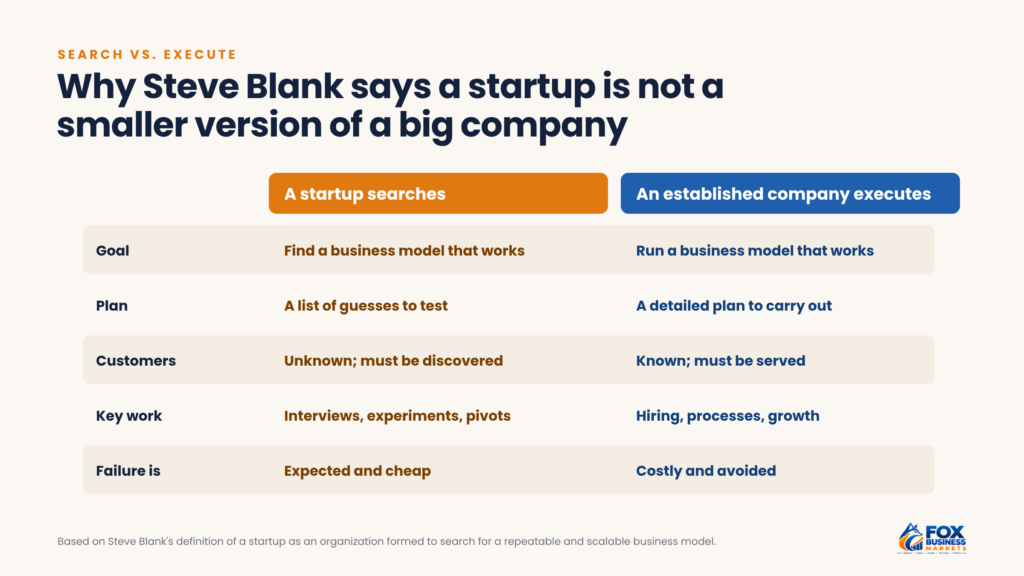
He concluded that startups were being run with tools designed for large companies. Business plans, five-year forecasts, and product launch schedules assume you already know who the customer is and what they’ll pay for. Established companies do know that. Startups don’t.
He later put that insight into a widely cited definition. In a January 2010 post titled “What’s A Startup? First Principles,” Blank wrote that “a startup is an organization formed to search for a repeatable and scalable business model.”
Our guide to what a startup is compares startups with traditional small businesses. Each word in Blank’s definition does work:
- Search means the business model isn’t known yet; finding it is the job.
- Repeatable means you can win customers again and again through the same sales and marketing channels, not just through the founder’s personal network.
- Scalable means revenue can grow faster than costs as the company adds customers.
What Is the Customer Development Method?
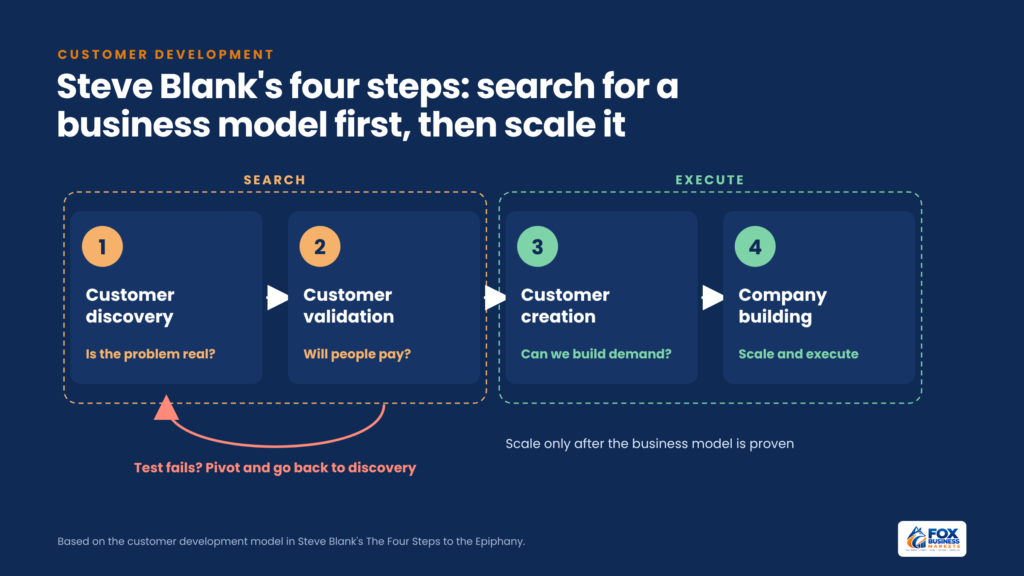
Customer development is a four-step process for testing a startup’s assumptions with real customers before committing to full-scale execution. Blank laid it out in The Four Steps to the Epiphany.
| Step | Goal | What you’re testing | Signal you’re ready to move on |
| 1. Customer discovery | Learn whether the problem is real | Who has the problem, how painful it is, what they use today | Customers describe the problem without prompting and want a fix |
| 2. Customer validation | Prove people will pay | Pricing, sales process, whether a repeatable sales model exists | Customers buy at your price through a process you can repeat |
| 3. Customer creation | Build demand | Which marketing channels bring in customers at a sustainable cost | Acquisition costs are predictable and below customer value |
| 4. Company building | Scale the organization | Moving from search to execution: departments, processes, hiring | The business model is known and the job becomes executing it |
The first two steps are the search. The last two are execution. The method’s central rule is that you don’t scale until the search is done.
When a test fails, the method expects you to go back, change an assumption, and test again. Blank originally described this as iterating. Eric Ries later named these course corrections “pivots,” a term Blank adopted in The Startup Owner’s Manual and that the lean startup movement made famous. A pivot might mean a new customer segment, a different pricing model, or a different sales channel, while the founders’ core vision stays the same.
What Does “Get Out of the Building” Mean?
“Get out of the building” is Blank’s shorthand for the first rule of customer discovery: the answers to your business questions aren’t inside your office. They’re with customers, suppliers, and partners.
In practice, it means:
- Talking to potential customers in person or by video before writing code or ordering inventory.
- Listening more than pitching. The goal is to learn how customers experience the problem, not to sell them.
- Testing one hypothesis at a time, such as “Restaurant owners spend more than five hours a week on scheduling.”
- Writing down what you hear and updating your assumptions after every round of interviews.
Questions that work well in a customer discovery interview include:
- Walk me through the last time you dealt with this problem.
- What do you use to solve it today, and what do you dislike about that?
- How much time or money does this problem cost you each month?
- Who else is involved in deciding how to solve it?
- If a solution existed, what would it need to do for you to switch?
- Who else should I talk to about this?
Avoid asking “Would you buy this?” People are polite and optimistic about hypothetical purchases. Past behavior, such as what they already pay for and how they’ve tried to solve the problem, is far more reliable.
How Is Customer Development Different From the Lean Startup?
The lean startup is the broader movement that grew out of customer development. Eric Ries, who popularized it, learned the method directly from Blank. Blank was an investor in IMVU, the startup Ries co-founded, and insisted that IMVU’s executives sit in on his entrepreneurship class at U.C. Berkeley. Ries published The Lean Startup in 2011.
| Customer development | Lean startup | Business model canvas | |
| Created by | Steve Blank | Eric Ries | Alexander Osterwalder and Yves Pigneur |
| Core question | Does a repeatable, scalable business model exist? | How fast can we learn what customers want? | What are the nine building blocks of our business? |
| Main tool | Customer interviews and the four-step process | Build-measure-learn loop and minimum viable product | A one-page visual map of the business model |
| Focus | Customers, sales, and the whole business model | Product development and rapid experiments | Mapping and comparing business models |
Blank’s Lean LaunchPad class combines all three. Teams start by sketching their business model on the canvas, treat every box as a guess, and spend each week getting out of the building to test those guesses. In a May 2013 Harvard Business Review cover story, “Why the Lean Start-Up Changes Everything,” Blank described the approach as favoring experimentation over elaborate planning, customer feedback over intuition, and iterative design over traditional big design up front.
Which Steve Blank Books Should You Read?
| Book | Year | Best for | What to expect |
| The Four Steps to the Epiphany | 2005 | Readers who want the original theory | The first full description of customer development; dense and written for tech founders |
| The Startup Owner’s Manual (with Bob Dorf) | 2012 | Founders ready to apply the method | A longer, step-by-step workbook with checklists for each stage, updated with a decade of new lessons |
If you plan to use the method, start with The Startup Owner’s Manual. Blank put his Lean LaunchPad class online through Udacity in 2012, and more than 500,000 students have taken it, according to his biography.
Is Customer Development Only for Tech Startups?
No. It’s a common assumption because Blank’s examples and students often come from technology, but the method applies to any new business where the customer, price, or sales channel is uncertain.
A few examples of how it translates:
- A bakery planning a wholesale line can interview café owners about how they buy pastries today, what they pay, and how often suppliers let them down, before buying a second oven.
- A home services company adding a maintenance plan can test sign-ups with a simple landing page and a few phone calls before hiring staff to deliver it.
- A consultant moving into a new industry can hold 10 to 15 discovery conversations to learn which problems clients will pay to solve, and at what price.
The method is less useful when the business model is already proven and the risk is mostly execution, such as opening a franchise location with a set playbook. That’s the distinction Blank draws between searching for a model and executing one. A franchise is execution; a new product line is often search.
Customer development has limits. Interviews tell you about problems, not whether people will actually pay, which is why validation, the second step, requires real sales. Some markets, such as new categories of consumer technology, are hard to test by interview because customers can’t yet imagine the product.
How Do You Know When the Search Is Over?
Proving the business model is easier to say than to measure. These signals help:
| Signal | What it shows | A simple test |
| Customers buy without heavy persuasion | The problem is real and your offer solves it | Most sales close through a standard pitch, not personal favors |
| Sales repeat through the same channel | Your sales model is repeatable | The same channel, such as referrals or online ads, keeps producing customers each month |
| Customer acquisition cost is below customer value | The model can pay for itself | What you spend to win a customer is well below the gross profit that customer brings in over time |
| Customers come back or renew | The product keeps delivering value | Repeat purchase or renewal rates hold steady or rise |
| Someone other than the founder can sell it | The process doesn’t depend on one person | A new salesperson closes deals using your playbook |
If several of these are missing, scaling up, such as hiring a sales team, signing a long lease, or raising a large round, multiplies a model that isn’t working yet.
What Mistakes Do Founders Make With Customer Development?
Founders who try customer development tend to make the same six mistakes:
- Interviewing friends and family. They want to be supportive, so their answers skew positive. Talk to strangers who fit your target customer.
- Pitching instead of listening. If you spend the interview describing your idea, you’ll learn what people think of your pitch, not how they experience the problem.
- Treating compliments as validation. “That’s a great idea” isn’t a purchase. Only a deposit, pre-order, or paid pilot counts as validation.
- Talking to too few segments. A product can fail with small business owners and succeed with office managers at larger firms. Test more than one segment before concluding there’s no market.
- Never stopping the search. Some teams keep interviewing to avoid the risk of launching. Set a deadline for each stage.
- Skipping the numbers. A model that customers love but that costs more to deliver than it earns is still not a business.
Where Is Customer Development Used Today?
Blank’s method has spread well beyond Silicon Valley classrooms:
- NSF I-Corps. In 2011, the National Science Foundation asked Blank to adapt the Lean LaunchPad class to help scientists turn research into companies. The program later expanded to the National Institutes of Health and the Departments of Energy and Defense, and 98 universities now teach the class, according to his biography.
- Hacking for Defense. Co-created by Blank and launched at Stanford in 2016, the class pairs student teams with real problems from defense and intelligence agencies. It became a federal program under the 2017 National Defense Authorization Act.
- Gordian Knot Center. In 2021, Blank co-founded the Stanford Gordian Knot Center for National Security Innovation.
How Can You Use Customer Development in Your Business?
You don’t need a venture-backed startup to use customer development. A 30-day plan for a new product, service, or business looks like this:
| Week | Focus | Actions |
| 1 | Write down your assumptions | Fill in a business model canvas. Mark every box that’s a guess. Pick the three riskiest guesses. |
| 2 | Customer discovery | Hold 10 to 15 interviews with people who fit your target customer. Ask about the problem, not your idea. |
| 3 | Revise and test | Update your assumptions. Build the simplest test: a landing page, a mock-up, a pre-order form, or a pilot offer. |
| 4 | Customer validation | Ask for a commitment: a deposit, a pre-order, a signed letter of intent, or a paid pilot. Count how many say yes. |
At the end of the month, you’ll be in one of three places: the evidence supports moving ahead, it points to a pivot, or it tells you to stop before you’ve spent much money. All three are useful outcomes.
Our step-by-step guide on how to start a startup walks through launch from idea to first customers, and startup funding stages explains how money usually comes in once you’ve found a model. Before you commit savings or take on debt, line up the numbers with our guides to small business finance and cash flow management. If a lender or investor asks how much money you’ve invested in your business, the evidence from your customer discovery work can strengthen your answer.
Frequently Asked Questions
What is a minimum viable product?
A minimum viable product, or MVP, is the simplest version of a product that lets you test a key assumption with real customers. It can be a landing page, a manual service delivered by the founders, or a basic prototype. Before you launch, write down what result would count as success.
Should you ask people to sign an NDA before an interview?
Usually not. Most people won’t sign a nondisclosure agreement for a 30-minute conversation, and the risk that an interviewee steals your idea is small compared with the cost of building something nobody wants. Talk about the problem rather than your solution, so there’s little to protect.
How do you find strangers to interview?
Start where your customers already gather: industry LinkedIn groups, trade associations, local business meetups, and online forums. Send a short, specific request, such as “I’m researching how restaurant owners handle scheduling, not selling anything.” Ask each person you interview for two more names before you hang up.
Can you use customer development after you’ve already launched?
Yes. If sales are flat or customers keep leaving, go back to discovery. Interview customers who left and prospects who said no, and look for the assumption that broke. Start with your five most recent lost deals, since those buyers still remember why they passed.
Get Out of the Building This Week
Write down the three assumptions your business depends on most. Then schedule five conversations with people who fit your target customer and ask how they deal with the problem today. You’ll learn more from those five calls than from another week of planning.
This article is for general information only and isn’t financial, tax, legal, or investment advice. Consider your own situation or talk to a qualified professional before making decisions.

