Free Health Insurance Cost Calculator: Out-of-Pocket Tool
Evaluating health insurance based solely on monthly premiums is one of the most expensive financial mistakes an individual or family can make. A low-premium plan often carries steep deductibles and high coinsurance rates that leave you exposed to devastating out-of-pocket liabilities when major medical events occur. The Free Health Insurance Cost Calculator projects your True Total Annual Healthcare Cost by modeling fixed annual premiums alongside anticipated doctor visits, prescriptions, hospital procedures, and annual out-of-pocket maximum caps across plan metal tiers.
Who it's for:
Employees navigating open enrollment benefits, self-employed professionals and freelancers purchasing ACA marketplace coverage, early retirees bridging the gap until Medicare eligibility, and families planning for major medical events such as childbirth or elective surgeries.
Why use it:
- Comprehensive Total Cost Modeling: Combine non-negotiable monthly premiums with realistic medical utilization to identify which plan structure costs less over a full 12-month calendar year.
- Automated OOP Max Safety Ceiling: Guarantee that cost-sharing formulas automatically stop once statutory annual out-of-pocket maximum thresholds are reached.
- HSA Tax Advantage Integration: Evaluate the net bottom-line savings of funding a Health Savings Account (HSA) paired with a high-deductible health plan (HDHP).
Monthly true cost: $810 / month
Under moderate medical utilization, your out-of-pocket costs remain below your plan cap ($7,500). If your expected medical care drops, a High-Deductible Health Plan (HDHP) paired with an HSA could yield significant tax and premium savings.
1. How to Use the Health Insurance Cost Calculator
Medical expenses consist of two distinct financial commitments: guaranteed fixed premiums that you pay regardless of health, and variable cost-sharing payments incurred when you seek care. Follow this step-by-step procedure to forecast your true annual healthcare liability:
- Select Your Currency: Choose your operating currency (USD $, GBP £, EUR €, CAD C$, or AUD A$) via the header dropdown. All figures, labels, and calculations adjust immediately.
- Choose Your Modeling Framework: Select Custom Plan Structure to manually enter policy parameters from your employer benefits portal, or click Metal Tier Presets to benchmark standardized Affordable Care Act (ACA) marketplace tiers (Bronze, Silver, Gold, or Platinum).
- Enter Monthly Premium & Policy Type: Input your recurring monthly health insurance payment (whether direct-pay or payroll-deducted) and identify whether the coverage is for an individual or a family unit.
- Define Cost-Sharing Parameters: Enter your plan's annual individual or family deductible, statutory Out-of-Pocket Maximum (OOP Max), and coinsurance percentage (commonly 20% member / 80% insurer after deductible).
- Estimate Expected Medical Utilization: Select a utilization profile (Low, Moderate, High, or Catastrophic) or input a specific custom gross medical bill projection based on scheduled surgeries, recurring specialist therapy, or routine primary care.
- Analyze True Total Outlays: Review your hero metrics to assess total combined healthcare outlays, effective monthly carrying costs, the exact out-of-pocket medical bill distribution, and how much cushion remains before hitting your annual OOP maximum ceiling.
2. How It Works & Core Mathematical Formulas
Under modern health insurance cost-sharing frameworks, medical bills pass through three chronological stages each calendar year: the deductible phase, the coinsurance phase, and the out-of-pocket maximum cutoff.
Under the ACA, in-network preventive health services (such as annual wellness checkups, childhood immunizations, and mammograms) must be covered at 100% with zero cost-sharing, meaning they bypass the deductible entirely. For all other covered services, the insured pays 100% of negotiated in-network rates until meeting the deductible. Once met, the insurer pays the majority share (e.g., 80%) while you pay coinsurance (e.g., 20%) until your cumulative out-of-pocket spending hits the statutory OOP Max, after which the insurer covers 100% of covered in-network benefits for the rest of the calendar year.
3. Fully Worked Numerical Example
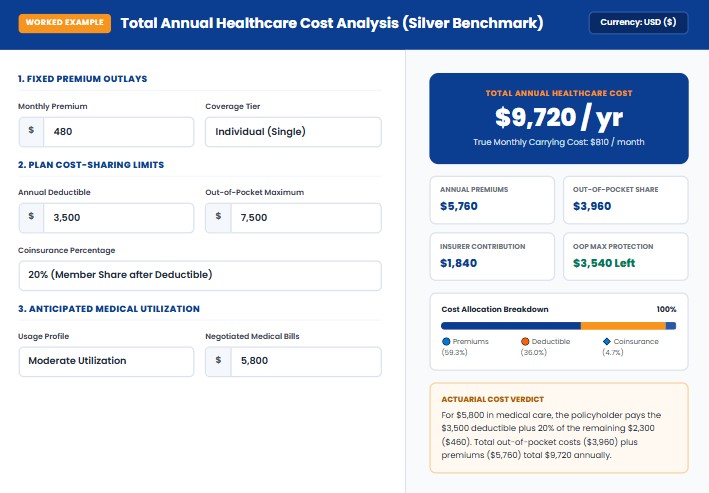
Consider an individual enrolled in a standard Silver Benchmark Plan who incurs $5,800 in negotiated medical bills over the course of the year due to routine care, specialist visits, and an outpatient diagnostic imaging procedure.
- Monthly Plan Premium: $480 / month ($5,760 annually)
- Annual Individual Deductible: $3,500
- Out-of-Pocket Maximum: $7,500
- Member Coinsurance Share: 20% (Insurer covers 80%)
- Negotiated Medical Charges: $5,800
Step 1: Calculate Guaranteed Fixed Premiums
Fixed Annual Premium = $480 * 12 = $5,760
Step 2: Allocate Deductible and Coinsurance Obligations
Deductible Paid by Patient = $3,500 (covers first $3,500 of bills)
Remaining Bill Subject to Coinsurance = $5,800 - $3,500 = $2,300
Patient Coinsurance (20%) = $2,300 * 0.20 = $460
Insurer Coinsurance Payout (80%) = $2,300 * 0.80 = $1,840
Step 3: Test Against Out-of-Pocket Maximum Cap
Total Variable Out-of-Pocket = $3,500 (Deductible) + $460 (Coinsurance) = $3,960
Comparison to Cap: $3,960 < $7,500 OOP Max (Patient retains $3,540 in remaining safety buffer)
Step 4: Compute True Total Annual Healthcare Expense
True Total Annual Cost = $5,760 (Premiums) + $3,960 (Medical OOP) = $9,720 / year
Effective Monthly Carrying Cost = $9,720 / 12 = $810 / month
Conclusion: Looking exclusively at the $480 monthly premium obscures the real cost of coverage. Factoring in moderate healthcare needs pushes the true carrying cost to $810/month ($9,720/year), with the member paying 68.3% ($3,960 / $5,800) of their gross medical charges directly before cost-sharing relief takes effect.
4. Calculator Interface & Output Breakdown
The visual preview below illustrates the exact input and output structure for our Silver Plan scenario, detailing the proportional split between fixed premiums, deductible payments, and coinsurance:
5. ACA Marketplace Metal Tier Actuarial Comparison
The Affordable Care Act structures insurance plans into standardized metal tiers based on Actuarial Value (AV)—the average percentage of total healthcare costs paid by the plan across a standard population:
| Metal Tier | Actuarial Value | Relative Premium Level | Typical Deductible (Individual) | Ideal Consumer Profile |
|---|---|---|---|---|
| Bronze (HDHP) | ~60% | Lowest (Base) | $6,500 – $7,500+ | Healthy individuals seeking catastrophic protection + HSA tax shelter |
| Silver (Benchmark) | ~70% | Moderate | $3,500 – $5,000 | Standard families & earners eligible for Cost-Sharing Reductions (CSR) |
| Gold | ~80% | High | $1,000 – $2,000 | Individuals expecting routine specialist care, surgery, or therapy |
| Platinum | ~90% | Highest | $0 – $500 | Patients with heavy chronic conditions or intensive maintenance prescriptions |
| Catastrophic | <60% | Sub-Bronze | Equals Statutory OOP Max | Adults under 30 or individuals with certified financial hardship exemptions |
6. Where to Find Your Insurance & Medical Inputs
Gathering verified policy numbers guarantees an accurate projection of your net annual healthcare liability:
- Monthly Premiums: Check your employer’s open enrollment benefits portal, monthly paystub deductions, or your state ACA health exchange dashboard. If offering benefits to your team, calculate full loaded costs with our Cost per Employee Calculator.
- Summary of Benefits and Coverage (SBC): Every insurer is legally required to provide an SBC document. Locate the exact figures on page 1 for "What is the overall deductible?" and "What is the out-of-pocket limit for this plan?"
- Historical Medical Billing Statements: Review your insurance portal’s "Explanation of Benefits" (EOB) statements from the previous 12 to 24 months to aggregate typical yearly spending on diagnostic testing, doctor copays, and prescription formularies.
- Health Savings Account (HSA) Reserves: If you select a qualifying HDHP, build a liquid cash reserve to cover your entire annual deductible. You can track emergency fund accumulation using our Deposit Growth Calculator.
- Long-Term Tax Advantage Modeling: Triple-tax-advantaged HSA funds that are not spent on current medical bills can be invested for retirement. Project your long-term compounding growth with our Compound Interest Calculator.
7. What This Calculator Can and Cannot Tell You
What It Can Tell You
- True Total Cost Transparency: Combines fixed premium overhead with variable medical out-of-pocket costs to identify the real lowest-cost plan.
- OOP Maximum Protection: Confirms the exact dollar threshold where your personal liability ends for in-network medical care.
- Metal Tier Efficiency: Shows mathematically whether paying higher monthly premiums for a Gold/Platinum plan actually saves money based on your expected care.
- Scenario Stress-Testing: Lets you model low, moderate, and catastrophic health events to evaluate risk tolerance.
What It Cannot Tell You
- Out-of-Network Liability: Does not cover non-participating providers, where balance billing rules may exceed standard in-network OOP maximums.
- Prescription Drug Tier Mechanics: Excludes multi-tier formulary nuances (e.g., specialty tier biologicals vs. generic tier copays).
- ACA Premium Tax Credits: Does not calculate means-tested Advanced Premium Tax Credit (APTC) subsidies based on Modified Adjusted Gross Income (MAGI).
- Dental & Vision Carve-Outs: Standard medical plans generally exclude adult comprehensive dental procedures, vision hardware, and cosmetic procedures.
8. Related Personal Finance & Risk Planning Tools
Medical costs represent one of the primary drivers of personal debt and operational overhead. Balance your healthcare strategy with these verified financial resources from Fox Business Markets:
What is the difference between an HSA and an FSA?
A Health Savings Account (HSA) is a tax-advantaged account available exclusively to individuals enrolled in a qualifying High-Deductible Health Plan (HDHP). HSAs offer a unique triple-tax advantage: contributions are tax-deductible, investments grow tax-free, and withdrawals for qualified medical expenses are 100% tax-free. Furthermore, HSA balances roll over indefinitely year after year and belong to you even if you switch jobs. A Flexible Spending Account (FSA) is owned by your employer and typically operates under a strict "use-it-or-lose-it" rule, where unspent funds forfeit back to the employer at the end of the plan year or grace period.
What is an Out-of-Pocket Maximum and what does it include?
The Out-of-Pocket Maximum is the absolute legal ceiling on what an insured member must pay for covered, in-network medical services during a single policy year. It includes your deductible, coinsurance payments, and copayments. Crucially, your monthly insurance premiums and costs for non-covered or out-of-network services do not count toward this cap. Once your cumulative deductible and coinsurance payments reach the OOP Max, the insurer pays 100% of all allowed covered in-network medical bills for the rest of that policy year.
Should I pick a High Deductible (HDHP) or a Low Deductible (Gold/Platinum) plan?
This depends entirely on your expected medical utilization and cash reserves. An HDHP (Bronze) is generally ideal if you are healthy, rarely visit the doctor, and want to minimize fixed premium overhead while leveraging an HSA for tax savings. However, you must have enough liquid savings to cover the high deductible if an emergency occurs. Conversely, a low-deductible plan (Gold/Platinum) makes financial sense if you have predictable, recurring medical needs—such as chronic prescription therapies, planned surgeries, or pregnancy—where higher fixed premiums prevent massive, unexpected out-of-pocket bills.
How do copayments differ from coinsurance?
A copayment (copay) is a flat, fixed fee you pay upfront for a specific medical service—for instance, a $30 copay for a primary care visit or a $15 copay for a generic prescription. Coinsurance is a percentage-based cost-sharing arrangement that applies after you meet your annual deductible. For example, with 20% coinsurance on an outpatient hospital procedure with a negotiated cost of $2,000, you pay $400 (20%) while your insurer pays $1,600 (80%), provided you haven't yet reached your out-of-pocket maximum.
What are Cost-Sharing Reductions (CSR) on ACA Marketplace plans?
Cost-Sharing Reductions (CSR) are federal subsidies available under the ACA that lower your out-of-pocket costs by reducing your deductible, copayments, and out-of-pocket maximum. CSR subsidies are available exclusively to households with incomes between 100% and 250% of the Federal Poverty Level (FPL) who enroll specifically in an ACA Silver Tier Plan. In many cases, CSR subsidies transform a standard Silver plan into the actuarial equivalent of a Gold or Platinum plan without charging the higher monthly premium.
10. The Bottom Line & Strategic Healthcare Budgeting
True healthcare cost management requires evaluating your total financial liability rather than focusing solely on the lowest sticker price for monthly premiums. By comparing fixed premium overhead against realistic out-of-pocket medical expectations, you protect your household balance sheet from unexpected financial shocks while ensuring you do not overpay for unused coverage. Re-evaluate your plan elections during every open enrollment period, account for upcoming life events, and maintain a dedicated liquid reserve to absorb your deductible comfortably.
Authoritative References & Further Reading
- Centers for Medicare & Medicaid Services (CMS.gov): Federal regulatory guidance on statutory annual out-of-pocket maximum caps and ACA plan standards.
- HealthCare.gov: Official federal health insurance marketplace resources explaining metal tiers, catastrophic plans, and cost-sharing subsidies.
- Kaiser Family Foundation (KFF): Annual Employer Health Benefits Surveys and independent research on national premium trends and cost-sharing benchmarks.
- Internal Revenue Service (IRS) Publication 969: Statutory rules, contribution limits, and qualifying high-deductible health plan definitions for HSAs and FSAs.