How to Use the E-commerce Profit Calculator
Follow these steps to calculate your true order-level unit economics and net take-home cash profit:
- Select Currency: Select your primary checkout currency (USD, GBP, EUR, CAD, or AUD) from the top-right menu.
- Retail Selling Price (AOV): Enter the total checkout price paid by the customer, including any collected shipping or sales value.
- Landed Product Cost (COGS): Enter the unit manufacturing cost plus all freight forwarding, port customs duties, and inbound transport costs.
- Fulfillment & Postage: Enter the courier postage cost and the physical packaging cost (boxes, mailers, tape, custom promotional flyers).
- Payment Gateway Fee: Confirm your merchant processor rate (Shopify Payments / Stripe defaults to 2.9% + $0.30 per transaction).
- Marketing Acquisition (CAC) & Returns: Enter your paid media cost per acquisition (CPA) and customer return rate to uncover your true Contribution Margin 3 (CM3).
Core Formulas and Contribution Margin Hierarchy
Institutional e-commerce finance evaluates unit profitability through three progressive contribution tiers:
1. Contribution Margin 1 (CM1 / Gross Product Margin)
CM1 = Retail Selling Price - Landed Cost of Goods Sold (COGS)
2. Contribution Margin 2 (CM2 / Delivered Order Margin)
CM2 = CM1 - Shipping - Packaging - Merchant Gateway Fees
3. Contribution Margin 3 (CM3 / Net Pocket Profit)
CM3 (Net Profit) = CM2 - Customer Acquisition Cost (CAC) - Return/Refund Drag
4. Break-Even Return on Ad Spend (ROAS)
Break-Even ROAS = Retail Selling Price ÷ CM2 (Pre-Ad Delivered Contribution)
Fully Worked Numerical Example
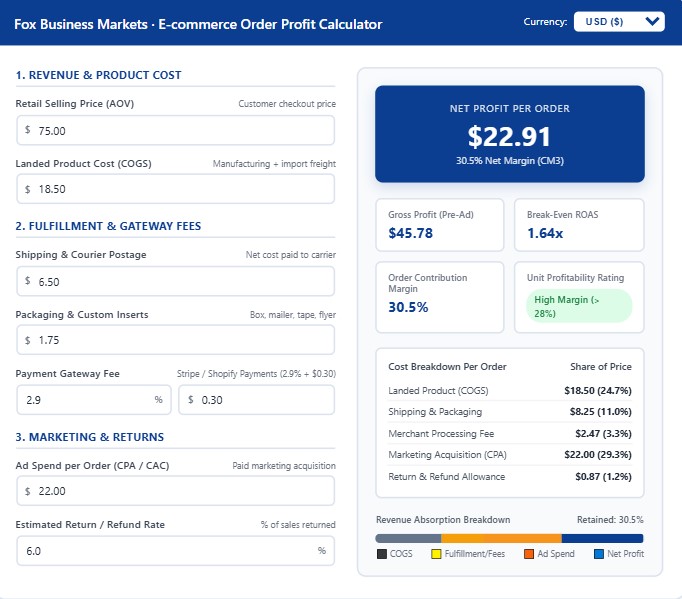
Consider an e-commerce skincare brand selling an essentials bundle with the following unit figures:
- Retail Selling Price: $75.00
- Landed COGS: $18.50
- Courier Shipping: $6.50
- Packaging & Inserts: $1.75
- Payment Processing: 2.9% + $0.30 = $2.48
- Ad Spend per Order (CAC): $22.00
- Return Rate: 6.0% (~$2.20 per order allowance)
Step 1: Calculate Gross Profit (CM1) = $75.00 - $18.50 = $56.50 (75.3% Gross Margin)
Step 2: Calculate Delivered Margin (CM2) = $56.50 - $6.50 (Shipping) - $1.75 (Packaging) - $2.48 (Gateway) = $45.77
Step 3: Calculate Break-Even ROAS = $75.00 ÷ $45.77 = 1.64x Break-Even ROAS
Step 4: Calculate Net Profit (CM3) = $45.77 - $22.00 (CAC) - $2.20 (Return Drag) = $21.57 Net Pocket Profit (28.8% Net Margin)
While the initial gross markup looked enormous at 75.3%, the actual retained cash profit per checkout is 28.8%. This leaves plenty of headroom to cover fixed operating software and team payroll.
Industry Benchmarks for Direct-to-Consumer (DTC) Margins
| Product Category | Gross Margin (CM1) | Delivered Margin (CM2) | Target Net Margin (CM3) |
|---|---|---|---|
| Beauty, Cosmetics & Skincare | 75% - 88% | 55% - 68% | 20% - 32% |
| Apparel & Fast Fashion | 55% - 70% | 35% - 48% | 10% - 18% |
| Consumer Electronics & Gadgets | 40% - 55% | 25% - 38% | 8% - 15% |
| Home Goods & Bulky Furniture | 60% - 72% | 30% - 42% | 12% - 20% |
Where to Find Your Numbers
To ensure precise unit economics, extract your inputs from your live merchant dashboards and companion financial tools:
- Retail AOV & Shipping Charges: Pull Average Order Value from Shopify Analytics under Reports → Sales by Order.
- Paid Customer Acquisition Cost (CAC): Pull blended ad costs from Meta Ads and Google Ads. For deep attribution, utilize our CAC Calculator.
- Ad Performance Benchmarks: Track ad efficiency thresholds with our ROAS Calculator.
- Customer Repeat Value: If your initial order break-even is slim, evaluate long-term second-order profit via our Customer Lifetime Value (LTV) Calculator.
What This Calculator Can and Cannot Tell You
✔ What This Tool Tells You:
- Exact net dollar profit deposited in your bank per completed checkout
- The maximum ad spend you can incur per order before losing money
- The true drag of packaging, payment processing, and customer returns
✖ What It Does Not Cover:
- Fixed general overhead (warehouse leases, full-time staff salaries)
- Cash flow timing delays from wholesale inventory financing
- State and local sales tax remittance liabilities
Related Calculators & Resources
Frequently Asked Questions
What is the difference between Gross Margin and Contribution Margin?
Gross Margin (CM1) only subtracts the product manufacturing cost (COGS) from the selling price. Contribution Margin (CM2 and CM3) subtracts all variable expenses required to fulfill and market the order (shipping, packaging, gateway fees, and paid ad spend). Contribution Margin reflects your true unit cash generation.
What is a healthy Contribution Margin 3 (CM3) for a DTC brand?
A healthy target for first-time customer orders is 15% to 25% CM3 after paid advertising acquisition spend. Brands with high repeat purchase rates (subscriptions, consumable beauty) can occasionally tolerate 0% to 10% CM3 on first orders if back-end retention profitability is proven.
How does offering free shipping impact order economics?
Free shipping directly absorbs your courier postage fee into your margin pool. If you absorb an $8 shipping fee without increasing product price or bundle threshold (AOV), your Contribution Margin can shrink by 10 to 15 percentage points.
Authoritative References & Methodologies
- Harvard Business Review: The Core Unit Economics of Direct-to-Consumer Commerce
- National Retail Federation (NRF): Consumer Returns and Fulfillment Benchmarks