1. How to Use the Auto Loan Calculator
Our automotive financing calculator gives vehicle buyers and fleet managers an institutional tool to determine fixed monthly car installments, evaluate dealership terms, and isolate total financing expenses. Follow these steps to model your vehicular debt service:
- Select Operating Currency: Choose USD ($), GBP (£), EUR (€), CAD (C$), or AUD (A$) from the top header to align calculations with your regional financial market.
- Select Financing Mode: Keep the default "Direct Loan Amount" tab if you already know your net borrowing requirement. Alternatively, switch to "Dealership Purchase" to calculate net loan capital based on vehicle MSRP, down payment, trade-in credit, and local sales tax.
- Enter Loan Principal or Vehicle Value: Input the gross purchase figure or net loan balance to be financed through your financial institution.
- Set Annual Percentage Rate (APR): Input the nominal fixed annual borrowing interest rate quoted by your credit union, commercial bank, or automotive dealer.
- Select Loan Tenure: Choose your planned repayment term from the dropdown list (ranging from 36 to 84 months) to evaluate the trade-off between monthly cash flow and cumulative lifetime interest.
2. How It Works & Core Mathematical Formulas
Automotive loans are structured as fully amortized, fixed-installment annuities. Equal monthly payments are applied to both interest charges and principal balance reduction. Monthly interest is computed against the remaining unpaid balance, so early installments allocate more toward interest overhead, while later payments accelerate vehicular equity growth.
The standard monthly automotive debt installment is calculated using the following equation:
Where:
M = Monthly car payment installment
P = Net financed principal balance
r = Periodic monthly interest rate (Annual Stated APR / 12 / 100)
n = Total number of monthly repayment periods (Term Months)
When modeling complete dealership purchase structures, net capitalized borrowing principal ($P$) integrates statutory sales tax and credit deductions:
Sales Tax ($) = Taxable Base * (Sales Tax Rate % / 100)
P = Vehicle Price + Sales Tax ($) - Down Payment - Trade-in Allowance
Total Cost of Acquisition = (M * n) + Down Payment + Trade-in Allowance
Total Interest Paid = (M * n) - P
3. Fully Worked Numerical Example
Case Study: Financing a $35,000 Vehicle Over 60 Months
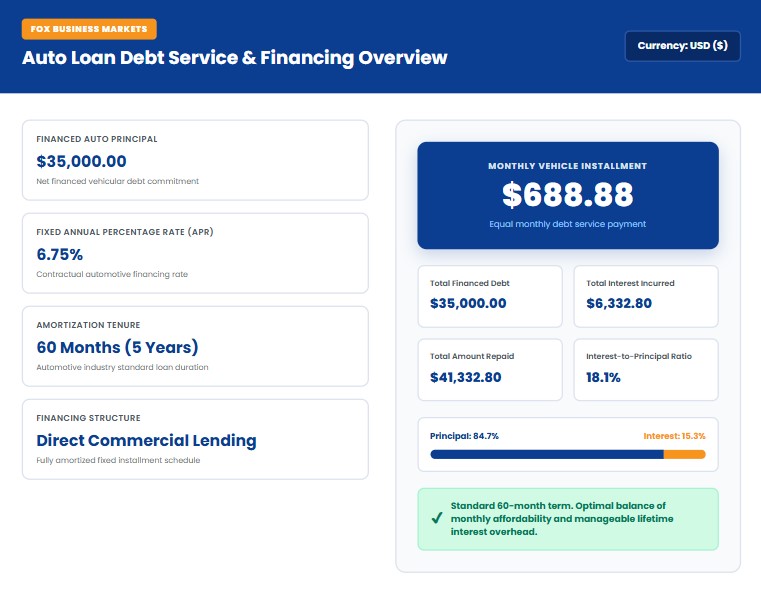
Consider an automotive purchaser financing a net vehicle balance of $35,000.00 through a credit union. The lender approves a fixed 6.75% APR over an industry-standard 60-month (5-year) amortization term.
- Net Financed Principal (P): $35,000.00
- Monthly Interest Rate (r): 0.0675 / 12 = 0.005625
- Installment Months (n): 60
- Compounding Factor [(1 + r)^n]: (1 + 0.005625)^60 = 1.398942
Applying the monthly installment formula:
M = 35,000 * [ 0.007869 ] / [ 0.398942 ]
M = $688.88 per month
Lifecycle Vehicular Debt Summary:
- Total Repayment (60 * $688.88): $41,332.80
- Total Cumulative Interest Incurred: $41,332.80 - $35,000.00 = $6,332.80
- Interest-to-Principal Leverage Ratio: 18.09% (The buyer pays 18.1 cents in financing charges for each dollar borrowed).
4. Interactive Calculator Interface & Amortization Analysis
5. Automotive Loan Tenure Benchmarks & Cost Trade-Offs
Automobile buyers often extend repayment terms to lower monthly installments, but this increases cumulative finance charges and negative equity risks. The table below compares loan durations for a $35,000 financed principal balance at a 6.75% APR:
| Loan Duration | Monthly Payment | Total Interest Paid | Total Lifetime Repaid | Interest-to-Loan Ratio | Balance Sheet & Equity Risk Level |
|---|---|---|---|---|---|
| 36 Months (3 Years) | $1,076.62 | $3,758.32 | $38,758.32 | 10.7% | Minimal Risk; rapid equity build-up, lowest total financing cost. |
| 48 Months (4 Years) | $834.02 | $5,032.96 | $40,032.96 | 14.4% | Low Risk; balances payment affordability with minimal interest drag. |
| 60 Months (5 Years - Standard) | $688.88 | $6,332.80 | $41,332.80 | 18.1% | Moderate Risk; standard benchmark balancing monthly cash flow and depreciation. |
| 72 Months (6 Years) | $592.51 | $7,660.72 | $42,660.72 | 21.9% | Elevated Risk; vulnerable to negative equity during initial 36 months. |
| 84 Months (7 Years - Extended) | $524.03 | $9,018.52 | $44,018.52 | 25.8% | High Risk; vehicle depreciation frequently outpaces outstanding loan balance. |
6. Where to Find Your Automotive Financing Numbers
To avoid dealership financing markups and ensure your inputs reflect exact transaction terms, consult these official documents:
- Vehicle Base Price & Options: Sourced from the official manufacturer window sticker (Monroney Label) or dealer buyer's order contract.
- Financing APR & Administrative Fees: Listed on Page 1 of your formal Truth in Lending Act (TILA) automotive disclosure. To examine whether dealer doc fees inflate your actual borrowing rate, verify costs using our APR Calculator or assess annual percentage returns with the APY Calculator.
- Unsecured Lending Alternatives: If you are considering an unsecured personal credit line to buy a car without collateral liens, compare terms using our Personal Loan Calculator.
- Commercial Vehicle Fleets: If financing corporate delivery vans, trucks, or fleet assets under an enterprise entity, calculate terms using our Business Loan Calculator.
- Working Capital Safeguards: Verify that out-of-pocket down payments do not compromise your liquid cash reserves using our Working Capital Calculator.
7. What This Calculator Can and Cannot Tell You
What It Tells You (Analytical Capabilities)
- Exact monthly principal and interest installments across standard automotive terms.
- Net capitalized borrowing principal after applying cash down payments and trade-in allowances.
- Total cumulative interest charges incurred over the full life of the vehicular loan.
- Financial risk assessments identifying terms prone to underwater negative equity.
What It Cannot Tell You (Model Limitations)
- Dealer documentation fees, vehicle registration levies, and title delivery charges.
- Add-on product pricing such as extended warranties, GAP insurance, or tire protection packages.
- Individual lender credit approval thresholds or tier-based APR underwriting margins.
- Future secondary market depreciation values for specific automotive makes and models.
8. Related Financing & Debt Calculators
Managing debt across personal and commercial balance sheets requires tracking interest rates, amortization timelines, and capital efficiency. Explore these verified calculators from Fox Business Markets:
Personal Loan Calculator
Analyze unsecured installment loans for debt consolidation, vehicle acquisitions, or unexpected expenses.
Mortgage Calculator
Estimate residential home financing payments, PITI escrow liabilities, and 30-year amortization schedules.
Business Loan Calculator
Model commercial equipment leases, fleet financing, and institutional working capital terms.
Compound Interest Calculator
Analyze the opportunity cost of allocating surplus cash toward auto debt versus high-yield compounding investments.
9. Frequently Asked Questions (FAQ)
10. The Bottom Line & Authoritative References
Managing vehicle financing effectively requires evaluating total transaction terms rather than focusing solely on monthly payments. While extending loan terms lowers monthly obligations, it significantly increases cumulative interest costs and exposes buyers to negative equity risks. By contributing a meaningful down payment, selecting terms within 48 to 60 months, and comparing lender rates, buyers can protect their balance sheet while securing necessary transportation.
For official automotive lending guidance, consumer protection laws, and credit rights, review these authoritative references:
- Consumer Financial Protection Bureau (CFPB) – Auto Loan Consumer Resources & Guides
- Federal Trade Commission (FTC) – Financing or Leasing a Vehicle Guidelines
- Federal Reserve Board – G.19 Consumer Credit & Commercial Auto Loan Averages
- National Automobile Dealers Association (NADA) – Industry Research & Market Data