Quick answer: Forex leverage lets you control a large currency position with a small deposit, called margin. U.S. rules cap retail leverage at 50:1 on major currencies and 20:1 on others. At 50:1, a 2% price move against you wipes out your entire deposit, so many experienced traders use far less.
At the maximum 50:1 leverage allowed in the U.S., holding a EUR/USD (euro/U.S. dollar) position for one month would have wiped out a trader’s entire deposit about 24% of the time over the past decade. That’s based on our simulation of 4,960 hypothetical one-month long and short positions, with no stop-loss, using Federal Reserve exchange-rate data from November 2016 to November 2026. At 10:1 leverage, it never happened for EUR/USD.
Brokers often present leverage as a way to grow a small account quickly. In practice, it magnifies losses just as much as gains, and it turns ordinary currency swings into account-ending events. EUR/USD typically moves only about 0.25% a day, yet a swing of about 2% within a month is routine.
This guide explains how leverage and margin work, how to calculate them, how often high leverage fails, what U.S. and foreign rules allow, how margin calls work, what the 2015 Swiss franc shock taught traders, and how much leverage makes sense.
What Is Leverage in Forex?
Leverage is the ratio between the size of your trading position and the money you put up to hold it. With 50:1 leverage, every $1 of your money controls $50 of currency.
Forex dealers offer leverage because currency prices usually move in small steps. A typical day’s move in EUR/USD is about 0.25%, so an unleveraged $10,000 position would gain or lose about $25. Leverage scales those moves up, for better or worse.
Leverage in forex differs from a regular loan in two ways:
- You don’t receive cash. The dealer lets you hold a larger position than your deposit would allow.
- Your deposit is the cushion. Losses come out of your account first, and the dealer can close your positions if the cushion gets too thin.
For a broader introduction to the market, see our guide to forex trading.
How Do Margin and Leverage Work Together?
Margin is the deposit a dealer requires to open and hold a position. It’s the flip side of leverage: the higher the leverage, the smaller the margin.
Leverage | Margin required | Margin for 1 standard lot of EUR/USD at 1.1154 |
| 50:1 | 2% | $2,231 |
| 30:1 | 3.33% | $3,718 |
| 20:1 | 5% | $5,577 |
| 10:1 | 10% | $11,154 |
| 1:1 | 100% | $111,540 |
A standard lot is 100,000 units of the base currency. Values use the Nov. 6, 2026, EUR/USD rate.
Margin isn’t a fee. It stays in your account as collateral while the position is open. What changes is your equity, which is your cash balance plus or minus any open gains or losses. If equity falls too far relative to your margin, the dealer will act, as explained below.
How Do You Calculate Leverage and Margin?
Three formulas cover most of what you need:
- Position value = lot size x exchange rate (in U.S. dollars for pairs such as EUR/USD)
- Required margin = position value / maximum leverage
- Effective leverage = total position value / account equity
The third number is the most telling, because it measures the risk you’re actually taking, not the maximum your dealer allows. Say you have $5,000 in your account:
Position | Value | Effective leverage |
| 1 micro lot (1,000 euros) | $1,115 | 0.2:1 |
| 1 mini lot (10,000 euros) | $11,154 | 2.2:1 |
| 1 standard lot (100,000 euros) | $111,540 | 22.3:1 |
| 2 standard lots | $223,080 | 44.6:1 |
Your dealer may allow 50:1, but trading a single mini lot in a $5,000 account means you’re using only about 2:1. Pip values depend on the pair you trade, and our guide to currency pairs shows how to calculate them.
How Far Can Prices Move Before You’re Wiped Out?
The math is simple: at any leverage level, a price move equal to 1 divided by the leverage (1/50 = 2%) erases 100% of your deposit.
Leverage | Price move that wipes out a fully used deposit |
| 5:1 | 20% |
| 10:1 | 10% |
| 20:1 | 5% |
| 30:1 | 3.3% |
| 50:1 | 2% |
| 100:1 | 1% |
| 500:1 | 0.2% |
Price move needed to wipe out a forex deposit at different leverage levels
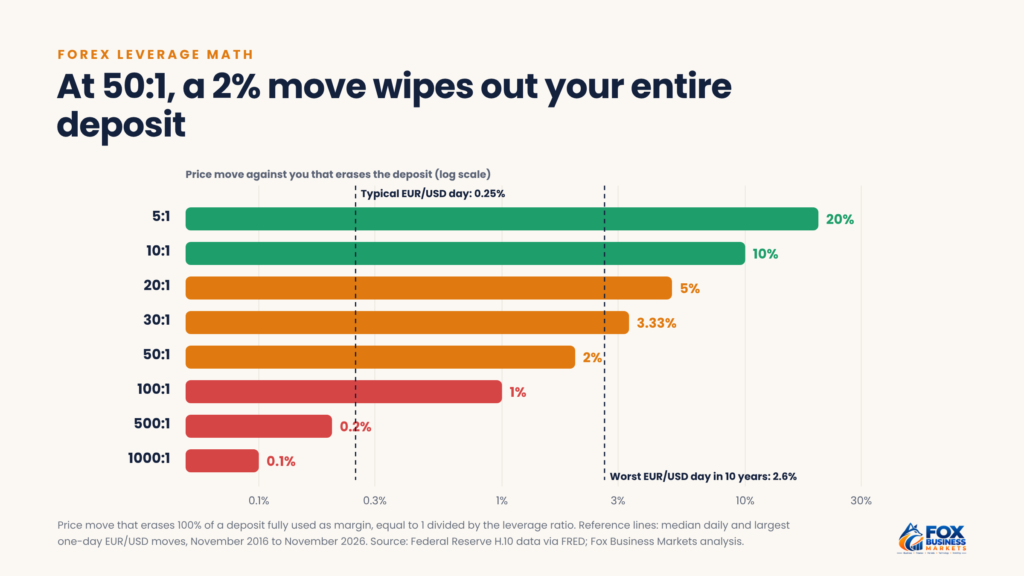
Compare those thresholds with how currencies actually behave. Over the past 10 years, based on Federal Reserve noon rates:
- Typical day: EUR/USD’s median daily move was about 0.25%. USD/JPY’s (U.S. dollar/Japanese yen) was about 0.28%.
- Rough day: One day in 20, EUR/USD moved more than 0.9%, and USD/JPY moved more than 1.1%.
- Worst day: EUR/USD’s biggest one-day move was 2.6%, and USD/JPY’s was 4.2%.
- Typical month: In half of all one-month periods, EUR/USD at some point moved at least 1.9% from its starting level.
At 500:1, which some offshore brokers advertise, a single typical day can erase your deposit. At 50:1, a normal month often can.
How Often Does High Leverage Wipe Out an Account?
To test this with real prices, we looked at every trading day from November 2016 to November 2026. For each day, we opened a hypothetical long position and a hypothetical short position in EUR/USD, USD/JPY, and GBP/USD (British pound/U.S. dollar), held them for 21 trading days (about one month), and checked whether the losses ever reached half or all of the deposit. That produced 4,960 one-month cases for each pair.
Leverage | EUR/USD: lost half | EUR/USD: lost all | USD/JPY: lost all | GBP/USD: lost all |
| 5:1 | 0% | 0% | 0% | 0% |
| 10:1 | 1.4% | 0% | 0.2% | 0.3% |
| 20:1 | 15.9% | 1.4% | 4.2% | 3.1% |
| 30:1 | 31.0% | 7.8% | 14.3% | 10.2% |
| 50:1 | 51.4% | 24.1% | 29.4% | 32.0% |
| 100:1 | 69.1% | 51.4% | 53.9% | 57.5% |
Assumes the full deposit is used as margin, with no stop-loss, spread, or financing costs. Uses daily noon rates, so intraday swings, which are larger, would raise these figures. Start dates overlap, so the cases aren’t independent, and past moves don’t predict future ones. Source: Federal Reserve H.10 data via the St. Louis Fed’s Federal Reserve Economic Data (FRED); Fox Business Markets analysis.
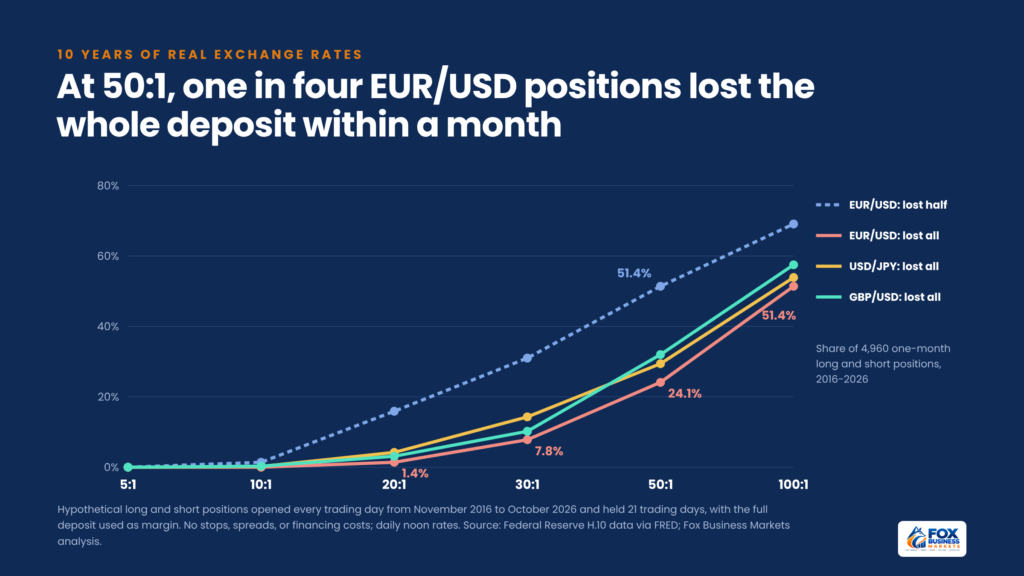
Chance of losing half or all of a forex deposit within one month at different leverage levels
The pattern is stark. At 10:1 or less, no more than 0.3% of simulated positions lost the whole deposit. Above 20:1, the odds climbed fast. At 50:1, about half of EUR/USD positions lost at least half the deposit within a month, and about one in four lost all of it.
Real trading would look worse. Dealers usually close positions before equity hits zero, spreads and overnight charges add up, and prices can gap past your stop-loss order.
What Are the Forex Leverage Limits in the U.S.?
U.S. retail forex leverage is set by the Commodity Futures Trading Commission (CFTC) and the National Futures Association (NFA). Since October 2010, CFTC rules have required minimum security deposits of:
- 2% for major currencies, or a maximum of 50:1 leverage
- 5% for all other currencies, or a maximum of 20:1
The NFA decides which currencies count as majors and can raise deposits when markets turn volatile. After the Swiss franc shock in January 2015, for example, it raised the deposit on the franc to 5% (since lowered to 3%), and it has adjusted requirements on other currencies, including the yen and pound, at times since. As a result, some major pairs carry less than 50:1 leverage. Dealers can also set stricter limits of their own, and many let you choose lower leverage settings.
Only dealers registered with the CFTC and NFA may offer retail forex to U.S. customers. Offshore firms that advertise 500:1 or more aren’t registered here, and U.S. regulators can do little if they fail or refuse to pay. Check any firm through the NFA’s BASIC database before you deposit money.
How Does Forex Leverage Compare With Stock Margin?
Forex leverage is far higher than what stock investors can use. In a U.S. stock margin account, Federal Reserve Regulation T generally lets you borrow up to 50% of a stock purchase, which works out to leverage of about 2:1. Financial Industry Regulatory Authority (FINRA) rules then require you to keep at least 25% equity in the account, and many brokers set higher thresholds. In June 2026, FINRA also replaced the old pattern day trader rule and its 4:1 day-trading buying power with a new intraday margin standard, which brokers have until October 2027 to adopt.
Product | Typical maximum leverage for U.S. retail traders |
| Stocks in a margin account | About 2:1 at purchase |
| Stocks, intraday | Varies by broker under a new FINRA intraday margin standard adopted in 2026 |
| Forex, major currencies | 50:1 |
| Forex, other currencies | 20:1 |
The gap reflects how much each asset usually moves. Stocks often swing 1% to 2% in a day, while major currencies typically move a quarter or less of that. Higher forex leverage partly offsets those smaller moves, which can make the risk per dollar of deposit roughly comparable on a normal day. The difference shows up on abnormal days, when a 2% currency move erases a 50:1 account entirely, the same as an unleveraged stock falling to zero.
That’s why forex leverage deserves more caution than the ratio alone suggests. If you already invest in stocks, our guide to how to buy stocks explains margin accounts and why many long-term investors skip them.
How Do U.S. Limits Compare With Other Countries?
The U.S. allows more leverage than many other major markets on major currencies, but less than offshore brokers.
Jurisdiction | Maximum retail leverage, major pairs | Other pairs | Negative balance protection required? |
| United States (CFTC/NFA) | 50:1 | 20:1 | No |
| European Union (European Securities and Markets Authority, or ESMA) | 30:1 | 20:1 | Yes |
| United Kingdom (Financial Conduct Authority, or FCA) | 30:1 | 20:1 | Yes |
| Australia (Australian Securities and Investments Commission, or ASIC) | 30:1 | 20:1 | Yes |
| Japan (Financial Services Agency, or FSA) | 25:1 | 25:1 | No |
| Many offshore jurisdictions | 500:1 or more | Varies | Rarely |
Sources: CFTC; NFA; ESMA; FCA; ASIC; FSA; TMGM summary of regulations.
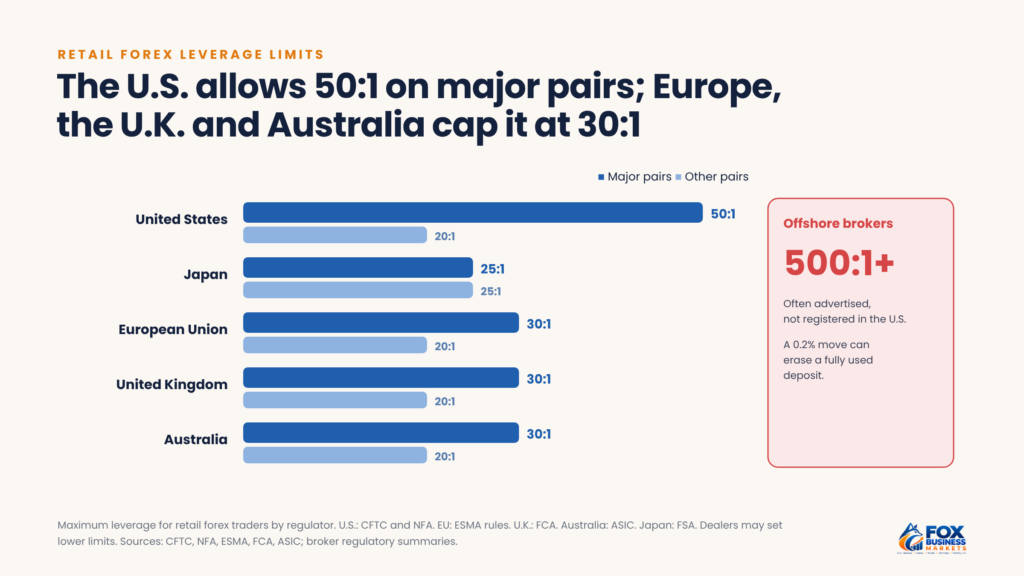
Maximum retail forex leverage by regulator
European rules for retail contracts for difference (CFDs), the main way forex is sold to individuals there, have been in effect since August 2018 and go further than leverage caps. According to a broker summary of the ESMA rules, dealers must close a retail client’s positions once account equity falls to 50% of the required margin, and retail clients can’t lose more than the money in their account. U.S. rules don’t include an automatic guarantee against negative balances.
What Are Margin Calls and Stop-Outs?
A margin call is a warning that your equity has fallen close to, or below, the margin your positions require. A stop-out, or margin closeout, is when the dealer closes some or all of your positions to stop further losses.
Dealers track a number called the margin level:
Margin level = equity / used margin x 100%
Consider how it can play out. You have $5,000 and open 2 standard lots of EUR/USD at 50:1. Used margin is about $4,462, so your margin level starts at about 112%. If EUR/USD moves 30 pips against you, you lose $600. Equity drops to $4,400, and your margin level falls to about 99%. Many dealers would now issue a margin call or begin closing positions.
What Are Used Margin and Free Margin?
Your trading platform splits your equity into two parts:
- Used margin: the deposit currently locked up by open positions.
- Free margin: equity minus used margin. It’s the money available to absorb losses or open new trades.
In the example above, free margin starts at just $538, or $5,000 minus $4,462. That thin buffer is why a 30-pip move, about one typical day’s swing in EUR/USD over the past decade, was enough to trigger trouble. If the same trader had opened 2 mini lots instead, used margin would be about $446 and free margin about $4,554. The same 30-pip move would cost only $60 and leave the margin level at about 1,100%.
Watching free margin, not just your cash balance, gives you an early warning before the dealer steps in. Many platforms show it in real time next to your balance and equity.
Each dealer sets its own thresholds and liquidation rules, so read your account agreement closely. In fast markets, closeouts can fill at much worse prices than the screen showed a moment earlier.
What Happened When Leverage Went Wrong in 2015?
On Jan. 15, 2015, the Swiss National Bank unexpectedly scrapped its cap of 1.20 francs per euro, which it had defended since 2011. The franc soared as much as 41% against the euro that day, according to Bloomberg data reported by Swissinfo, and prices skipped past many stop-loss orders.
The damage spread quickly:
- FXCM, then the largest U.S. retail forex dealer, was left with about $225 million in negative client balances and needed a $300 million rescue loan from Leucadia, according to a Congressional Research Service report.
- Alpari UK entered insolvency after client losses exceeded their account equity.
- Many traders lost more than their deposits, and some were asked to repay the shortfall.
The lesson: leverage turns a rare event into a disaster. The franc’s jump of up to 41% would have cost an unleveraged trader 41%. At 50:1, it would have cost about 20 times the deposit.
Is It a Myth That Higher Leverage Means Bigger Profits?
Yes. Leverage doesn’t make a trading strategy better. It only scales the results, good and bad, and it makes costs heavier relative to your deposit.
Consider the spread. A 1.5-pip spread on one standard lot of EUR/USD costs $15. If you post the minimum $2,231 margin at 50:1, that cost equals 0.67% of your deposit on every trade. If you hold the same position with $11,154 of equity, or 10:1, the cost is just 0.13%.
High leverage also shortens your margin for error. A strategy that wins 55% of the time can still fail if a normal losing streak triggers a margin call before the winners arrive. Lower leverage gives a sound approach room to work.
For most people, building wealth comes from steady, long-term investing rather than leveraged trading. Our guide to how the stock market works explains why.
How Much Leverage Should You Use?
No single number fits everyone, but a few guidelines help keep forex leverage in check:
- Keep effective leverage low. Many experienced traders stay at 10:1 or below. Our simulation, which ignores costs and intraday swings, found that month-long losses rarely threatened the whole deposit at that level.
- Risk a fixed share per trade. Many traders risk 1% or less of their account on any single position.
- Size positions from your stop-loss. Decide your stop distance in pips, then choose a position size that loses no more than your set amount if the stop is hit.
- Leave free margin. Don’t tie up most of your equity as margin. A buffer keeps normal swings from triggering a margin call.
- Cut leverage around big events. Central bank decisions and jobs reports can move prices sharply. Our list of major news events shows when to be careful.
- Use a registered U.S. dealer. Avoid offshore firms that compete on how much leverage they offer.
- Practice first. Test your sizing on a demo account in a platform such as MetaTrader, and build a consistent trading routine.
For example, with a $5,000 account and a 1% risk limit, you can lose $50 on a trade. If your stop-loss is 25 pips away on EUR/USD, where a mini lot is worth $1 per pip, you’d trade 2 mini lots. That’s about $22,300 of currency, or effective leverage of roughly 4.5:1.
Frequently Asked Questions
Can wealthy traders get more than 50:1 leverage in the U.S.?
Possibly. The retail limits don’t apply to “eligible contract participants,” a category that generally includes individuals with more than $10 million invested on a discretionary basis. Few individual traders qualify. Tip: Treat any offer of higher leverage that skips this test as a red flag.
Can you trade forex without leverage?
Yes. You can fund the full value of a position, which is 1:1 leverage, and some dealers let you set your account’s maximum leverage that low. Your gains and losses then match the currency’s actual move. Tip: Use an account-level leverage setting so you can’t accidentally open an oversized position.
Can you hedge a position to avoid a margin call?
Not at a U.S. dealer. NFA rules bar dealers from carrying offsetting long and short positions in the same pair in one account and require positions to be closed on a first-in, first-out basis. Tip: If a trade is going against you, reduce or close it rather than trying to lock in the loss with an opposite position.
Do dealers raise margin requirements before weekends or holidays?
Some do, because prices can gap when markets reopen. Dealers may also raise requirements before major events such as elections or central bank decisions. Tip: Read your dealer’s margin notices and keep extra free margin ahead of weekends and big announcements.
Keep Your Leverage Low and Your Risk Defined
Forex leverage is a tool that cuts both ways. The 50:1 limit in the U.S. lets a small deposit control a large position, but it also means a 2% move can erase that deposit, and our 10-year analysis shows such moves within a month are common.
Measure your effective leverage, not your dealer’s maximum. Size every trade from a stop-loss and a fixed risk limit, keep a buffer of free margin, and trade only with money you can afford to lose.
This article is for general information only and isn’t financial, tax, legal, or investment advice. Consider your own situation or talk to a qualified professional before making decisions.

