Quick answer: Dividend stocks are shares of companies that pay part of their profits to shareholders, usually every quarter. You earn income without selling shares, and you can reinvest payments to buy more. Look beyond the yield: steady earnings, a sustainable payout ratio, and a record of dividend growth count for more.
S&P 500 companies paid a record $78.92 per share in dividends in 2025, up 5.5% from 2024 and the 16th straight year of higher payments, according to S&P Dow Jones Indices. About 81% of the companies in the index pay a dividend, from banks and utilities to some of the largest technology companies.
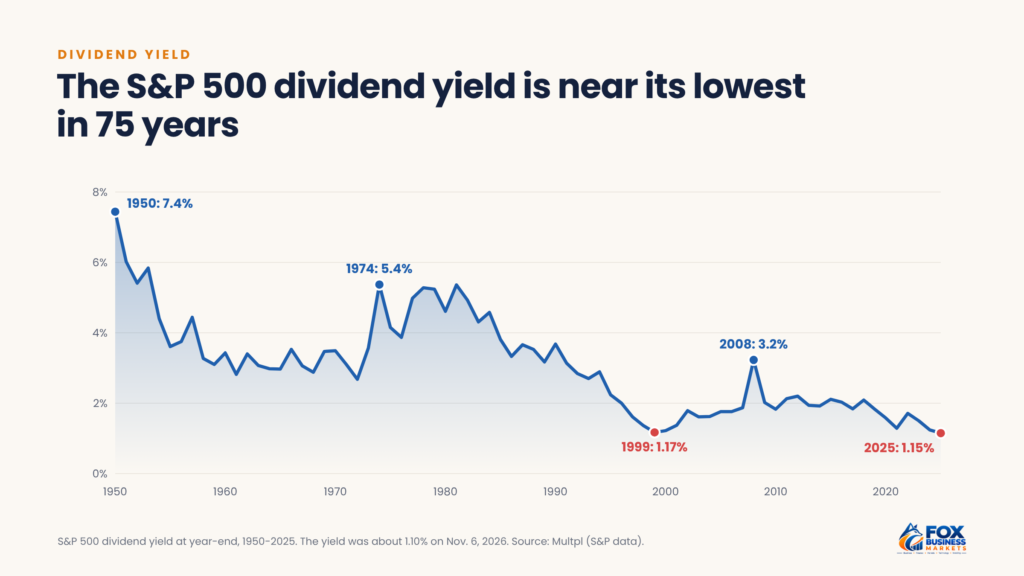
Yet the S&P 500’s dividend yield was only about 1.1% in early November 2026, near its lowest level in decades and far below the 3% to 5% that was normal for much of the 20th century, according to Multpl data. And payouts aren’t guaranteed. Even in a record year, some companies cut theirs.
This guide explains how dividend stocks work, how to measure them, how dividends are taxed in 2026, what can go wrong, and how to choose dividend stocks or funds that fit your goals.
What Are Dividend Stocks?
A dividend stock is a share of a company that regularly sends part of its profits to shareholders in cash or extra shares. If you own 100 shares of a company that pays $1 per share each quarter, you’d receive $100 every three months, or $400 a year.
Companies that pay dividends tend to be established businesses with steady cash flow, such as consumer goods makers, utilities, banks, health care companies, and energy producers. Younger, fast-growing companies usually reinvest their profits in the business instead.
Dividend stocks appeal to several kinds of investors:
- Retirees and near-retirees who want regular income without selling shares
- Long-term investors who reinvest dividends to compound their returns
- Cautious investors who prefer mature companies that often fall less in downturns
- Anyone building passive income alongside a paycheck
Dividends are one of two ways stocks reward you. The other is price growth. Together, they make up a stock’s total return. For a broader look at how stock returns work, see our guide to how the stock market works.
How Do Dividends Work?
A company’s board of directors decides whether to pay a dividend and how much. Most U.S. companies pay quarterly, though some pay monthly, twice a year, or once a year. Four dates control who gets paid:
Date | What happens |
| Declaration date | The board announces the dividend amount and key dates. |
| Ex-dividend date | You must own the stock before this date to get the dividend. Buy on or after it, and the seller gets the payment. |
| Record date | The company checks its records to see who owns shares. Because most trades now settle one business day after you buy, this is usually the same day as the ex-dividend date. |
| Payment date | The dividend is deposited in your brokerage account, often a few weeks later. |
On the ex-dividend date, the stock price usually drops by roughly the amount of the dividend, because new buyers won’t receive it. That’s why buying a stock just before the ex-dividend date to “capture” a dividend rarely works.
You can take dividends as cash or reinvest them automatically. Our guide on how to buy stocks explains how to set up a brokerage account to receive them.
How Do You Calculate Dividend Yield?
Dividend yield tells you how much a stock pays each year compared with its price:
Dividend yield = annual dividend per share ÷ share price × 100
For example, a stock trading at $50 that pays $2 a year has a 4% yield. If the price falls to $40 and the dividend stays the same, the yield rises to 5%.
That last point is why yield alone can mislead you. A high yield can mean a bargain, or it can mean the market expects a dividend cut.
Market-wide yields have fallen over time. The S&P 500 yielded 7.4% at the end of 1950 and just 1.15% at the end of 2025. Yields fell mainly because stock prices rose faster than dividends and because companies began returning more cash through share buybacks, which don’t show up in the yield.
Two other yield measures are useful:
- Forward yield uses the expected dividend for the next 12 months.
- Yield on cost compares today’s dividend with the price you originally paid. It grows over time as a company raises its dividend.
What Is a Payout Ratio?
The payout ratio shows how much of a company’s earnings go to dividends:
Payout ratio = annual dividends per share ÷ earnings per share × 100
A company earning $4 a share and paying $2 has a 50% payout ratio. In general:
- Under 60% leaves room to keep raising the dividend and absorb a bad year.
- 60% to 80% can be fine for stable businesses but leaves less cushion.
- 80% to 100% leaves little room for error outside very stable industries.
- Over 100% means the company pays more than it earns, which usually can’t last.
Some industries are exceptions. Real estate investment trusts (REITs) must pay out at least 90% of their taxable income, so investors judge them by funds from operations (FFO) rather than earnings. Utilities also tend to have higher payout ratios because their profits are steady and regulated.
A free cash flow payout ratio compares dividends with the cash a company actually generates, which earnings can hide. For a deeper look at earnings, see our guide on how to read an earnings report.
What Types of Dividend Stocks Are There?
Type | What it is | Typical yield | Watch out for |
| Dividend growth stocks | Companies that raise dividends every year | Low to moderate | Paying too much for quality |
| Dividend Aristocrats | S&P 500 companies with at least 25 straight years of dividend increases | Moderate | Slower growth in mature businesses |
| High-yield stocks | Stocks with yields well above the market average | High | Dividend cuts and falling share prices |
| REITs | Companies that own income-producing real estate | Moderate to high | Interest rate sensitivity; dividends often taxed as ordinary income |
| Utilities | Electric, gas, and water providers | Moderate | Regulation and debt |
| Business development companies (BDCs) and master limited partnerships (MLPs) | Lenders to small companies and energy pipeline partnerships | High | Complex taxes and credit risk |
| Preferred stocks | Shares that pay a fixed dividend before common stockholders | High | Limited price growth and interest rate risk |
Dividend Aristocrats are a popular starting point because a long record of increases usually signals a durable business. Companies such as Procter & Gamble, Dover, and Genuine Parts have raised their dividends for roughly 70 years in a row.
How Fast Do Dividends Grow?
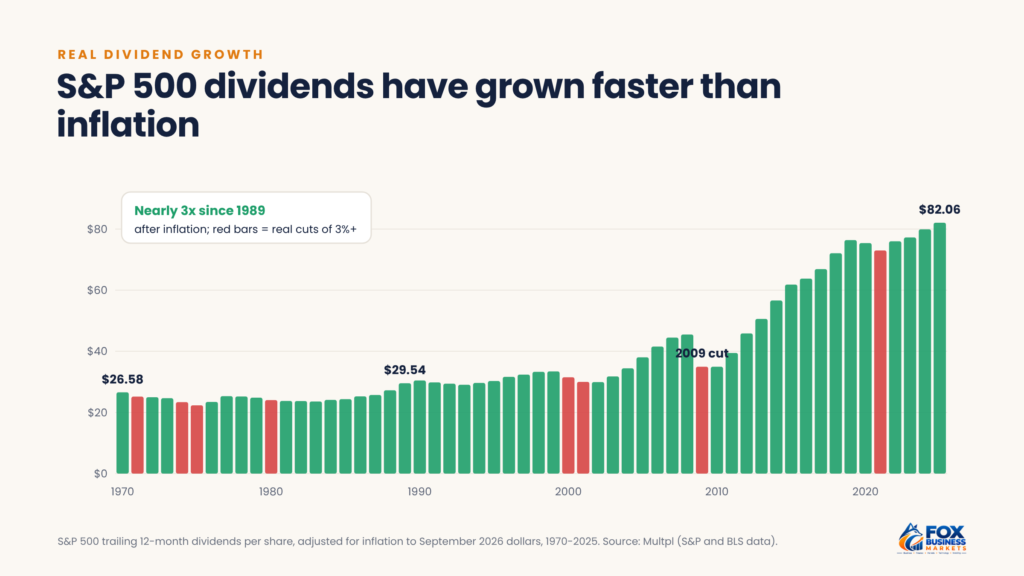
Over long periods, dividends have grown faster than inflation.
Adjusted for inflation, S&P 500 dividends per share were roughly flat from 1970 to the late 1980s. Since 1989 they’ve nearly tripled after inflation, based on Multpl’s inflation-adjusted data, despite a steep cut in 2009 and a dip around 2020.
Future increases may be modest, though. S&P Dow Jones Indices senior index analyst Howard Silverblatt warned in January 2026 that “investors should not be overly optimistic about the size of dividend increases,” and he expected a mid-single-digit gain in 2026.
Rising dividends help protect your income from inflation. A fixed payment from a bond or CD buys less each year, while a company that raises its dividend 5% a year can keep your income growing.
What Is a Dividend Reinvestment Plan (DRIP)?
A dividend reinvestment plan automatically uses your dividends to buy more shares of the same stock or fund, often including fractional shares and with no commission. Most brokers let you turn on reinvestment with one setting.
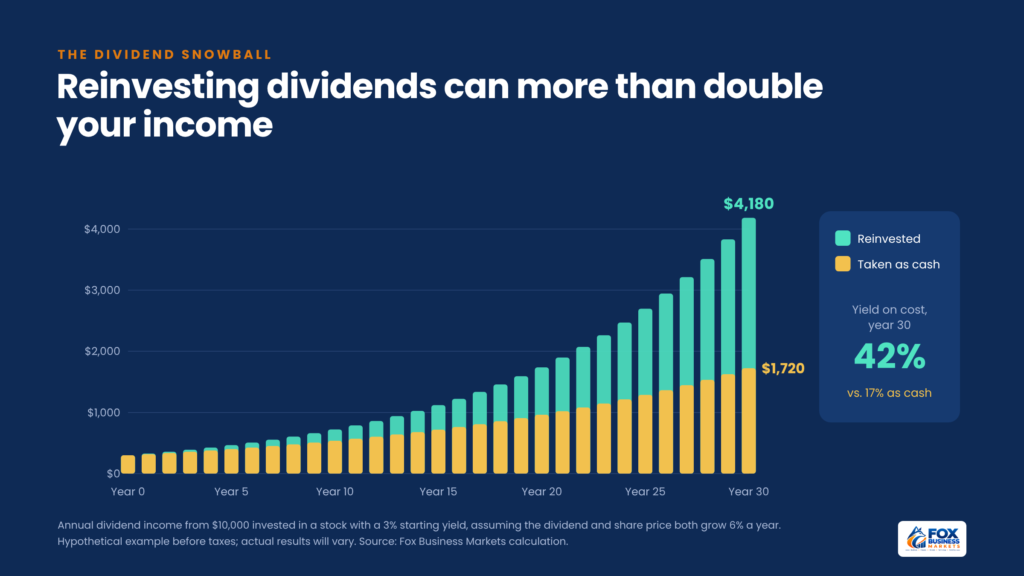
Reinvesting creates a snowball. More shares produce more dividends, which buy more shares. Consider $10,000 invested in a stock yielding 3%, whose dividend and share price both grow 6% a year:
Year | Annual income without reinvesting | Annual income with reinvesting |
| Start | $300 | $300 |
| 10 | About $540 | About $720 |
| 20 | About $960 | About $1,740 |
| 30 | About $1,720 | About $4,180 |
After 30 years, reinvesting would turn a 3% starting yield into income equal to about 42% of your original investment each year. This is a simplified example; real results depend on prices, taxes, and whether dividends keep growing.
Two cautions: reinvested dividends in a taxable account are still taxed in the year you receive them, and reinvesting everything into one stock can concentrate your portfolio over time.
How Do Dividends Compare With Share Buybacks?
Dividends aren’t the only way companies return cash to shareholders. Many also buy back their own stock, which reduces the number of shares outstanding and gives each remaining share a larger slice of future profits.
The two compare like this:
| Dividends | Share buybacks | |
| How you benefit | Cash paid to you on a schedule | Each share you own represents more of the company |
| Taxes | Taxed when paid in a taxable account | No tax until you sell your shares |
| Flexibility for the company | Cutting a dividend is seen as a bad sign | Buybacks can be paused with less fallout |
| Signal to investors | Confidence in steady future cash flow | Belief that shares are undervalued, or excess cash |
| Federal excise tax | None | 1% tax on net buybacks since 2023 |
Large U.S. companies now spend more on buybacks than on dividends in most years. Some investors look at shareholder yield, which adds dividends and net buybacks together, to get a fuller picture.
For income investors, dividends have a practical edge: you get cash without selling anything. For growth-focused investors in taxable accounts, buybacks can be more tax-efficient. Neither is automatically better. What counts is whether the company earns enough to fund both while still investing in its future.
How Are Dividends Taxed?
In a taxable brokerage account, dividends are taxed in the year you receive them, even if you reinvest them. The rate depends on the type of dividend.
Qualified dividends get the same lower rates as long-term capital gains. Most dividends from U.S. companies and many foreign companies qualify if you’ve held the stock for more than 60 days during the 121-day period that starts 60 days before the ex-dividend date. For 2026, according to NerdWallet’s summary of IRS thresholds:
Rate | Single | Married filing jointly | Head of household |
| 0% | Up to $49,450 | Up to $98,900 | Up to $66,200 |
| 15% | $49,451 to $545,500 | $98,901 to $613,700 | $66,201 to $579,600 |
| 20% | Over $545,500 | Over $613,700 | Over $579,600 |
Thresholds are based on taxable income.
Ordinary (nonqualified) dividends are taxed at your regular income tax rate. These include most REIT and BDC dividends and dividends on stocks you haven’t held long enough.
Net investment income tax. Higher earners may owe an extra 3.8% on dividends if their modified adjusted gross income exceeds $200,000 for single filers or $250,000 for married couples filing jointly.
Holding dividend stocks in a Roth IRA lets dividends grow tax-free, with tax-free withdrawals in retirement if you meet the rules, while a traditional IRA or 401(k) defers taxes until withdrawal. Our comparison of Roth vs. traditional IRAs can help you choose.
Is It a Myth That a Higher Dividend Yield Is Always Better?
Yes. A very high yield is often a warning sign, not a bargain. This is known as a yield trap.
Because yield rises when a stock’s price falls, a company in trouble can show an eye-catching yield right before it cuts the dividend. When the cut comes, investors often lose twice: the income drops, and the share price falls further.
Warning signs of a yield trap include:
- A yield far above similar companies in the same industry
- A payout ratio above 100%, or dividends paid with borrowed money
- Falling revenue, earnings, or free cash flow
- Rising debt or a credit rating downgrade
- A share price that has dropped sharply over the past year
Dividend cuts aren’t rare, even in a good year. S&P Dow Jones Indices counted 176 U.S. common stocks that cut or suspended dividends in 2025, up from 132 in 2024.
A moderate yield backed by growing earnings usually beats a high yield on shaky ground. Many dividend investors focus on companies yielding 2% to 4% that raise payouts every year.
What Are the Risks of Dividend Stocks?
Dividend stocks can be steadier than the broader market, but they carry real risks:
- Dividend cuts. Companies can reduce or suspend dividends at any time, especially in recessions (see the yield-trap warning signs above).
- Interest rate risk. When bond yields rise, high-yield stocks such as utilities and REITs can fall because their income looks less attractive.
- Sector concentration. High-yield portfolios often lean heavily on a few sectors, such as utilities, energy, real estate, and financials.
- Slower growth. Mature dividend payers may grow more slowly than companies that reinvest everything.
- Tax drag. In taxable accounts, you owe tax on dividends each year, even if you don’t need the income.
- Missing out on growth stocks. Many of the market’s biggest winners paid small or no dividends for years.
How Do You Pick Dividend Stocks?
Use this checklist before you buy:
- Check dividend history. Look for a long record of steady or rising payments, including through recessions.
- Check the payout ratio. Prefer companies paying a sustainable share of earnings and free cash flow.
- Look at earnings and cash flow trends. Over time, dividends can’t grow faster than profits.
- Review the balance sheet. Moderate debt and a solid credit rating protect the dividend in hard times.
- Compare the yield. Check the yield against the company’s own history and its industry peers.
- Consider valuation. A great dividend company bought at too high a price can still disappoint.
- Spread your holdings across at least 15 to 20 companies in different sectors, or use a fund.
Should You Buy Dividend Stocks or Dividend ETFs?
You can build a dividend portfolio from individual stocks or buy a dividend-focused fund.
| Individual dividend stocks | Dividend ETFs and funds | |
| Diversification | Depends on how many you buy | Dozens to hundreds of companies |
| Research | Significant | Minimal |
| Control | Full control over what you own and when you sell | The fund decides holdings |
| Cost | No ongoing fees | Small annual expense ratio |
| Income | You choose the yield and payment schedule | Steady, blended yield |
Dividend ETFs typically follow a rule, such as owning companies with long records of dividend growth or the highest yields. Check the fund’s expense ratio, how it selects stocks, and its sector weights. For broad, low-cost market exposure, an S&P 500 index fund also pays dividends, though at a lower yield.
Many investors combine both: a dividend ETF as the core and a handful of individual stocks they understand well. See our guide to building an investment portfolio for more on balancing income and growth.
Frequently Asked Questions
What is a special dividend?
A special dividend is a one-time payment, separate from a company’s regular dividend. Companies often pay one after a big asset sale or an unusually strong year, or when they have extra cash. It doesn’t signal that future dividends will be higher. Tip: Don’t count a special dividend when calculating a stock’s ongoing yield.
How much money do you need to live off dividends?
It depends on your spending and your portfolio’s yield. At a 3% yield, $1 million produces about $30,000 a year before taxes; at 4%, about $40,000. Most retirees combine dividends with Social Security, other income, and occasional share sales. Tip: Plan around the income you need, then compare a dividend-only strategy with a total-return approach that also uses withdrawals.
Do dividends count as earned income for IRA contributions?
No. Dividends are investment income, not earned income, so they can’t be used to qualify for IRA contributions. You need wages, salary, or self-employment income to contribute. Tip: If you’re retired with only investment income, look into a spousal IRA if your spouse still works.
What happens to dividends when a stock splits?
The company adjusts the dividend per share to match the split, so your total income stays the same. After a 2-for-1 split, you own twice as many shares, and each pays half the old dividend. The yield doesn’t change. Tip: Compare dividend history on a split-adjusted basis so a split doesn’t look like a cut.
Build a Dividend Plan Around Growth, Not Just Yield
Decide what you want dividends to do for you: grow your wealth through reinvestment, or produce income you’ll spend. Then choose a mix of reliable dividend growers or a low-cost dividend ETF, hold them in the most tax-efficient account you have, and turn on reinvestment until you need the cash. Review each holding’s payout ratio and dividend record once a year. Consider a financial advisor if you’re building a retirement income plan. Track how your income grows over time alongside your broader results. For context, see our investing statistics.
This article is for general information only and isn’t financial, tax, legal, or investment advice. Consider your own situation or talk to a qualified professional before making decisions.

