1. How to Use the Yield to Maturity (YTM) Calculator
Calculating the total annualized return of a debt security requires reconciling periodic interest payments with the capital gain or loss realized upon maturity. Follow these steps to configure your bond valuation:
- Select Your Operating Currency: Choose USD ($), GBP (£), EUR (€), CAD (C$), or AUD (A$) from the top currency bar to match the denomination of the bond issue.
- Select Payment Convention: Choose the default Semi-Annual Bond (Standard) tab for government treasuries and the majority of US corporate bonds, or switch to the Annual / Zero-Coupon Bond tab for European debt, emerging market issues, or non-coupon strip bonds.
- Enter Bond Face Value (Par Value): Input the nominal principal amount returned to the investor at maturity (typically $1,000 for standard corporate and municipal bonds).
- Input Current Market Trading Price: Provide the actual market execution price of the bond in the secondary market (e.g., $920 for a discount bond or $1,050 for a premium bond).
- Enter Stated Annual Coupon Rate (%): Input the contractual interest rate stated on the indenture (enter 0% for zero-coupon instruments).
- Set Remaining Years to Maturity: Input the exact duration in decimal years remaining until the bond reaches its maturity redemption date.
- Review Comprehensive Yield Output: Examine the calculated Yield to Maturity (annualized IRR), Current Yield, pricing status (Discount, Par, or Premium), annual coupon cash flow, and total capital collected over the life of the bond.
2. How It Works & Core Mathematical Formulas
Yield to Maturity (YTM) is the internal rate of return (IRR) of a bond, assuming the investor holds the debt instrument until its redemption date and reinvests every coupon payment at the exact same yield rate. Unlike current yield—which only measures the immediate cash return relative to market price—YTM accounts for the time value of money, scheduled cash flow timing, and principal accretion or amortization.
The institutional pricing formula equates the current bond market price to the present value of all future coupon payments plus the present value of the face value:
P = Σ [ C / (1 + y/m)^t ] + [ F / (1 + y/m)^(n*m) ]
Where:
P = Current Market Trading Price of the Bond
F = Face Value / Par Value at Maturity
C = Periodic Coupon Payment = (F * Annual Coupon Rate) / m
m = Compounding Frequency per Year (m = 2 for semi-annual; m = 1 for annual)
n = Number of Years to Maturity
t = Current Period Index (from 1 to n*m)
y = Yield to Maturity (YTM)
Because the variable y cannot be isolated algebraically when multiple coupon periods exist, our calculator executes a high-speed Newton-Raphson numerical iteration algorithm to solve for exact YTM. For quick heuristic checks, analysts use the standard approximation formula:
YTM ≈ [ C_annual + ((F - P) / n) ] / [ (F + P) / 2 ]
Current Yield Formula:
Current Yield (%) = (Annual Coupon Payment / Current Market Price) * 100
For zero-coupon bonds (where coupon payments are zero and return is generated entirely through capital appreciation from purchase discount to par), the formula simplifies to:
YTM_zero = [ (F / P) ^ (1 / n) ] - 1
3. Fully Worked Numerical Example
Consider an institutional fixed-income investor evaluating a secondary market corporate bond issue trading at a discount. The bond specifications are structured as follows:
Worked Scenario: 10-Year Corporate Discount Bond
- Bond Face Value (Par): $1,000.00
- Current Market Price: $920.00 (Trading at an $80.00 discount)
- Annual Coupon Rate: 5.0% ($50.00 annually)
- Payment Frequency: Semi-Annual ($25.00 every 6 months; 20 total periods)
- Duration: 10.0 Years to Maturity
Step-by-Step Calculation:
- Calculate Periodic Cash Flows:
Semi-Annual Coupon:($1,000.00 * 0.05) / 2 = $25.00 per period
Total Periodic Payments:10 Years * 2 = 20 Coupon Payments - Compute Immediate Current Yield:
Current Yield = ($50.00 / $920.00) * 100 = 5.434% -> 5.43% - Apply Heuristic YTM Approximation:
Annual Capital Gain Accretion:($1,000.00 - $920.00) / 10 = $8.00 / year
Average Invested Capital:($1,000.00 + $920.00) / 2 = $960.00
Approximate YTM:($50.00 + $8.00) / $960.00 = $58.00 / $960.00 = 6.041% - Execute Exact Newton-Raphson Iteration:
Solving the full present value equation for 20 semi-annual periods yields a per-period discount rate ofr = 0.03046 (3.046%).
Annualized Semi-Annual Bond YTM:3.046% * 2 = 6.092% -> 6.09% - Calculate Total Cash Realized:
Coupons:20 periods * $25.00 = $500.00
Principal:$1,000.00 (Maturity Redemption)
Total Cash:$500.00 + $1,000.00 = $1,500.00(Net gain of $580.00 on a $920.00 outlay).
Verdict: Because the bond was purchased at a discount ($920.00), the investor captures both 5.0% coupon cash flows and an $80.00 capital gain at maturity, elevating the effective Yield to Maturity to 6.09%—significantly higher than the 5.00% nominal coupon rate.
4. Interactive Calculator Interface & Visual Output
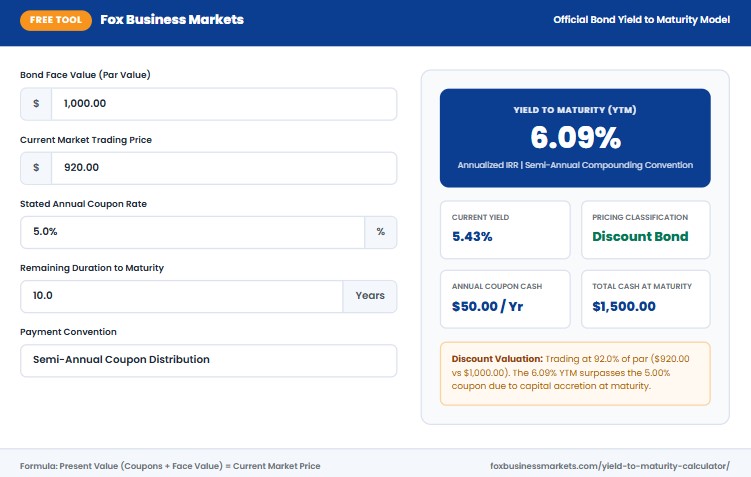
The visual model below illustrates the exact dashboard layout, input parameters, and iterative yield calculations produced by our fixed-income engine using the 10-year discount bond scenario:
5. Fixed-Income Pricing Relationships & Yield Dynamics
Understanding the mathematical relationship between market price, coupon rate, current yield, and YTM is foundational to debt portfolio management. The table below outlines these pricing relationships across market conditions:
| Pricing Classification | Price vs. Par Relationship | Yield Curve Dynamic | Portfolio Yield Behavior |
|---|---|---|---|
| Discount Bond | Price < Par Value (e.g., $920 < $1,000) | Coupon < Current Yield < YTM | Capital appreciation occurs at maturity, pulling total yield above stated coupon rate. |
| Par Bond | Price = Par Value (e.g., $1,000 = $1,000) | Coupon = Current Yield = YTM | Zero capital gain or loss at maturity; return consists entirely of coupon income. |
| Premium Bond | Price > Par Value (e.g., $1,080 > $1,000) | YTM < Current Yield < Coupon | Capital depreciation occurs at maturity, reducing total annualized return below stated coupon. |
| Zero-Coupon Bond | Deep Discount (Price << Par) | Current Yield = 0% | YTM > 0% | No reinvestment risk; total return derived exclusively from capital accretion to par value. |
6. Where to Find Your Numbers
To ensure high calculation accuracy, retrieve your bond metrics from verified financial filings, prospectuses, and trade confirmation slips:
- Bond Face Value (Par): Stated on the bond indenture, prospectus summary, or brokerage security detail tab (standardized at $1,000 for US corporate/municipal bonds and $100 or $1,000 for Treasuries).
- Current Market Price: Obtain real-time secondary trading quotes from your brokerage terminal, FINRA TRACE (Trade Reporting and Compliance Engine), or municipal bond repositories like EMMA.
- Coupon Rate & Payment Frequency: Listed in the bond indenture description (e.g., "5.00% Senior Notes Due 2036, Semi-Annual").
- Maturity Date: The official contractual date when the issuer is legally obligated to return par principal. Calculate remaining years in decimal format (e.g., 5 years and 6 months = 5.5 years).
- Compounding Context: If planning to reinvest coupon distributions into cash equivalents or term deposits, model future balances using our Compound Interest Calculator and Deposit Growth Calculator.
7. What This Calculator Can and Cannot Tell You
While Yield to Maturity is the standard benchmark metric in fixed-income markets, analysts must understand its theoretical assumptions and operational boundaries:
What It CAN Tell You
- Exact annualized internal rate of return (IRR) if held through final maturity.
- Current Yield providing immediate cash return relative to capital invested today.
- Precise classification of bond pricing as discount, par, or premium.
- Total cumulative cash flow generated across the life of the debt instrument.
What It CANNOT Tell You
- Reinvestment Risk: YTM assumes all interim coupons can be reinvested at the exact same YTM rate—an assumption that fails in declining interest rate environments.
- Call / Redemption Risk: For callable bonds, Yield to Call (YTC) must be evaluated separately if the issuer redeems the bond early.
- Credit & Default Risk: YTM assumes 100% principal repayment at par and does not factor in issuer bankruptcy or credit rating downgrades.
- Tax Liabilities: Excludes federal and state income taxes on coupon distributions. For after-tax profit modeling, pair with our Capital Gains Tax Calculator.
8. Related Guides and Financial Calculators
Broaden your fixed-income modeling, corporate debt evaluation, and investment yield framework by exploring these verified Fox Business Markets resources:
9. Frequently Asked Questions (FAQ)
10. The Bottom Line & Authoritative References
Yield to Maturity is the definitive gold standard for pricing and comparing fixed-income securities. By accounting for the interplay between coupon cash flows, secondary market purchase price, and par value redemption at maturity, YTM provides investors with an objective benchmark to evaluate risk-adjusted returns across government, corporate, and municipal debt markets.
To further examine fixed-income market mechanics, yield curve analysis, and regulatory debt reporting, consult these authoritative institutions:
- Financial Industry Regulatory Authority (FINRA) — Fixed Income & Bond Market Fundamentals
- U.S. Securities and Exchange Commission (SEC) — What Are Corporate Bonds & How Yield Works
- TreasuryDirect — U.S. Department of the Treasury Marketable Securities
- Investopedia — Yield to Maturity (YTM) Meaning, Formula, and Calculation