1. How to Use the Credit Card Payoff Calculator
Our credit card debt payoff calculator provides cardholders and balance sheet managers with an exact roadmap to eliminate high-interest revolving credit. Follow these procedural steps to model your payoff timeline or determine your target budget:
- Select Your Operating Currency: Choose between USD ($), GBP (£), EUR (€), CAD (C$), or AUD (A$) from the top header to align calculations with your regional financial accounts.
- Enter Outstanding Revolving Balance: Input the total statement balance or aggregated credit card balances you intend to pay down.
- Input Purchase APR: Provide the annual percentage rate currently assessed on your revolving balances by the credit card issuer.
- Select Strategic Payoff Mode: Choose between "Fixed Monthly Payment" (to determine how quickly a specific monthly budget clears the debt) or "Target Payoff Timeframe" (to find the exact monthly installment required to become debt-free within a specific number of months).
- Analyze Payoff Velocity & Interest Overhead: Review the hero readout, interest-to-principal ratio, and progress bar to measure how accelerating monthly allocations saves thousands in cumulative finance charges.
2. How It Works & Core Mathematical Formulas
Credit card interest accrues on an average daily balance basis and compounds monthly. Unlike fixed installment loans where monthly payments are pre-structured to amortize principal over a fixed schedule, credit cards require an iterative month-by-month calculation because interest charges decline as principal is retired.
When solving for the payoff timeline ($N$ months) under a fixed monthly payment plan ($PMT$), the logarithmic derivation of the annuity formula is applied:
Where:
N = Total months to achieve zero balance
B = Current outstanding revolving balance
r = Periodic monthly interest rate (Annual Nominal APR / 12 / 100)
PMT = Fixed monthly payment committed (Must be > B * r)
Conversely, when you designate a target debt-free horizon ($N$ months), the required monthly payment is computed using the standard fixed amortization annuity formula:
Total Cost of Repayment = PMT * N
Total Cumulative Interest Paid = (PMT * N) - B
Interest-to-Principal Ratio = (Total Interest Paid / B) * 100
3. Fully Worked Numerical Example
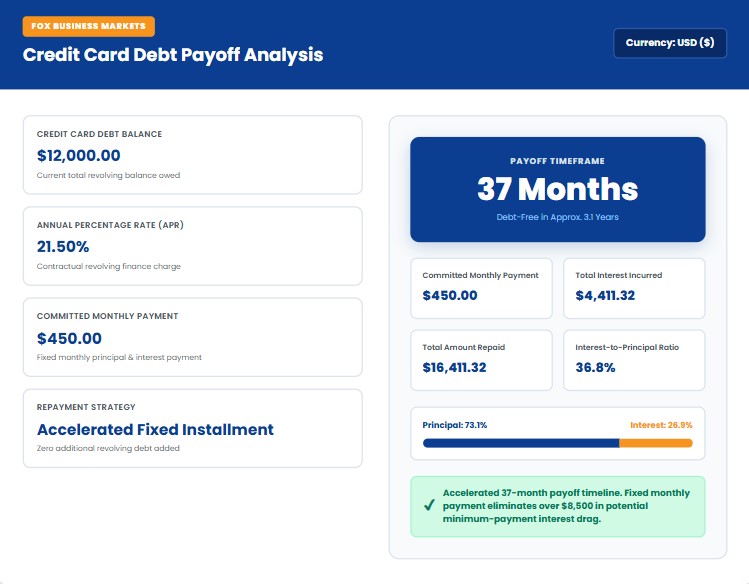
Case Study: Eliminating a $12,000 Credit Card Balance at 21.50% APR
Consider a consumer carrying a $12,000.00 aggregate balance across credit cards with a weighted average APR of 21.50%. Rather than paying the variable minimum payment (which starts around $280/mo and extends payoff past 18 years), the borrower commits to an accelerated fixed monthly payment of $450.00.
- Current Balance (B): $12,000.00
- Monthly Interest Rate (r): 0.2150 / 12 = 0.0179167 (1.7917% per month)
- Initial Month Finance Charge: $12,000.00 * 0.0179167 = $215.00
- Initial Principal Reduction: $450.00 - $215.00 = $235.00
Applying the logarithmic payoff equation:
Denominator = ln( 1 + 0.0179167 ) = ln(1.0179167) = 0.017758
N = - (-0.64972) / 0.017758 = 36.59 Months (~37 Months)
Aggregate Debt Elimination Summary:
- Debt-Free Horizon: 37 Months (Approx. 3.1 Years)
- Total Repayment Amount: $16,411.32
- Total Cumulative Interest Paid: $16,411.32 - $12,000.00 = $4,411.32
- Total Savings vs. Minimum Payments: Over $8,500.00 in saved finance charges and more than 14 years eliminated from the repayment timeline.
4. Interactive Calculator Interface & Amortization Display
5. Repayment Strategy Comparison: Fixed Budget vs. Minimum Payment Trap
Credit card issuers generally set minimum monthly payments between 2% and 3% of the outstanding balance. As your balance drops, the required minimum payment decreases, stretching out the repayment timeline and maximizing cumulative finance charges. The table below illustrates this dynamic for a $12,000 balance at a 21.50% APR:
| Repayment Strategy | Monthly Outflow | Payoff Timeline | Total Interest Paid | Total Cost of Debt | Long-Term Financial Impact |
|---|---|---|---|---|---|
| Aggressive Fixed Plan | $650.00 / month | 23 Months (< 2 Years) | $2,618.40 | $14,618.40 | Lowest financing overhead; rapid credit score and credit utilization recovery. |
| Balanced Fixed Plan (Benchmark) | $450.00 / month | 37 Months (3.1 Years) | $4,411.32 | $16,411.32 | Predictable budget schedule; saves over $8,500 compared to minimum payments. |
| Moderate Fixed Plan | $325.00 / month | 62 Months (5.2 Years) | $8,012.50 | $20,012.50 | Manageable cash flow; interest exceeds 66% of original principal borrowed. |
| Standard Minimum Payment Trap | Variable (Starts ~$280) | 228 Months (19 Years) | $13,150.00+ | $25,150.00+ | Severe interest drain; total interest paid surpasses original principal balance. |
| Zero-APR Balance Transfer Plan | $575.00 / month | 21 Months (0% Window) | $360.00 (3% Transfer Fee) | $12,360.00 | Maximum interest savings; requires strong credit qualification (720+ FICO). |
6. Where to Find Your Credit Card Underwriting Figures
To accurately configure your debt elimination model and verify card terms, reference your official monthly credit card statements:
- New Balance & Statement Balance: Located on the summary header of your monthly credit card billing statement.
- Nominal APR by Balance Type: Found in the "Interest Charge Calculation" section at the end of your billing statement. Note that cash advance or balance transfer APRs may differ from your standard purchase APR. To evaluate how compounding frequencies affect effective rates, check our verified APR Calculator or examine yield benchmarks via the APY Calculator.
- Fixed Debt Consolidation Alternatives: If your card APR exceeds 20%, consider consolidating balances into a single fixed installment term using our Personal Loan Calculator.
- Commercial & Small Business Credit: If managing corporate revolving credit cards or enterprise credit lines, model long-term commercial financing options using our Business Loan Calculator.
- Cash Flow Reserves: Verify that aggressive monthly credit card allocations do not compromise your liquid operating reserves using our Working Capital Calculator.
7. What This Calculator Can and Cannot Tell You
What It Tells You (Analytical Capabilities)
- Exact debt-free payoff dates based on steady, fixed monthly installment commitments.
- The precise monthly payment needed to eliminate your balance within a specific timeframe.
- Total cumulative interest charges incurred under your selected repayment strategy.
- The minimum payment threshold required to avoid negative amortization.
What It Cannot Tell You (Model Limitations)
- Variable rate resets driven by Federal Reserve prime rate adjustments.
- Annual card membership fees, late payment penalties, or foreign transaction surcharges.
- New purchases made on the card while executing your repayment schedule.
- Direct credit score changes resulting from lower credit utilization ratios.
8. Related Debt Management & Banking Calculators
Restructuring debt, eliminating revolving interest, and optimizing balance sheet liquidity require a comprehensive set of analytical tools. Explore these verified resources from Fox Business Markets:
Personal Loan Calculator
Evaluate fixed-rate personal loans to consolidate high-APR credit card debt into lower-cost installments.
APR Calculator
Unpack complex compounding schedules and calculate true annual borrowing costs across credit facilities.
Compound Interest Calculator
Model how redirecting debt service payments into investments builds compounding capital over time.
Business Loan Calculator
Analyze commercial credit facilities and structured term debt to replace revolving business lines.
9. Frequently Asked Questions (FAQ)
10. The Bottom Line & Authoritative References
Revolving credit cards are useful for short-term transaction liquidity when paid in full each month, but carrying high-APR balances creates substantial financial drag. Relying on minimum monthly payments can extend repayment over decades and cost multiples of the original charges in interest. Committing to a fixed monthly payment plan, exploring lower-rate personal loan consolidation, and pausing new charges are proven strategies for systematically eliminating credit card debt.
For additional regulatory guidelines, consumer protection standards, and debt management resources, consult these authoritative organizations:
- Consumer Financial Protection Bureau (CFPB) – Credit Card Consumer Resources & Regulations
- Federal Reserve Board – G.19 Consumer Credit Historical Reports
- Federal Trade Commission (FTC) – Coping with Debt & Credit Counseling Advice
- U.S. Department of Justice – Approved Credit Counseling Agencies