1. How to Use the Personal Loan Calculator
Our personal loan calculator enables borrowers to evaluate unsecured lending facilities, identify true monthly debt service commitments, and isolate upfront lender deductions. Follow these practical steps to analyze your financing terms:
- Select Operating Currency: Choose your functional transaction currency (USD, GBP, EUR, CAD, or AUD) via the top header selector to align the calculations with your local banking system.
- Enter Gross Borrowing Principal: Input the gross loan amount requested from the banking institution or online lending platform.
- Input Fixed Annual Interest Rate (APR): Specify the contractual annual borrowing percentage rate offered by the lender based on your credit tier.
- Select Amortization Term: Choose your planned repayment timeline from the loan term dropdown (ranging from 12 to 84 months).
- Toggle Standard vs. Origination Fee Mode: Use the "Standard Installment" tab for clean principal and interest scheduling, or switch to "With Origination Fee" to inspect the net liquidity disbursed after upfront processing deductions.
2. How It Works & Core Mathematical Formulas
Unsecured personal loans utilize a fixed installment annuity model. Equal monthly payments are distributed across interest and principal reduction. Because interest is charged monthly on the declining balance, early payments contain a higher ratio of finance charges, while later payments accelerate principal reduction.
The standard monthly installment is calculated using the standard fixed amortization formula:
Where:
M = Fixed monthly installment payment
P = Gross principal amount borrowed
r = Periodic monthly interest rate (Annual Nominal APR / 12 / 100)
n = Total number of monthly repayment cycles (Term Years * 12)
When lenders assess an upfront origination fee, the fee is deducted directly from the gross disbursement rather than added to the debt. The net cash received by the borrower is modeled as follows:
Total Cost of Borrowing = (M * n) - Net Disbursed Cash
Where:
Total Interest Paid = (M * n) - P
Upfront Lender Fee = P * Origination Fee %
3. Fully Worked Numerical Example
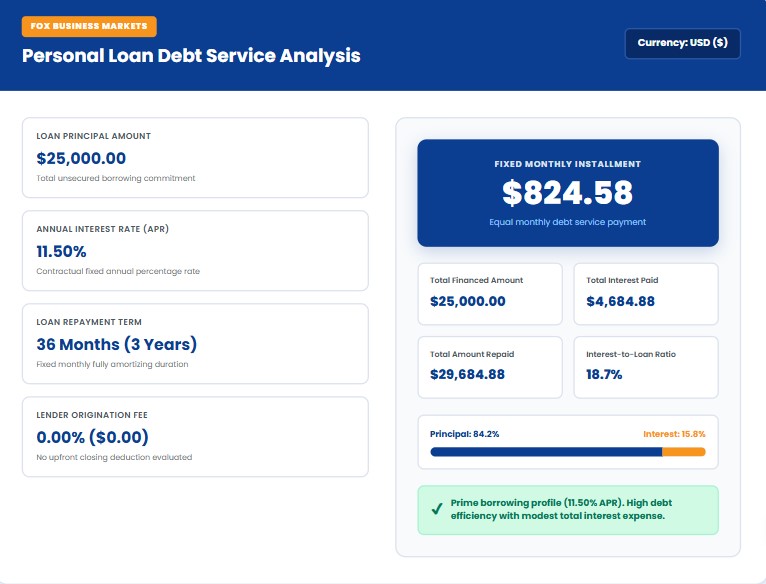
Case Study: Financing a $25,000 Unsecured Debt Consolidation Loan
Consider a prime borrower securing a $25,000 personal loan to consolidate revolving credit balances. The lender issues a fixed 11.50% APR over a 36-month (3-year) repayment schedule with zero origination fees.
- Principal (P): $25,000.00
- Monthly Rate (r): 0.1150 / 12 = 0.0095833
- Installment Months (n): 36
- Compounding Factor [(1 + r)^n]: (1 + 0.0095833)^36 = 1.409395
Executing the installment formula:
M = 25,000 * [ 0.0135074 ] / [ 0.409395 ]
M = $824.58 per month
Aggregate Debt Service Breakdown:
- Total Repayment (36 * $824.58): $29,684.88
- Total Cumulative Interest Paid: $29,684.88 - $25,000.00 = $4,684.88
- Interest-to-Principal Ratio: 18.74% (Finance charges represent 18.7 cents per dollar borrowed).
4. Interactive Calculator Interface & Cost Analysis
5. Credit Tier Benchmarks & Rate Ranges
Unsecured personal loans carry rates based on credit scores, debt capacity, and lender underwriting models. The table below outlines prevailing 2026 unsecured lending benchmarks for a $25,000 personal loan across standard credit tiers:
| Credit Rating Tier | Typical Credit Score | Average APR Range | 36-Month Monthly Payment | Total Lifetime Interest | Underwriting Approval Likelihood |
|---|---|---|---|---|---|
| Excellent (Super-Prime) | 750 - 850 | 7.50% - 10.50% | $777.68 - $812.55 | $2,996.48 - $4,251.80 | Very High; lowest fees, rapid automated approval. |
| Good (Prime Benchmark) | 700 - 749 | 11.00% - 14.50% | $818.55 - $860.52 | $4,467.80 - $5,978.72 | High; standard documentation, minor fees possible. |
| Fair (Near-Prime) | 640 - 699 | 15.00% - 21.00% | $869.21 - $942.23 | $6,291.56 - $8,920.28 | Moderate; higher origination fees (3% - 6% typical). |
| Poor (Subprime) | 580 - 639 | 22.00% - 32.00% | $954.74 - $1,089.45 | $9,370.64 - $14,220.20 | Low; requires income verification or co-signers. |
| Secured Collateral Alternative | Flexible | 6.00% - 9.00% | $760.36 - $794.99 | $2,372.96 - $3,619.64 | High; backed by savings, certificates, or real property. |
6. Where to Find Your Borrowing Figures
To accurately configure your repayment schedule and verify lender charges, reference the following formal documents:
- Gross Loan Amount & Stated Rate: Displayed on Page 1 of your formal Truth in Lending Act (TILA) disclosure or pre-qualification loan agreement.
- Effective APR vs. Nominal Interest: If your lender levies upfront processing fees, calculate the real annualized borrowing impact using our verified APR Calculator, or verify annual yields via the APY Calculator.
- Commercial & Enterprise Alternatives: If you are borrowing to capitalize business operations rather than personal needs, evaluate commercial borrowing structures with our Business Loan Calculator.
- Long-Term Property Financing: If considering home equity financing over unsecured personal lines, model residential amortization rates with our dedicated Mortgage Calculator.
- Cash Flow Buffers: Ensure your monthly loan payment does not drain critical operating liquidity by cross-checking reserve levels with our Working Capital Calculator.
7. What This Calculator Can and Cannot Tell You
What It Tells You (Analytical Capabilities)
- Exact monthly installment figures across varying repayment terms (12 to 84 months).
- The total lifetime dollar amount of interest incurred across the loan duration.
- Net cash proceeds disbursed to your bank account after subtracting origination fees.
- The interest-to-principal efficiency ratio, showing total interest cost relative to loan size.
What It Cannot Tell You (Model Limitations)
- Lender-specific late payment penalties, returned check fees, or payment processing surcharges.
- Prepayment penalty clauses (though most modern personal lenders waive prepayment fees).
- Your specific likelihood of credit approval or underwriting debt-to-income (DTI) thresholds.
- Potential credit score fluctuations caused by hard credit inquiries during application.
8. Related Credit & Debt Management Calculators
Managing debt effectively involves comparing interest rates, evaluating opportunity costs, and optimizing debt service. Use these verified resources across Fox Business Markets:
Business Loan Calculator
Model commercial working capital lines, equipment financing, and commercial debt terms.
Mortgage Calculator
Estimate residential home financing payments, PITI escrow liabilities, and 30-year amortization curves.
Compound Interest Calculator
Analyze how accelerated debt repayment preserves compounding investment returns over time.
APR Calculator
Deconstruct hidden lender administrative fees to uncover your true effective annual borrowing rate.
9. Frequently Asked Questions (FAQ)
10. The Bottom Line & Authoritative References
An unsecured personal loan can be an effective financing option for consolidating high-interest debt or funding significant expenses. However, evaluating loan affordability requires analyzing monthly cash flow impact, origination fee deductions, and total interest expenses over the entire repayment term. Comparing rate offers, loan durations, and fee structures helps borrowers choose terms that align with their overall balance sheet.
For additional regulatory guidelines, consumer protection standards, and lending rate trends, consult these verified sources:
- Consumer Financial Protection Bureau (CFPB) – Credit Reporting & Consumer Lending Rights
- Federal Reserve Board – G.19 Consumer Credit Historical Reports
- Federal Trade Commission (FTC) – Consumer Credit & Truth in Lending Standards
- Office of the Comptroller of the Currency (OCC) – Truth in Lending Act Compliance