Free Export Cost Calculator: Calculate Export Pricing & Profit Margins
Determining competitive export pricing requires capturing every cost layer beyond the domestic factory gate—including specialized export crating, domestic origin drayage, port terminal handling charges (THC), commercial documentation, export customs clearance, and international ocean or air freight. Under-calculating these export-specific logistical expenses erodes cross-border margins or leaves shipments stalled at origin customs. Our free export cost calculator computes both FOB (Free on Board) and CIF (Cost, Insurance, and Freight) export price quotes alongside your Net Export Profit Margin (%), ensuring your foreign trade quotations remain both globally competitive and reliably profitable.
Who it's for: Manufacturers entering foreign markets, agricultural and industrial exporters, international sales directors, freight forwarders, and commercial trade consultants formulating cross-border pro forma quotes.
Why use it:
- Standardize Incoterms Quotations: Seamlessly transition price quotes from factory Ex Works (EXW) to Free on Board (FOB) and Cost, Insurance, and Freight (CIF).
- Isolate Origin Export Overhead: Ensure non-tariff trade compliance, export inspection certificates, and terminal handling charges are fully amortized across unit volume.
- Lock in Targeted Foreign Trade Margins: Prevent currency volatility and overseas shipping fee shocks from turning lucrative export contracts into balance sheet deficits.
Strong export margins. Pricing covers all origin compliance and freight surcharges while delivering targeted commercial return.
How to Use the Free Export Cost Calculator
Formulating competitive cross-border quotations requires calculating manufacturing costs alongside export packaging, inland transport, origin terminal handling charges (THC), commercial compliance documents, and international freight. Follow these steps to audit your export contract profitability:
- Select Your Pricing Strategy Mode: Use the Cost-Plus Export Pricing (Target Margin) tab to automatically determine the required FOB or CIF selling price needed to achieve your target profit percentage. Switch to the Contract Price Audit (Fixed Selling Price) tab if you need to evaluate net profitability against a buyer's fixed target price.
- Input Production Volume & Factory Cost: Enter total contract units and the baseline Ex Works (EXW) direct manufacturing cost per unit. Use the top-bar currency selector (USD, GBP, EUR, CAD, AUD) to match your foreign sales contract terms.
- Enter Origin Packaging & Inland Drayage: Add export palletizing, specialized moisture-barrier crating, domestic factory-to-port trucking, and terminal handling charges at the port of departure.
- Account for Regulatory Export Compliance: Enter export customs filing fees, legalization fees for commercial invoices, chamber of commerce certificates of origin, and pre-shipment quality inspection costs.
- Add International Ocean or Air Freight: Enter transit freight and cargo insurance if quoting Cost, Insurance, and Freight (CIF). If submitting a pure Free on Board (FOB) origin port quote, leave international freight set to zero.
- Analyze Export Margins & Contract Breakeven: Review your FOB Unit Price, CIF Unit Price, Net Export Profit ($), and Net Export Profit Margin (%) to protect against operational shortfalls.
How It Works & Core Mathematical Formulas
International commercial transactions adhere strictly to International Commercial Terms (Incoterms 2020). Calculating export profitability requires cascading costs from factory gate (EXW) through port of departure (FOB) to destination maritime terminal (CIF).
Total EXW Cost = Factory Unit Cost × Total Units
Origin Export Logistics = Export Packaging + Inland Drayage + Port THC + Export Compliance Docs
Total FOB Cost = Total EXW Cost + Origin Export Logistics
Total CIF Cost = Total FOB Cost + International Freight + Marine Insurance
2. Cost-Plus Export Selling Price:
Unit Export Cost = Total CIF Cost / Total Units
Target Selling Price Per Unit = Unit Export Cost / [1 - (Target Profit Margin % / 100)]
Total Contract Revenue = Target Selling Price Per Unit × Total Units
3. Net Export Profitability Metrics:
Net Export Profit ($) = Total Contract Revenue - Total CIF Cost
Net Export Profit Margin (%) = (Net Export Profit / Total Contract Revenue) × 100
FOB Selling Price Per Unit = Target Selling Price Per Unit - (International Freight & Insurance / Total Units)
Fully Worked Numerical Example
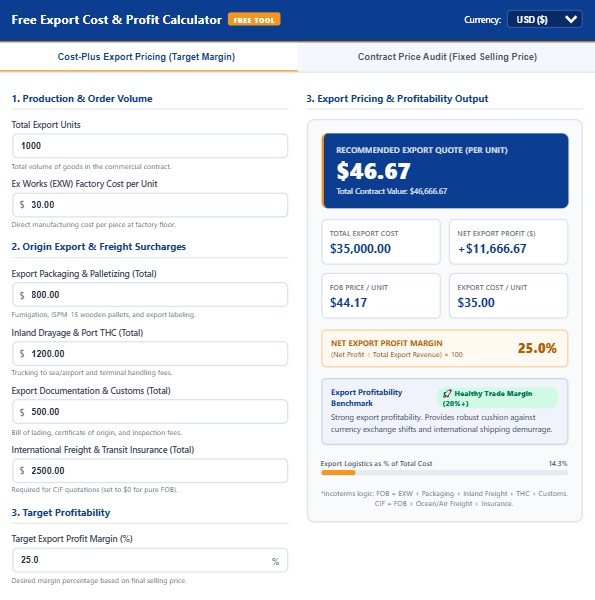
Consider an industrial hardware manufacturer in North America negotiating an export contract to deliver 1,000 specialized components to an overseas distribution partner on CIF maritime terms.
Export Quotation Case Study: Industrial Machinery Components
- Total Export Units: 1,000 units
- Factory Ex Works (EXW) Cost: $30.00 per unit ($30,000.00 base production)
- Export Packaging & Heat-Treated Pallets: $800.00
- Inland Drayage & Departure Port THC: $1,200.00
- Export Customs Clearance & Certificate of Origin: $500.00
- International Ocean Freight & Marine Transit Insurance: $2,500.00
- Target Commercial Profit Margin: 25.0%
Step-by-Step Mathematical Execution:
- Calculate Total Origin Logistics: $800.00 + $1,200.00 + $500.00 = $2,500.00
- Calculate Total FOB Cost: $30,000.00 (EXW) + $2,500.00 (Origin) = $32,500.00 ($32.50/unit)
- Calculate Total CIF Export Cost: $32,500.00 + $2,500.00 (Ocean Freight) = $35,000.00 ($35.00/unit)
- Calculate Target CIF Unit Selling Price: $35.00 / (1 - 0.25) = $46.67 per unit
- Calculate Total Commercial Contract Value: $46.67 × 1,000 units = $46,666.67
- Calculate Net Dollar Export Profit: $46,666.67 - $35,000.00 = +$11,666.67
- Calculate Equivalent FOB Port Unit Price: $46.67 - ($2,500.00 / 1,000) = $44.17 per unit
Strategic Financial Takeaway: To secure a 25.0% net margin, the exporter must quote $46.67 on CIF terms or $44.17 on FOB terms. Quoting based solely on the $30.00 factory cost would have ignored $5,000.00 in mandatory export logistics, cutting realized returns by over 40%.
Industry Benchmarks Comparison Table
Export margins, origin packaging burdens, and shipping surcharges vary by commodity category, perishability, and regulatory complexity:
| Export Industry Sector | Typical Export Margin | Logistics % of EXW | Dominant Incoterm | Primary Export Risk Factor |
|---|---|---|---|---|
| Specialty Manufacturing & Tools | 22% – 35% | 8% – 15% | FOB / CIF | Quality Discrepancies & Warranty Reserves |
| Packaged Consumer Goods (CPG) | 18% – 28% | 12% – 20% | FOB / DAP | Bilingual Labeling & Overseas Shelf Life |
| Agricultural Bulk Commodities | 4% – 9% | 20% – 45% | FOB / CFR | Port Demurrage & Commodity Price Swings |
| Chemicals & Hazardous Materials | 25% – 40% | 15% – 30% | CIF / DDP | Hazmat Surcharges & IMO Dangerous Goods Compliance |
| Industrial Heavy Machinery | 20% – 32% | 10% – 22% | FCA / CIF | Breakbulk Heavy-Lift Fees & Transit Rust |
Where to Find Your Numbers
Accurately modeling cross-border export profitability requires gathering verified operational data from commercial and trade records:
- Ex Works (EXW) Factory Cost: Retrieved from your internal standard cost accounting sheets or bill of materials (BOM). Validate unit production floors with our Break-Even Calculator and check workforce labor inputs using our Cost per Employee Calculator.
- Inland Drayage & Port THC: Quoted directly by domestic intermodal motor carriers and freight forwarders for container cartage from factory docks to container yards (CY).
- Export Documentation Charges: Confirmed by licensed customs brokers, freight forwarders, and international chambers of commerce for bills of lading, electronic export information (EEI) filings, and phytosanitary or inspection certificates.
- Ocean & Air Freight Tariffs: Sourced from carrier ocean rate contracts or air cargo booking confirmations. Compare with foreign buyer import metrics using our Landed Cost Calculator.
- Target Profit Margins: Established by executive commercial policy. Ensure returns exceed enterprise capital requirements evaluated in our Net Profit Margin Calculator.
What This Calculator Can and Cannot Tell You
What This Calculator Can Tell You:
- The exact selling price needed to achieve your targeted profit margin across EXW, FOB, and CIF commercial quotation structures.
- How much foreign trade logistics and export documentation add to factory production costs.
- The financial viability of a buyer's target price before signing binding international supply agreements.
What This Calculator Cannot Tell You:
- Destination Import Duties & VAT: This tool covers the exporter's side through CIF delivery. If quoting on a DDP (Delivered Duty Paid) basis, destination customs tariffs and VAT must be calculated via our Landed Cost Calculator.
- Currency Volatility & Hedging Costs: Multi-month export contracts invoiced in foreign currencies risk exchange rate losses between pro forma quote issuance and final wire settlement. Monitor balance sheet liquidity with our Working Capital Calculator.
- Letter of Credit (LC) Financing Fees: International banking charges for letter of credit issuance, advising, and confirmation sit outside physical logistics costs.
Related Guides and Calculators
Export profitability connects manufacturing operations, working capital solvency, and global commercial strategy. Deepen your cross-border trade analysis with these tools:
Frequently Asked Questions (FAQ)
Under Ex Works (EXW), the seller makes goods available at their factory; the buyer pays all transport, customs, and export fees. Under Free on Board (FOB), the seller pays for export packaging, inland transport, and loading onto the ship at the departure port. Under Cost, Insurance, and Freight (CIF), the seller covers all FOB costs plus international ocean or air freight and marine cargo insurance to the buyer's destination port.
Foreign buyers frequently prefer FOB quotes because navigating foreign domestic trucking, inland permits, and origin customs clearance is complex and risky from abroad. By quoting FOB, the exporter controls domestic logistics, selects local freight forwarders, avoids origin terminal surprises, and builds a predictable logistics markup into the commercial invoice.
Export Markup is the percentage added on top of total export cost ($Markup = [Profit / Cost] \times 100$). Export Margin is the percentage of the final contract selling price that represents net profit ($Margin = [Profit / Selling\ Price] \times 100$). For example, a 25% profit margin requires a 33.3% markup over cost. Conflating these two metrics leads to underpriced international contracts.
Under standard Incoterms rules (such as FOB, CFR, CIF, and CPT), the exporter (seller) is legally responsible for origin export customs clearance, including electronic export filings, obtaining export licenses, and complying with sanction screenings. Only under EXW is the buyer technically responsible, though local customs authorities often require a resident exporter of record.
Export packaging, inland trucking, and port handling represent largely fixed or batch-level expenses. Shipping a Full Container Load (FCL) of 1,000 units spreads these fixed logistics expenses to $2.50 per unit. Shipping a Less than Container Load (LCL) of 100 units can cause per-unit export overhead to jump to $8.00 or more, significantly eroding net margins unless minimum order quantities (MOQs) are enforced.
The Bottom Line & Authoritative References
Strategic export costing and disciplined quotation modeling protect international trading companies against unseen logistics surcharges and cross-border margin compression. Structuring contracts with transparent Incoterms baselines ensures your export operations remain profitable while expanding market reach globally.
Authoritative Trade Standards & Export Guidelines:
- International Chamber of Commerce (ICC): Incoterms 2020 Rules for Exporters and Importers
- International Trade Administration (ITA): A Basic Guide to Exporting - Pricing, Quotations, and Terms
- World Trade Organization (WTO): Export Regulations, Customs Procedures, and Trade Facilitation
- U.S. Department of Commerce: Export Pricing Strategy and Incoterms Application