On August 25, 2026, the FDIC released its quarterly report card on the U.S. banking industry. The headline was strong: banks earned $90.1 billion in the second quarter, and deposits grew for the eighth quarter in a row. A month later, regulators closed Nano Banc in Irvine, California, the sixth and largest bank failure of the year. Both facts are true at once, and together they explain why banking statistics matter to anyone with a checking account: the system is profitable and stable, and individual banks still fail.
This roundup collects the latest banking statistics from official sources, including the FDIC, NCUA, Federal Reserve, and CFPB, with the date and source for every number.
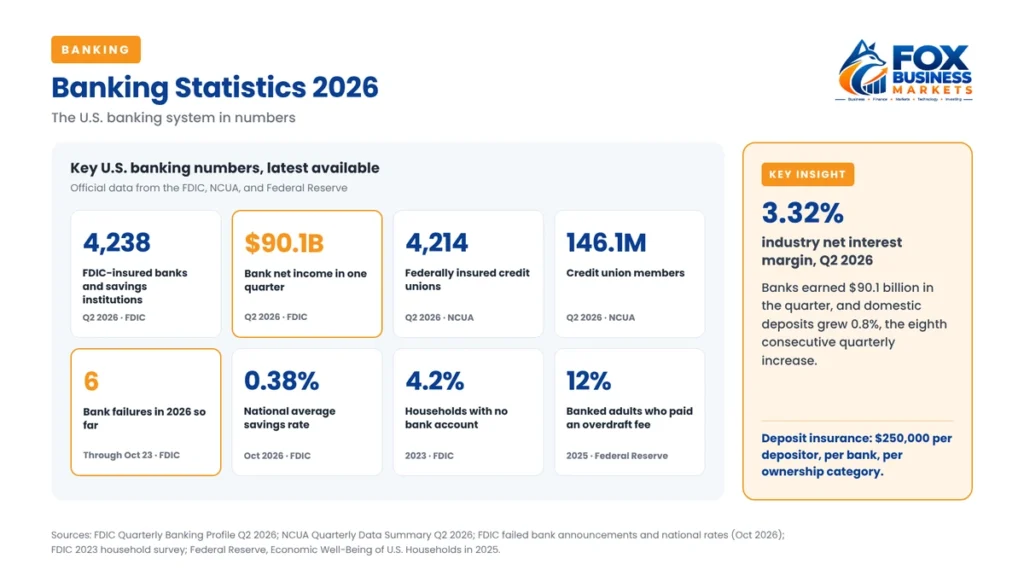
Quick answer: In 2026, there are 4,238 FDIC-insured banks and savings institutions and 4,214 federally insured credit unions with 146.1 million members. Banks earned $90.1 billion in Q2 2026, six banks have failed so far this year, the national average savings rate is 0.38%, and 4.2% of U.S. households have no bank account (2023 data).
Banking Statistics at a Glance
These are the headline banking statistics for 2026, using the latest available data.
Statistic | Latest figure | Source and date |
| FDIC-insured banks and savings institutions | 4,238 (Q2 2026) | FDIC, Aug 2026 |
| Bank net income | $90.1 billion (Q2 2026) | FDIC, Aug 2026 |
| Bank return on assets | 1.37% (Q2 2026) | FDIC, Aug 2026 |
| Net interest margin | 3.32% (Q2 2026) | FDIC, Aug 2026 |
| Federally insured credit unions | 4,214 (Q2 2026) | NCUA, Sept 2026 |
| Credit union members | 146.1 million (Q2 2026) | NCUA, Sept 2026 |
| Credit union assets | $2.5 trillion (Q2 2026) | NCUA, Sept 2026 |
| Bank failures in 2026 | 6 (through Oct 23) | FDIC |
| Deposit insurance limit | $250,000 per depositor, per bank, per ownership category | FDIC, NCUA |
| National average savings rate | 0.38% (Oct 2026) | FDIC |
| Federal funds target range | 3.75% to 4.00% (since Sept 16, 2026) | Federal Reserve |
| Unbanked households | 4.2%, about 5.6 million (2023) | FDIC |
| Adults who paid an overdraft fee | 12% of banked adults (2025) | Federal Reserve |
How Many Banks Are There in the U.S.?
There were 4,238 FDIC-insured commercial banks and savings institutions in the second quarter of 2026, according to the FDIC’s Quarterly Banking Profile, released August 25, 2026. That count fell by 41 during the quarter, as 36 institutions merged with other banks, four were sold to non-FDIC-insured buyers, and one failed, while four new banks opened, according to the ABA Banking Journal.
Credit unions are almost as numerous. There were 4,214 federally insured credit unions in the second quarter of 2026, serving 146.1 million members, according to the National Credit Union Administration’s (NCUA) Quarterly Data Summary. Credit unions held about $2.5 trillion in assets and $2.13 trillion in total shares and deposits. Total assets rose $120 billion, or 5.0%, from a year earlier, the NCUA said.
How Profitable Are U.S. Banks?
By the FDIC’s numbers, U.S. banks are highly profitable right now. FDIC-insured institutions earned $90.1 billion in net income in the second quarter of 2026, with a return on assets of 1.37%, according to the FDIC.
The industry’s net interest margin, the gap between what banks earn on loans and investments and what they pay on deposits, rose 1 basis point to 3.32%. Domestic deposits grew 0.8% in the quarter, “the eighth consecutive quarterly increase,” the FDIC reported.
The FDIC’s Deposit Insurance Fund, which protects insured deposits, held $161.1 billion on June 30, 2026, a reserve ratio of 1.48%, according to an analysis by KBRA (a credit rating firm) and the ABA Banking Journal. The number of banks on the FDIC’s “problem bank” list fell by seven to 47, according to the ABA Banking Journal’s summary of the FDIC report.
How Many Banks Have Failed in 2026?
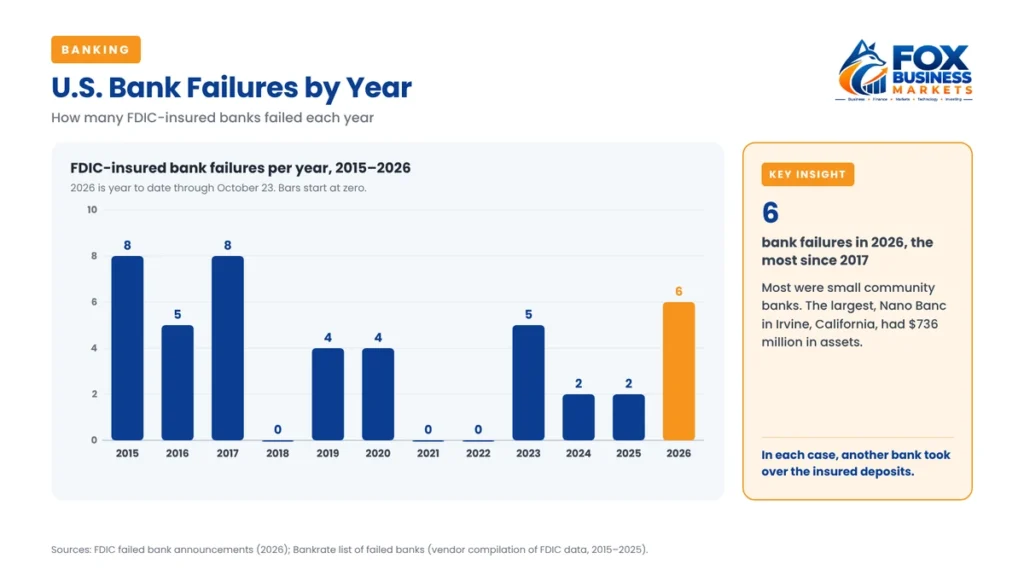
Six FDIC-insured banks have failed so far in 2026, up from two in 2025, according to FDIC announcements. Most were small community banks.
Date | Bank | Location | Assets |
| Jan 30 | Metropolitan Capital Bank & Trust | Chicago, IL | $261.1 million |
| May 1 | Community Bank and Trust–West Georgia | LaGrange, GA | about $288 million |
| July 10 | Kentland Federal Savings and Loan Association | Kentland, IN | $3.73 million |
| July 17 | Small Business Bank | Lenexa, KS | $73 million |
| Aug 21 | Tioga-Franklin Savings Bank | Philadelphia, PA | $68 million |
| Sept 25 | Nano Banc | Irvine, CA | $736 million |
In every 2026 case, another bank took over the failed bank’s insured deposits, and in several cases substantially all deposits. At Community Bank and Trust–West Georgia, the acquiring bank assumed only insured deposits; about $27 million in deposits exceeded insurance limits, and those depositors must recover funds through the FDIC receivership. It’s a reminder of why staying within insurance limits matters.
Bank failures have been rare in recent years. The FDIC recorded 8 failures in 2015, 5 in 2016, 8 in 2017, none in 2018, 4 in 2019, 4 in 2020, none in 2021 or 2022, 5 in 2023, 2 in 2024, and 2 in 2025, according to failure data compiled by Bankrate (vendor data). For a plain-English explanation of what happens to your money when a bank fails, see our banking basics guide.
What Do Banks Pay on Deposits in 2026?
The FDIC’s national average deposit rates in October 2026 were 0.07% for interest checking, 0.38% for savings, and 0.63% for money market accounts, according to FDIC data published on FRED (checking, savings, money market). The 12-month CD averaged about 1.76%, according to the FDIC’s national rates.
Those averages are far below what many online banks pay. Vendor surveys from NerdWallet (Oct 22, 2026) and Bankrate (Oct 23, 2026) found top high-yield savings accounts paying roughly 4% to 4.35% APY, excluding short-term promotions. Our guide to the high-yield savings account explains the gap.
Deposit rates are linked to Federal Reserve policy. On September 16, 2026, the Fed raised the federal funds target range by a quarter point to 3.75% to 4.00%. Its next meeting is October 27–28, 2026.
How Much Do Bank Fees Cost?
Bank fees have fallen sharply for many customers, but they still add up. Banking statistics on fees come from both regulators and vendors:
- Overdraft and NSF revenue: Reported overdraft and insufficient funds (NSF) fee revenue at banks with more than $1 billion in assets fell to $5.83 billion in 2023, from $11.96 billion in 2019, according to the Consumer Financial Protection Bureau.
- Who pays: 12% of adults with a bank account paid an overdraft fee in the prior 12 months, according to the Federal Reserve’s 2025 household survey.
- Average fees (vendor data): Bankrate’s 2025 Checking Account and ATM Fee Study found an average overdraft fee of $26.77, an average NSF fee of $16.82, and an average out-of-network ATM cost of $4.86.
A CFPB rule that would have limited overdraft fees at banks and credit unions with more than $10 billion in assets never took effect. Congress overturned it with a Congressional Review Act resolution signed May 9, 2025 (Public Law 119-10). Our guide to checking vs savings accounts explains how to avoid most fees.
How Many Americans Don’t Have a Bank Account?
About 4.2% of U.S. households, roughly 5.6 million, were unbanked in 2023, meaning no one in the household had a checking or savings account at a bank or credit union, according to the FDIC’s 2023 National Survey of Unbanked and Underbanked Households. That’s the lowest since the survey began in 2009.
The unbanked rate has fallen since peaking at 8.2% in 2011 (it was 7.6% in 2009), dropping to 7.0% in 2015, 5.4% in 2019, 4.5% in 2021, and 4.2% in 2023, according to the FDIC’s 2021 survey report and the 2023 survey.
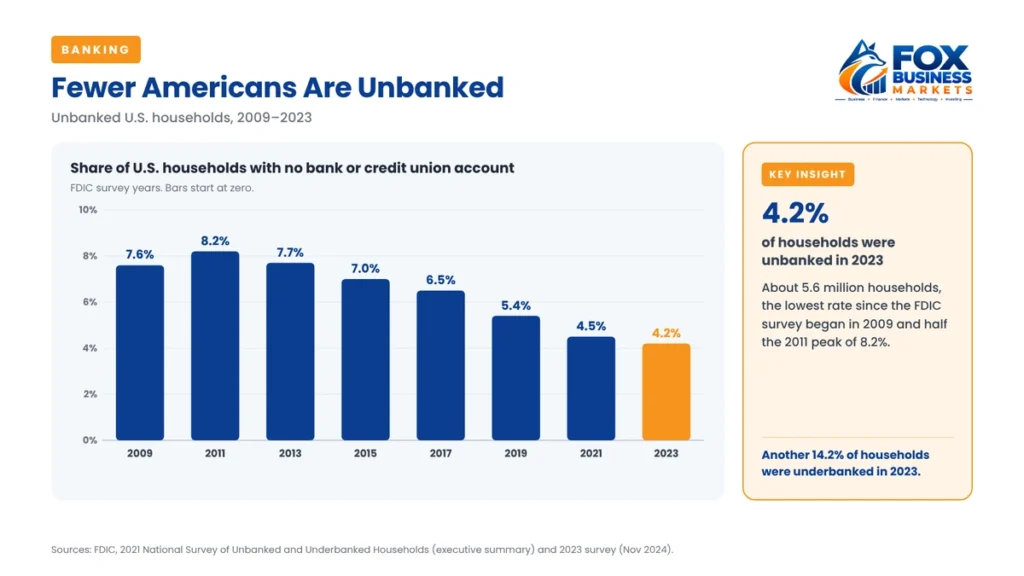
Another 14.2% of households, about 19.0 million, were underbanked in 2023, meaning they had a bank account but also used nonbank financial services such as money orders, check cashing, payday loans, or pawn shop loans in the past year. The most common main reason unbanked households gave for not having an account was not having enough money to meet minimum balance requirements (23.3%). Our guide on how to open a bank account covers low-cost options.
The Federal Reserve measures adults instead of households and found that 6% of adults were unbanked in 2025, little changed from recent years.
How Do Americans Bank Today?
Mobile banking is now the most common way Americans access their accounts. In 2023, 48.3% of banked households used mobile banking as their primary method of accessing their accounts, according to the FDIC’s household survey.
Prepaid cards are fading. Just 5.9% of households were using prepaid cards in 2023, down from 6.9% in 2021, the FDIC found. Unbanked households used them far more often (21.6%) than banked households (5.2%).
What Do These Banking Statistics Mean for You?
These banking statistics describe a system that is profitable overall, with a growing deposit insurance fund, but they also point to a few practical lessons for your own money:
- Stay within insurance limits. Bank failures are rare, but they still happen. Keep deposits within $250,000 per depositor, per bank, per ownership category.
- Don’t settle for the national average. With savings averaging 0.38% and top accounts above 4%, where you keep your cash matters.
- Avoid overdraft fees. Don’t opt in to debit card overdraft coverage, and set low-balance alerts.
- Check your bank’s insurance. Confirm that your bank is FDIC-insured, or your credit union NCUA-insured, especially if you use a fintech app.
Frequently Asked Questions
How many banks are there in the U.S. in 2026?
There were 4,238 FDIC-insured commercial banks and savings institutions in the second quarter of 2026, according to the FDIC. There were also 4,214 federally insured credit unions with 146.1 million members, according to the NCUA. The number of banks keeps shrinking, mostly because of mergers rather than failures.
How many banks have failed in 2026?
Six FDIC-insured banks have failed in 2026 as of late October, compared with two in 2025. The largest was Nano Banc in Irvine, California, with $736 million in assets, which closed on September 25, 2026. In each case, another bank took over the failed bank’s insured deposits.
What percentage of Americans are unbanked?
About 4.2% of U.S. households, roughly 5.6 million, were unbanked in 2023, according to the FDIC, the lowest rate since its survey began in 2009. The Federal Reserve, which surveys adults rather than households, found that 6% of adults were unbanked in 2025.
What is the average savings account interest rate in 2026?
The FDIC’s national average savings rate was 0.38% in October 2026, and the average money market rate was 0.63%. Many online banks pay far more: vendor surveys found top high-yield savings accounts paying roughly 4% to 4.35% APY in October 2026. Rates are variable and change often.
How profitable are banks in 2026?
FDIC-insured banks earned $90.1 billion in net income in the second quarter of 2026, with a return on assets of 1.37% and a net interest margin of 3.32%, according to the FDIC. Domestic deposits grew 0.8% in the quarter, the eighth consecutive quarterly increase.
How much money is FDIC-insured?
The FDIC insures deposits up to $250,000 per depositor, per FDIC-insured bank, for each account ownership category, such as single, joint, retirement, and trust accounts. Credit union deposits get the same coverage from the NCUA. Investments like stocks, bonds, mutual funds, and crypto are not covered.
The Bottom Line
The banking statistics for 2026 tell a two-sided story. The industry earned $90.1 billion in a single quarter, deposits keep growing, and the share of unbanked households is the lowest since the FDIC began tracking in 2009. At the same time, six banks have failed this year, average deposit rates remain far below what the best accounts pay, and overdraft fees still hit 12% of banked adults.
The August report and the September failure that opened this article point to the same lesson. The system as a whole is strong, but your individual choices still matter: keep your money in insured accounts within the limits, shop for a better rate, and avoid unnecessary fees. We’ll update these banking statistics as new data arrives, including the FDIC’s third-quarter Quarterly Banking Profile.

