Yasmin was 26 and had just moved to Houston for her first full-time job when HR asked for her direct deposit details. She’d been getting by with a prepaid card and a payment app since college, and she had no idea what a “routing number” was. That night she opened a checking account online in about fifteen minutes, from her couch, with her driver’s license and her Social Security number. Her first paycheck landed in it nine days later. (Yasmin is a composite example, but her first-account story is a common one.)
Opening a bank account is easier than most people expect, and knowing how to open a bank account the right way can save you fees for years. This guide explains how to open a bank account in the U.S. step by step, which documents you need, what it costs, and what to do if you’ve been turned down before.
Quick answer: To open a bank account, choose an insured bank or credit union, pick an account type, and apply online or in a branch. You’ll need your name, date of birth, a street address, and an ID number such as a Social Security number (non-U.S. citizens can often use an ITIN or passport), plus a government photo ID. Most accounts can be opened in minutes with a small opening deposit.
What Do You Need to Open a Bank Account?
When you learn how to open a bank account in the U.S., the first thing to know is that federal law requires the bank to collect four pieces of information before opening it: your name, your date of birth, your address, and an identification number. That’s the minimum under the Customer Identification Program rule, 31 CFR 1020.220, which applies to banks, savings associations, and credit unions.
For the address, the rule calls for “a residential or business street address.” If you don’t have one, the rule allows alternatives, such as an Army or Fleet Post Office box or the street address of next of kin or another contact. For the ID number, a U.S. person provides a taxpayer identification number, usually a Social Security number. A non-U.S. person can provide “one or more” of the following: a taxpayer identification number such as an ITIN, a “passport number and country of issuance,” an “alien identification card number,” or the number of another government-issued document “evidencing nationality or residence and bearing a photograph or similar safeguard.”
Banks also verify your identity, usually with an unexpired government photo ID “such as a driver’s license or passport,” according to the same rule.
Here’s a practical checklist of what to have ready:
What you’ll need | Common examples |
| Government photo ID | Driver’s license, state ID, passport, military ID |
| ID number | Social Security number, or ITIN or passport number for non-U.S. persons |
| Date of birth | Shown on your ID |
| Street address | A residential or business street address; some banks ask for proof, like a utility bill or lease |
| Contact details | Phone number and email |
| Opening deposit | Often $0 to $100, by card, transfer, check, or cash |
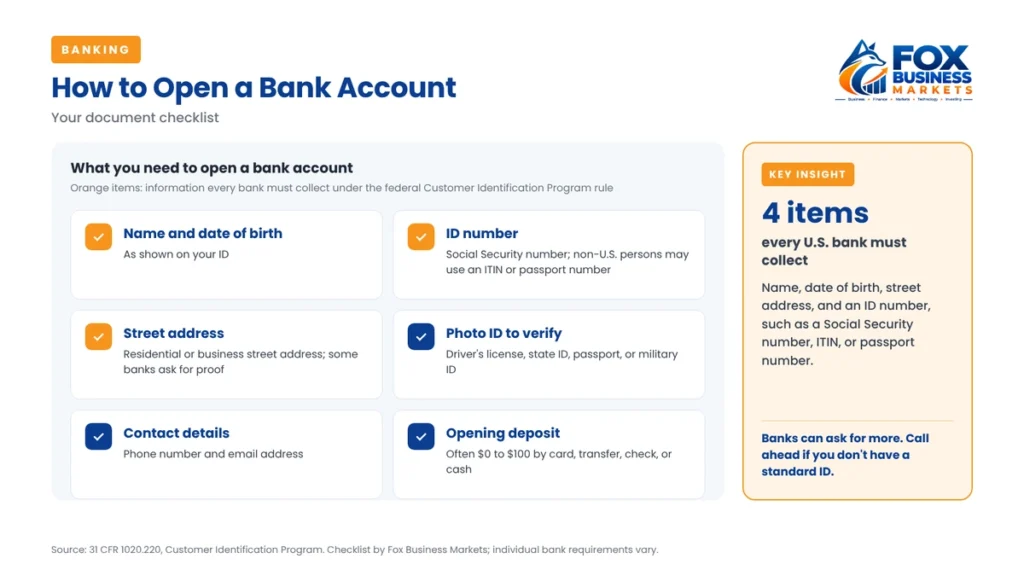
Each bank sets its own policies on top of the federal minimum. Some ask for a second form of ID or proof of address, especially in person. If you don’t have a standard ID, call the bank first and ask what it accepts.
How Do You Open a Bank Account Step by Step?
Here’s how to open a bank account in seven steps. Most people finish in under half an hour.
Step 1: Decide What Kind of Account You Need
Most people should start with a checking account for paychecks and bills, plus a savings account for emergencies and goals. Our guide to checking vs savings accounts explains the difference. If you want to earn more on savings, consider a high-yield savings account, often offered by online banks.
Step 2: Choose a Bank or Credit Union
Compare a few options on fees, ATM access, branches, mobile app, and interest rates. Make sure the bank is FDIC-insured or the credit union is federally insured by the NCUA, which protects deposits up to $250,000 per depositor, per institution, for each account ownership category. You can check using the FDIC’s BankFind tool or the NCUA’s credit union locator. Our banking basics guide covers how to choose.
Step 3: Gather Your Documents
Have your photo ID, Social Security number or other ID number, and address ready. If you’re applying in person, bring originals, not photocopies.
Step 4: Apply Online or in a Branch
Online applications usually take 10 to 15 minutes. You’ll enter your personal information, answer a few identity questions, and may upload a photo of your ID. In a branch, a banker will walk you through the same steps. If you’re opening a joint account, both people usually need to provide their information.
Step 5: Make Your Opening Deposit
Fund the account with a debit card, a transfer from another bank, a check, or cash in a branch. Many accounts require no minimum, while others ask for $25 to $100.
Expect possible holds on your first check deposits. Under the Federal Reserve’s Regulation CC, banks can hold most check deposits longer while an account is less than 30 days old. Cash and electronic payments, such as direct deposit, must still generally be available by the next business day.
Step 6: Set Up Your Account Features
Before you start using the account, take a few minutes to:
- Set up direct deposit with your employer using your account and routing numbers.
- Download the mobile app and turn on alerts for low balances and large transactions.
- Decide on overdraft coverage. Under federal Regulation E, banks can’t charge overdraft fees on ATM withdrawals or one-time debit card purchases unless you opt in. If you don’t opt in, the bank usually declines those transactions instead of charging a fee.
- Add a beneficiary (payable-on-death designation) if your bank offers it.
- Activate your debit card and set a PIN.
Step 7: Link Your Savings and Automate
Link your checking and savings accounts and set up an automatic transfer to savings on payday. Even $25 a paycheck builds an emergency fund over time.
How Much Does It Cost to Open a Bank Account?
Cost is a common worry when people look up how to open a bank account, but it’s usually free or costs only a small opening deposit, which stays in your account as your own money. The real costs come later, from monthly maintenance fees, overdraft fees, and out-of-network ATM fees.
Many banks and credit unions now offer free checking accounts with no monthly fee and no minimum balance. If an account does charge a monthly fee, check whether it’s waived with direct deposit or a minimum balance you can realistically keep.
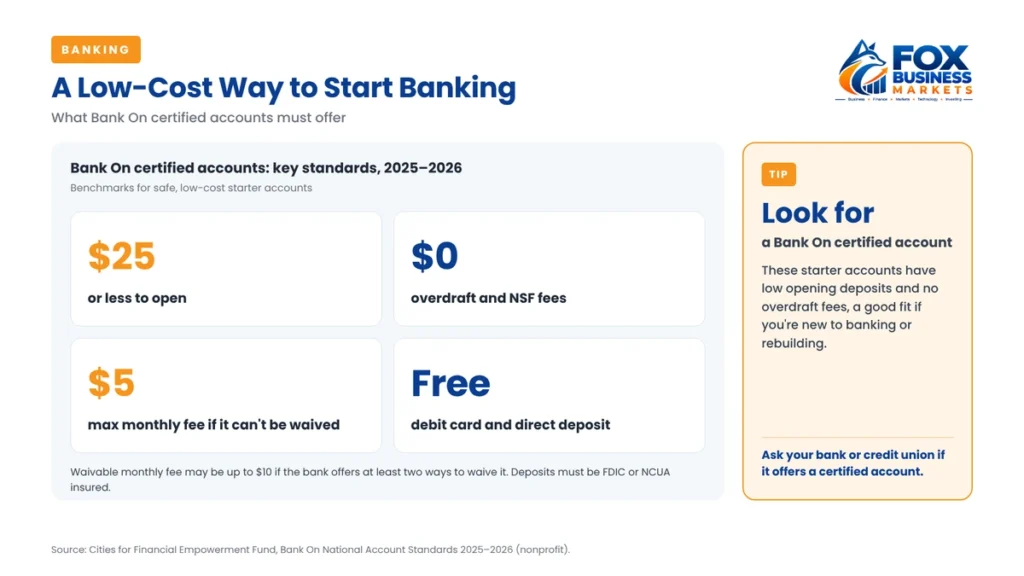
For a low-cost starter account, look for one certified under the Bank On National Account Standards, a set of affordability benchmarks published by the nonprofit Cities for Financial Empowerment Fund. According to the 2025–2026 standards, certified accounts must have a minimum opening deposit of “$25 or less,” no overdraft or insufficient funds fees, and a monthly fee of “$5 or less” if it can’t be waived (up to $10 if it can be waived in at least two ways). They also include a free debit card and free direct deposit.
Can You Open a Bank Account Online?
Yes. For most people, how to open a bank account today simply means applying online: most banks and credit unions let you open an account entirely online or in their app, and many online-only banks don’t have branches at all. Mobile banking is now the main way many Americans bank: according to the FDIC’s 2023 household survey, 48.3% of banked households used mobile banking as their primary method of accessing their accounts.
Online applications use the same federal ID rules as branches. You’ll usually be asked to take a photo of your ID and sometimes a selfie, and the bank may check your information against outside databases. If the bank can’t verify your identity online, it may ask you to upload documents or visit a branch.
Why Do Some People Not Have a Bank Account?
About 4.2% of U.S. households, roughly 5.6 million, didn’t have a bank or credit union account in 2023, according to the FDIC’s household survey. The most common main reason was “don’t have enough money to meet minimum balance requirements,” cited by 23.3% of unbanked households, followed by “don’t trust banks,” cited by 15.7%. When households could list any reason, 42.3% mentioned minimum balance requirements.
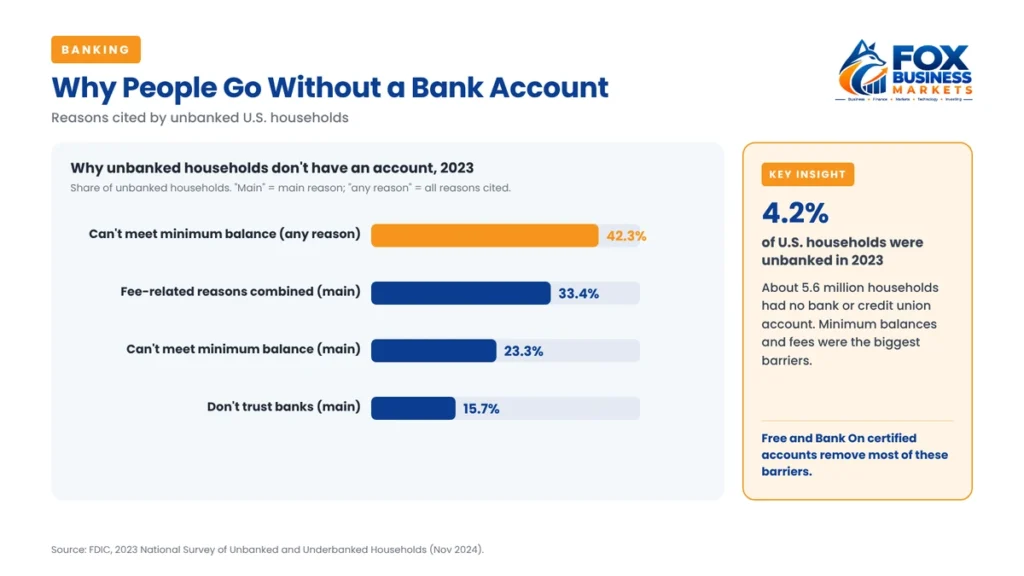
One-third of unbanked households (33.4%) cited a reason related to fees or a minimum balance as their main reason. And 70.9% of unbanked households said they were not very or not at all interested in having an account.
The good news is that many of these barriers are easier to get past than they once were. Free and low-cost accounts, including Bank On certified accounts, have no or low minimum balances and no overdraft fees.
What If You’ve Been Denied a Bank Account?
If you’ve been denied, you’re not out of options. Banks and credit unions usually check a checking account report from companies such as ChexSystems or Early Warning Services before opening an account, and an unpaid negative balance from a past account is a common reason for denial.
Knowing how to open a bank account after a denial starts with a few steps:
- Ask why. If you’re denied based on a consumer report, you’re entitled to know which company provided it.
- Get your report. You can request a free copy every 12 months, and another if you’re denied based on it, according to the CFPB.
- Dispute errors with the reporting company if something is wrong.
- Pay off old balances you owe to a former bank, and ask that bank to update the report.
- Ask about “second chance” or lower-risk accounts, which many banks and credit unions offer to people with past account problems.
Can a Minor Open a Bank Account?
Generally, minors can’t open a standard bank account alone, but they can have a joint account with a parent or guardian, or a custodial account managed by an adult. Rules vary by bank and state, and some banks offer teen checking accounts with a parent as co-owner starting around age 13. In most states, people can open their own account at 18, the age of majority (a few states set it higher).
Frequently Asked Questions
What documents do I need to open a bank account?
You’ll need a government photo ID, such as a driver’s license, state ID, or passport, plus your Social Security number. Banks must also collect your name, date of birth, and a street address. Non-U.S. citizens can often use an ITIN, passport number, or other government ID. Some banks also ask for proof of address.
Can I open a bank account without a Social Security number?
Often, yes. Federal rules let banks accept other ID numbers from non-U.S. persons, including an Individual Taxpayer Identification Number (ITIN), a passport number and country of issuance, or an alien identification card number. Each bank sets its own policies, so call ahead and ask which documents it accepts before you apply.
How much money do I need to open a bank account?
Many checking and savings accounts require no opening deposit at all, while others ask for $25 to $100. Bank On certified accounts require $25 or less. Your opening deposit isn’t a fee; it stays in your account. Watch instead for monthly maintenance fees and minimum balance requirements.
How long does it take to open a bank account?
Most online applications take 10 to 15 minutes, and many accounts are approved instantly or within a day or two. You can usually start using online banking right away, while a debit card typically arrives by mail within a week or two. Opening an account in a branch takes a similar amount of time.
Can I open a bank account online with bad credit?
Usually, yes. Many banks don’t pull your credit score to open a checking or savings account, though some do. Most check a checking account report from companies like ChexSystems. If you have past account problems, like an unpaid negative balance, ask about second-chance accounts, and request your free report to dispute any errors.
Is it better to open an account at a bank or a credit union?
Both are safe when federally insured up to $250,000. Credit unions are member-owned and may charge lower fees, but you must meet membership requirements. Banks usually offer more branches, ATMs, and technology. Compare fees, rates, and access, and choose the one that fits how you actually bank.
The Bottom Line
Yasmin’s account took fifteen minutes to open and spared her ongoing prepaid card fees. The hardest part was simply starting.
That’s how to open a bank account: pick an insured bank or credit union, choose the account type you need, gather your ID and Social Security number (or ITIN or passport), apply online or in a branch, and make a small opening deposit. Then set up direct deposit, turn on alerts, think carefully about overdraft coverage, and automate your savings. If you’ve been turned down before, request your free checking account report and ask about second-chance or Bank On accounts. For the bigger picture, see our personal finance guide and the latest banking statistics.

