Quick answer: If you’re wondering how to buy stocks, open a brokerage account, deposit money, research the stock or fund you want, and place an order using its ticker symbol. Most large online brokers charge no commission on U.S. stocks and ETFs, and many sell fractional shares for as little as $1. Beginners often start with a broad index fund.
Charles Schwab opened about 1.2 million new brokerage accounts in the third quarter of 2026 alone, and Robinhood ended the quarter with 28.7 million funded customers, according to company reports. Most trades now cost nothing, and you can own a slice of almost any large company with a few dollars.
That ease cuts both ways. In June 2026, a new FINRA rule took effect that replaces the $25,000 minimum that limited frequent day trading in small accounts, though brokers have until October 2027 to switch over. Nasdaq and NYSE Arca are also scheduled to start near-round-the-clock trading on Dec. 6, 2026. More access means more chances to trade on impulse. Research has long found that investors who trade less tend to do better than frequent traders.
This guide walks through how to buy stocks step by step: choosing an account and a broker, picking what to buy, placing the right type of order, deciding how much to invest, and avoiding the mistakes that cost new investors the most.
What Do You Need Before You Buy Stocks?
Before you buy your first share, make sure your finances can handle the ups and downs of the stock market. Check these boxes first:
- An emergency fund. Keep three to six months of expenses in savings so you won’t have to sell stocks at a bad time. Our emergency fund guide shows how much you need.
- No high-interest debt. Paying off a credit card charging 22% interest is a guaranteed return that stocks can’t match.
- A clear goal and time frame. Money for retirement 30 years away can ride out market drops. Money for a house down payment next year probably shouldn’t be in stocks.
- Your workplace match. If your employer matches 401(k) contributions, contribute enough to get the full match before opening other accounts.
- Identification and bank details. You’ll need your Social Security number, a government ID, and a bank account to fund your brokerage account.
How to Buy Stocks: What Are the Steps?
The process works like this from start to finish:
- Choose an account type. Decide between a regular taxable brokerage account and a tax-advantaged retirement account, such as a Roth IRA.
- Pick a broker. Compare fees, investment choices, tools, and customer service.
- Open and fund the account. Apply online in about 10 to 15 minutes, then link your bank account and transfer money. Transfers usually take one to three business days.
- Decide what to buy. Choose individual stocks, exchange-traded funds (ETFs), or index funds based on your goals and research.
- Find the ticker symbol. Every stock and ETF has a short code of letters, such as AAPL for Apple, that you’ll enter to place a trade.
- Choose your order type and amount. Enter the number of shares or the dollar amount and pick an order type, such as a market or limit order.
- Review and submit. Check the details, then place the order. Most orders for large stocks fill within seconds during market hours.
- Monitor, but don’t obsess. Review your investments a few times a year and rebalance, or adjust your mix back to your target, as needed.
You own the shares once your order fills. The trade formally settles one business day later.
Which Type of Account Should You Open?
The account you choose affects your taxes as much as the stocks you buy.
Account | Taxes | Withdrawal rules | Best for |
| Taxable brokerage account | Pay taxes on dividends each year and on gains when you sell | Withdraw anytime | Flexible goals and money beyond retirement accounts |
| Roth IRA | Contributions are after tax; qualified withdrawals are tax-free | Contributions can come out anytime; earnings may be taxed and penalized before 59½ (and 5 years) unless an exception applies | Younger investors and those expecting higher future taxes |
| Traditional IRA | Contributions may be tax-deductible; withdrawals are taxed | Penalties before 59½ with some exceptions | Lowering your tax bill today |
| 401(k) or 403(b) | Similar to traditional or Roth IRA, depending on the plan | Penalties before 59½ with some exceptions | Employer matches and higher contribution limits |
| Custodial account (UGMA/UTMA) | Taxed partly at the child’s rate | Belongs to the child; control passes at 18 to 21 in most states | Investing for a minor |
If you’re investing for retirement, a Roth or traditional IRA is often the best place to start after your employer plan. Our comparison of Roth vs. traditional IRAs can help you decide.
How Do You Choose a Brokerage?
A broker is the company that buys and sells investments for you. Today, most investors use an online broker or app. When comparing brokers, look at:
- Commissions and fees. Most large brokers charge $0 to trade U.S. stocks and ETFs online. Watch for account fees, transfer-out fees, and charges for broker-assisted trades.
- Fractional shares. Some brokers let you buy a slice of a share for as little as $1, which helps if you have a small budget.
- Investment choices. Check whether the broker offers the stocks, ETFs, mutual funds, and bonds you want.
- Research and tools. Beginners benefit from stock screeners, analyst reports, and educational content.
- Account types. Make sure the broker offers IRAs, custodial accounts, or joint accounts if you need them.
- Customer service. Look for phone support and, if you want in-person help, local branches.
- Safety record. Confirm the broker is a member of the Securities Investor Protection Corporation (SIPC) and check its record on FINRA’s BrokerCheck.
If you’d rather not pick investments at all, a robo-advisor can build and manage a portfolio for a small annual fee.
Should You Buy Individual Stocks or Funds?
You don’t have to choose just one, but the difference is big for beginners.
| Individual stocks | Index funds and ETFs | |
| What you own | Shares of one company | Small pieces of dozens to thousands of companies |
| Diversification | Low unless you own many stocks | High, even with a small investment |
| Research needed | A lot | Little |
| Risk | One company can fall sharply or fail | Spread across the market |
| Typical cost | $0 commission | $0 commission plus a small annual expense ratio |
Many financial planners suggest beginners build a core of low-cost index funds, such as an S&P 500 or total market fund. You can then add a few individual stocks you’ve researched, often limited to a small share of your portfolio.
How Do You Research a Stock Before Buying?
If you want to buy individual stocks, do your homework first. Start with these questions:
- What does the company do, and how does it make money? If you can’t explain the business in a sentence or two, keep researching.
- Is it profitable and growing? Look at revenue and earnings over several years. Our guide on how to read an earnings report explains the key lines.
- How much debt does it carry? Heavy debt can become a problem when interest rates rise or sales slow.
- What is the stock’s valuation? Ratios such as price-to-earnings (P/E) compare the stock price with profits. A high P/E often means investors expect strong growth, or that the stock is expensive.
- What gives it an edge? Strong brands, patents, network effects, and low costs can protect profits from competitors.
- What are the risks? Read the “risk factors” section of the company’s annual report (Form 10-K), available free on the SEC’s EDGAR website.
Avoid buying a stock just because it’s trending on social media or a friend recommended it. Those stocks can rise fast and fall faster.
What Order Type Should You Use?
When you place a trade, you choose an order type. It tells your broker how and at what price to buy or sell.
Order type | How it works | When to use it |
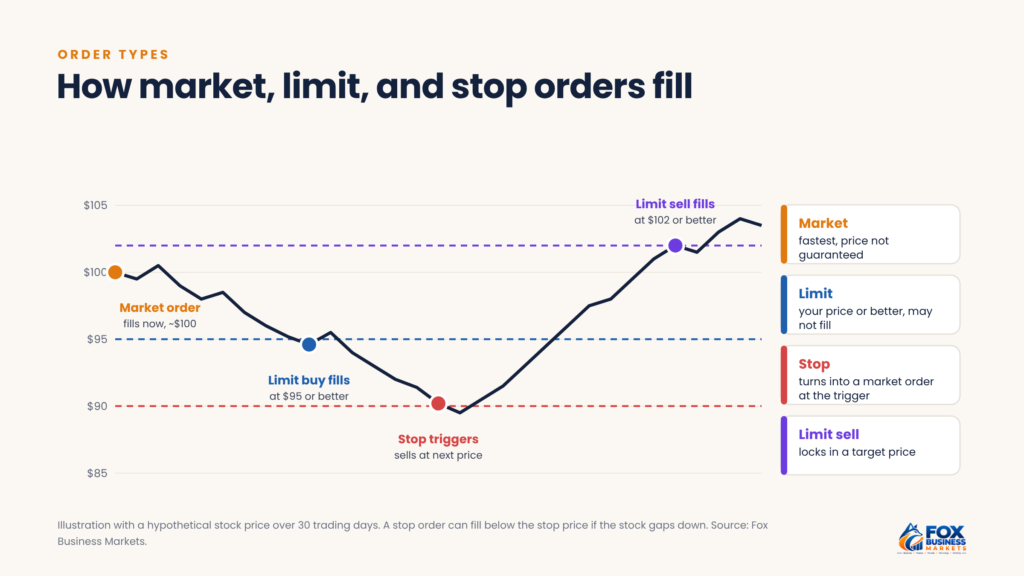
| Market order | Buys or sells right away at the best available price | Large, frequently traded stocks during regular hours |
| Limit order | Buys only at your price or lower, or sells at your price or higher | When price is more important than speed, or in extended hours |
| Stop order (stop-loss) | Becomes a market order once the stock hits your stop price | Limiting losses on a position you own |
| Stop-limit order | Becomes a limit order once the stop price is hit | Limiting losses while controlling the sale price |
| Trailing stop | A stop price that moves up as the stock rises | Locking in gains while giving a stock room to grow |
For most beginners buying large, popular stocks or ETFs, a market order during regular hours works fine. Use a limit order if the stock trades thinly, the price is moving fast, or you’re trading outside regular hours. A stop-loss order can fill well below your stop price if a stock gaps down overnight.
Orders also have a time limit. A day order expires at the close if it doesn’t fill. A good-’til-canceled (GTC) order stays open, usually for 60 to 180 days, depending on the broker.
Is It a Myth That You Need a Lot of Money to Buy Stocks?
Yes, that’s a myth today. Not long ago, buying stock meant paying a commission of $5 to $10 or more per trade and buying whole shares, which could cost hundreds or thousands of dollars for some companies. That made small investments impractical.
Two changes ended that barrier:
- $0 commissions. Most major online brokers dropped commissions on U.S. stock and ETF trades in 2019.
- Fractional shares. Many brokers let you buy a portion of a share by entering a dollar amount, such as $25, instead of a number of shares.
That means you can start with whatever amount fits your budget. At first, building the habit counts for more than the amount you invest. Investing $100 a month from age 25 to 65 could leave you with about twice as much as investing $100 a month from 35 to 65, assuming a 7% average annual return.
A few practical points:
- Some mutual funds require a minimum first investment, often $0 to $3,000. ETFs cost the price of one share, or less if your broker offers fractional shares.
- Not every stock or fund is available in fractional shares, and fractional shares may not transfer easily to another broker.
- Fees take a bigger bite out of small accounts. Avoid brokers or apps that charge monthly fees on low balances.
Should You Invest All at Once or Over Time?
Investing a fixed amount on a regular schedule, called dollar-cost averaging, is how most people buy stocks through workplace retirement plans. It removes the temptation to guess the perfect moment to buy.
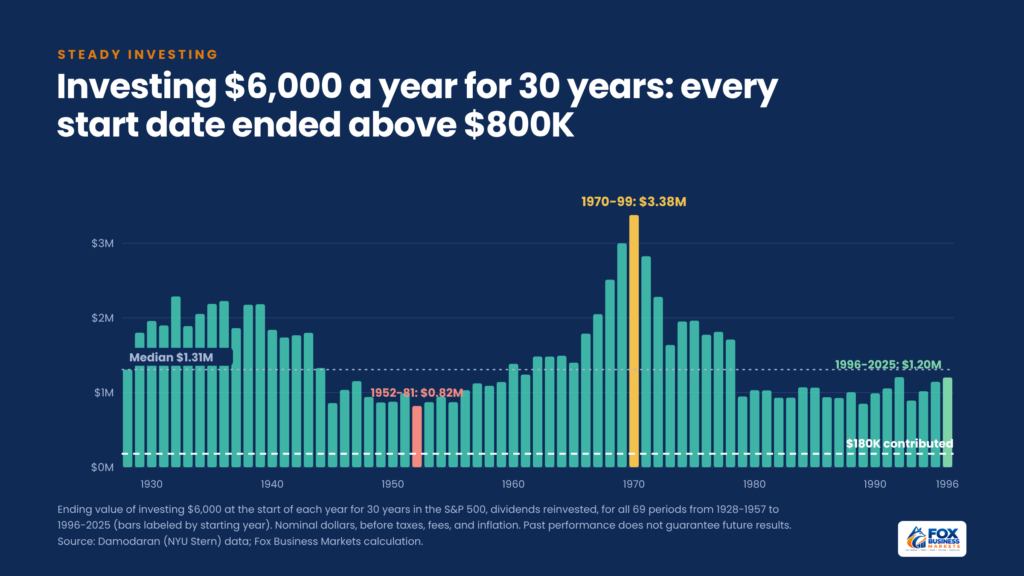
We tested a simple plan using S&P 500 calendar-year returns from 1928 through 2025: invest $6,000 at the start of every year for 30 years, a total of $180,000. Across all 69 possible 30-year periods:
- Every period ended with roughly $820,000 or more, before taxes, fees, and inflation.
- The median ending value was about $1.31 million.
- The best period, 1970 to 1999, ended with about $3.38 million.
- The most recent period, 1996 to 2025, ended with about $1.2 million, despite including the 2000-2002 crash and the 2008 crisis.
If you receive a large sum at once, such as an inheritance, investing it all at once has historically come out ahead about two-thirds of the time, according to Vanguard research, because markets rise more often than they fall. But spreading it over a few months can make the decision easier to live with. Either approach has historically beaten leaving the money in cash for years waiting for a dip.
When Can You Buy Stocks?
Regular trading runs from 9:30 a.m. to 4 p.m. Eastern time on weekdays, and many brokers also offer premarket, after-hours, and overnight sessions. Our stock market guide covers the basics of how the market operates.
Trading hours are about to expand further. Nasdaq and NYSE Arca are scheduled to launch overnight sessions on Dec. 6, 2026. The SEC has approved both exchanges’ extended-hours plans, though some supporting rules were still awaiting approval this fall. Trading would run from 9 p.m. to 4 a.m. Eastern, alongside existing sessions, creating a 23-hour trading day from Sunday night through Friday evening, according to an analysis by the law firm Jones Day.
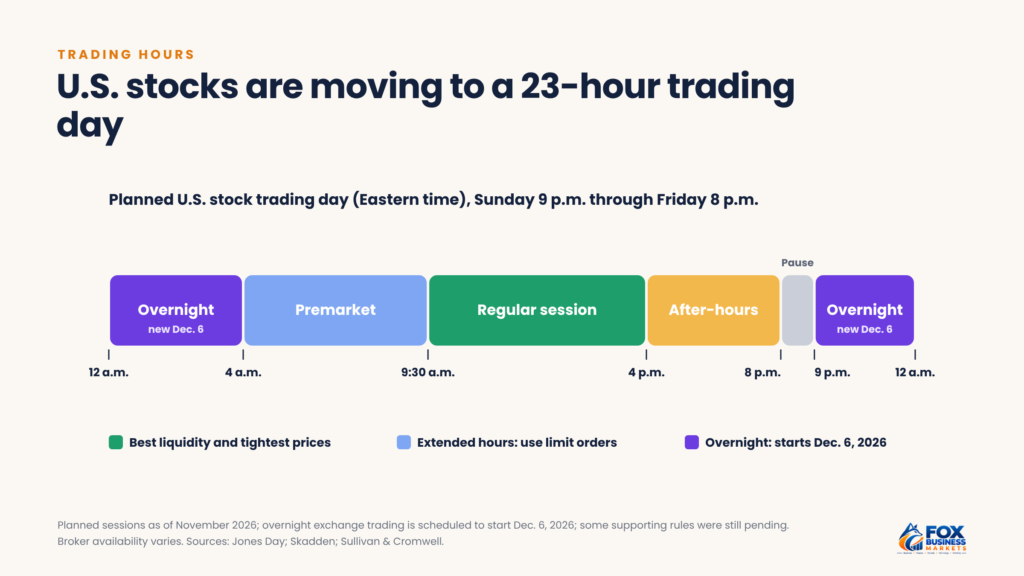
Extended-hours trading carries extra risk. Fewer buyers and sellers mean wider gaps between bid and ask prices and bigger price swings. Most brokers accept only limit orders outside regular hours, and that’s a good rule to follow even when they don’t require it.
What Changed for Day Traders in 2026?
For years, the pattern day trader rule required anyone who made four or more day trades within five business days in a margin account to keep at least $25,000 in the account. In April 2026, the SEC approved FINRA’s plan to replace that rule with new intraday margin standards, which took effect June 4, 2026, according to FINRA’s regulatory notice. Brokers can phase in the new system through Oct. 20, 2027.
Under the new approach, brokers measure the risk of your positions during the day instead of counting your day trades. Each broker can set its own requirements, so rules vary.
The change makes frequent trading easier, but it doesn’t make it more profitable. Studies of individual day traders have long found that most lose money after costs. If you want to try it, use a small amount you can afford to lose and keep your long-term investments separate.
What Mistakes Should You Avoid When Buying Stocks?
New investors tend to make the same handful of mistakes:
- Putting too much in one stock. A single company can drop 50% or more. Keep any one stock to a small share of your portfolio.
- Chasing hot stocks. By the time a stock is all over the news, much of the gain may be gone.
- Trading too often. Frequent trading raises taxes and the odds of mistakes.
- Selling in a panic. Market drops are normal. Selling during a downturn locks in losses.
- Using margin too early. Borrowing to invest magnifies losses and can force you to sell at the worst time.
- Ignoring fees and taxes. High-cost funds and short-term gains, which are taxed as ordinary income, can quietly eat into returns.
- Skipping diversification. Build your portfolio across many companies and sectors. Our guide to building an investment portfolio shows how.
Frequently Asked Questions
Can you buy stocks without a broker?
Yes, in some cases. Many large companies offer direct stock purchase plans or dividend reinvestment plans (DRIPs) through a transfer agent, letting you buy shares directly. These plans may charge fees and offer fewer features than a brokerage account. Tip: Compare the plan’s fees with a $0-commission broker before you enroll.
When do you get dividends after buying a stock?
You get the next dividend only if you buy before the ex-dividend date. If you buy on or after that date, the seller gets that payment. Most brokers can reinvest dividends automatically. Tip: Check the ex-dividend date on your broker’s stock page before buying for income.
Can you buy stocks of foreign companies?
Yes. Many foreign companies trade on U.S. exchanges through American depositary receipts (ADRs), which you can buy like any U.S. stock. Some brokers also offer direct trading on foreign exchanges, and international index funds give you broad exposure. Tip: Check for ADR fees and foreign tax withholding on dividends before you buy.
Can you sell a stock right after you buy it?
Yes, but timing rules apply in cash accounts. If you buy a stock with unsettled cash, such as proceeds from a sale that hasn’t settled yet, and then sell the new shares before that cash settles, you can trigger a “good faith violation.” Three violations in 12 months can limit your account to settled cash for 90 days. Tip: Before you sell shares you just bought, make sure the cash you paid with has settled, which usually takes one business day.
Open Your Account and Make Your First Purchase This Week
Pick a broker, open an IRA or brokerage account, and fund it with an amount you’re comfortable with, even $50. Start with a low-cost broad-market index fund, place a market order during regular hours, and set up an automatic monthly deposit. Then give it time. For more on how prices move and what to expect, revisit our guide to how the stock market works, and see our investing statistics for the bigger picture.
This article is for general information only and isn’t financial, tax, legal, or investment advice. Consider your own situation or talk to a qualified professional before making decisions.

