Quick answer: Fintech is now mainstream in the U.S. Forty-four percent of Americans bank mainly through a mobile app, 47% have used buy now, pay later, and robo-advisors manage more than $1.2 trillion. But fintech venture funding fell to $10.6 billion in the third quarter of 2026, with the fewest deals in Crunchbase records.
Americans sent more than $1.2 trillion through Zelle alone in 2025, up 20% from a year earlier, according to Zelle’s annual figures reported by eMarketer. Digital wallets now account for 40% of U.S. online spending, more than credit cards, and app-only banks such as SoFi and Chime keep adding millions of members a year.
At the same time, the industry is growing up. Investors are writing fewer checks, several big banks have shut their robo-advisors, and nearly half of buy now, pay later users paid late in the past year. Fraud also hit a record, with Americans reporting $15.9 billion in losses to the Federal Trade Commission (FTC) in 2025.
This roundup collects the latest fintech statistics on digital banking, funding, payments, BNPL, investing apps, crypto, and fraud, with sources and what each number means for your money or your business.
Fintech Statistics at a Glance
- 44% of Americans use a mobile app as their main way to bank (ABA/Morning Consult, Nov. 2026).
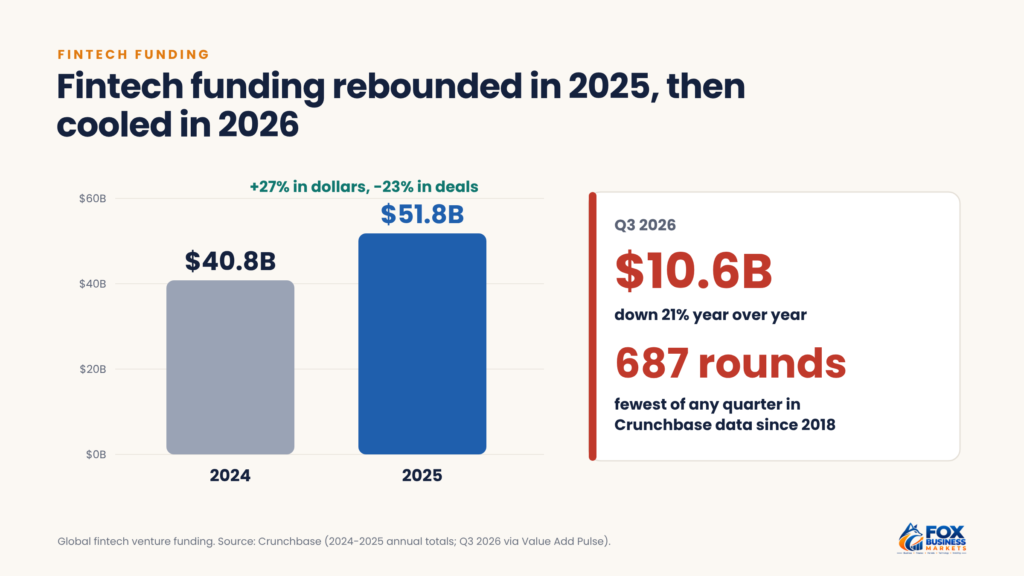
- $51.8 billion in global fintech venture funding in 2025, up 27% from 2024 (Crunchbase).
- $10.6 billion in fintech funding in Q3 2026, down 21% year over year, across the fewest deals in Crunchbase data going back to 2018.
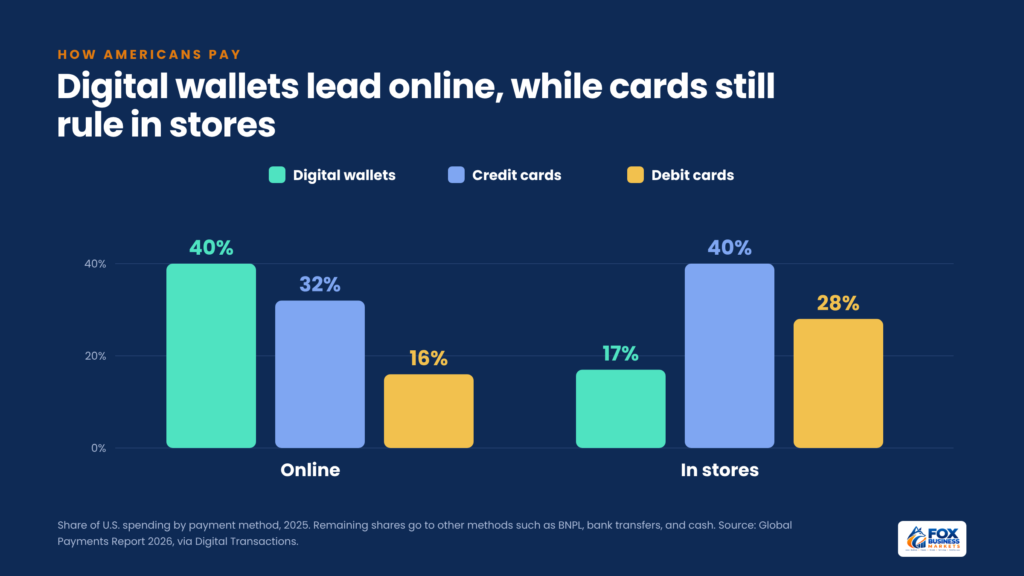
- 40% of U.S. online spending goes through digital wallets (Global Payments Report 2026).
- More than $1.2 trillion sent through Zelle in 2025, up 20% (Zelle).
- 1 million SoFi members and 10.9 million Chime active members in Q3 2026 (company reports).
- 47% of Americans have used buy now, pay later, and 47% of those users paid late at least once in the past year (LendingTree, 2026).
- More than $1.2 trillion managed by robo-advisors (AAII, 2026).
- 10% of U.S. adults used cryptocurrency in 2025 (Federal Reserve).
- About $310 billion in stablecoins outstanding in mid-2026 (Spark).
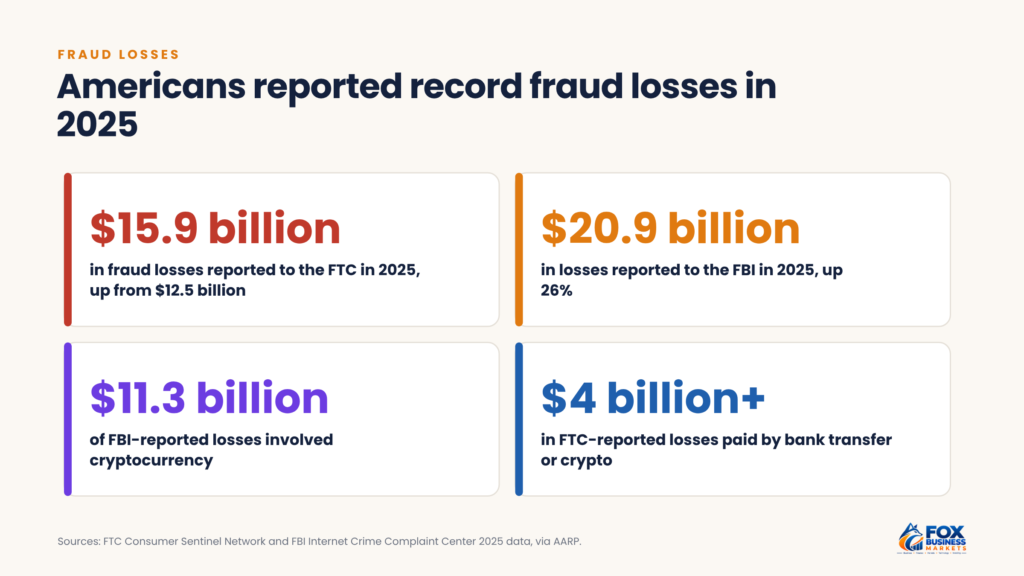
- $15.9 billion in fraud losses reported to the FTC in 2025, up from $12.5 billion in 2024 (FTC).
How Many Americans Use Digital Banking?
Apps are now the most common way Americans bank. An ABA and Morning Consult survey of 4,402 adults, conducted Oct. 9-12, 2026, found:
- 44% use a mobile app as their main way to bank.
- 20% mainly use a laptop or computer.
- 10% mainly visit a branch.
- 54% of Gen Z and millennials bank mostly by app, compared with 40% of Gen X and 32% of baby boomers.
- 95% rate their bank’s online and mobile experience as good or better.
- 75% agree that bank technology makes financial services easier to access.
The share of adults without any bank account remains low. The Federal Reserve’s 2025 household survey found that 6% of adults were unbanked in 2025. Some people turned away by traditional banks open accounts with app-only providers, which may use different screening.
For more on how Americans use traditional banks, see our banking statistics.
How Much Money Is Flowing Into Fintech?
Fintech funding rebounded in 2025, then cooled sharply in 2026.
| Period | Global fintech venture funding | Source |
| 2024 | $40.8 billion | Crunchbase |
| 2025 | $51.8 billion, up 27% | Crunchbase |
| Q2 2026 | $11.7 billion, 726 rounds | CB Insights |
| Q3 2026 | $10.6 billion, 687 rounds | Crunchbase |
Different data providers count deals differently, so compare trends within one source rather than across sources.
Key points from the latest data:
- 2025 deal count fell 23% to 3,457, even as total dollars rose, according to Crunchbase. Money went into fewer, larger rounds.
- The biggest 2025 rounds went to prediction markets and crypto: Polymarket and Binance each raised $2 billion, and Kalshi raised $1 billion.
- Q3 2026 funding fell 28% from the prior quarter and 21% from a year earlier. Deal count dropped to 687 from 995, the lowest quarterly total in Crunchbase data going back to 2018.
- S. fintechs raised $5.38 billion in Q3 2026, just over half the global total.
- New fintech unicorns slowed. CB Insights counted only four new $1 billion-plus fintech companies in Q2 2026.
For founders, the takeaway is that investors now favor companies with revenue and a path to profit. Our startup statistics cover broader venture trends.
How Big Are Neobanks?
App-only banks keep adding customers, and several are becoming chartered banks.
- SoFi:1 million members in Q3 2026, up 35%, with $51.3 billion in deposits.
- Chime:9 million active members, up 20%, and $718 million in quarterly revenue. Chime posted its third straight quarterly profit under standard accounting rules.
- Dave:15 million monthly transacting members, up 18%, and $198 million in quarterly revenue.
- Account openings: Chime opened 8% of new checking accounts among mass-market customers in Q2 2026, more than any other U.S. institution in that segment, according to J.D. Power data reported by eMarketer.
- Charters: In 2026, the Office of the Comptroller of the Currency (OCC) granted conditional national bank approvals to Nubank, Mercury, and Revolut. Chime agreed to buy its partner Stride Bank for $590 million.
Learn how these companies work and how to check whether your money is insured in our guide to neobanks.
How Do Americans Pay With Fintech?
Digital wallets and instant payments are reshaping checkout, though cards still dominate in stores.
According to the Global Payments Report 2026, as reported by Digital Transactions:
- Online: Digital wallets account for 40% of U.S. e-commerce spending, ahead of credit cards at 32% and debit cards at 16%.
- In stores: Wallets make up 17% of point-of-sale spending in 2025, expected to reach 26% by 2030.
- Cards in stores: Credit and debit cards combined account for 71% of in-store spending, forecast to fall to 61% by 2030.
- Wallet spending is projected to reach about $4.1 trillion in the U.S. by 2030.
Peer-to-peer apps are also growing fast:
- Zelle: more than $1.2 trillion sent in 2025, up 20%, across 2 billion transactions.
- Small businesses on Zelle: $347 billion received in 2025, up 26%.
- Venmo: total payment volume rose 13% year over year in Q4 2025.
For the full picture of how Americans pay, including cards, ACH, and FedNow, see our payment statistics.
How Popular Is Buy Now, Pay Later?
Buy now, pay later keeps growing, but so do signs of strain. From LendingTree’s 2026 surveys:
- 47% of Americans have used BNPL.
- 47% of BNPL users paid late at least once in the past year, up from 41% in 2025 and 34% in 2024.
- 63% have held more than one BNPL loan at a time, and 25% have held three or more.
- 29% have used BNPL to buy groceries, up from 14% two years earlier.
- 54% regret at least one BNPL purchase.
Spending and lender data show the scale:
- $21.3 billion in BNPL online spending is expected in November and December 2026, up 6.6%, according to Adobe.
- $1.09 billion in BNPL spending is expected on Cyber Monday alone.
- Affirm processed $14.4 billion in purchase volume in the quarter ended Sept. 30, 2026, up 34%.
Our guide to buy now, pay later explains real costs and how BNPL affects your credit.
How Much Do Robo-Advisors Manage?
Automated investing is now a trillion-dollar business, but the field is consolidating.
- More than $1.2 trillion: assets managed by robo-advisors, according to the American Association of Individual Investors’ 2026 review.
- Wealthfront: $100.5 billion in platform assets and 54 million funded clients as of Sept. 30, 2026.
- Betterment: more than $70 billion in assets and more than 1 million
- Typical fees: 0% to 0.35% a year at major robo-advisors, compared with about 1% at many human advisors.
- Closures: UBS, U.S. Bank, JPMorgan, and BlackRock have shut their robo services in recent years, and Schwab retired its premium hybrid tier in 2026.
Compare providers and fees in our guide to robo-advisors, and see our investing statistics for broader market trends.
How Many Americans Use Crypto and Stablecoins?
Crypto use remains limited for everyday Americans, while stablecoins are growing as a payments tool.
- 10% of U.S. adults used cryptocurrency in 2025, according to the Federal Reserve’s household survey.
- 9% held it as an investment, and only 2% used it to make a purchase, payment, or money transfer.
- About $310 billion in stablecoins were outstanding in mid-2026 (June 2026, Spark).
- Tether’s USDT held about 61% of the market and Circle’s USDC about 25%.
- The GENIUS Act, signed in July 2025, created the first federal rules for payment stablecoins. The OCC proposed implementing rules in February 2026.
How Much Do Americans Lose to Fintech-Related Fraud?
Faster payments also mean faster scams. Fraud losses hit records in 2025:
- $15.9 billion in losses reported to the FTC in 2025, up from $12.5 billion in 2024, according to AARP’s summary of FTC and FBI data.
- About 3 million fraud reports were filed with the FTC.
- More than $4 billion of reported losses were paid by bank transfer or cryptocurrency.
- $736.9 million was lost through credit cards and payment apps.
- $20.9 billion in losses were reported to the FBI’s Internet Crime Complaint Center, up 26%.
- $11.3 billion of FBI-reported losses involved cryptocurrency.
Reported losses understate the true total, since many victims never file a report. Payments you authorize yourself, such as sending money to a scammer, are often hard to recover.
What Do Fintech IPOs Show?
After a near-total freeze in 2024, fintech companies returned to the stock market in 2025.
- 2024: North America saw no fintech IPOs, according to Mergermarket.
- 2025: Major listings included eToro, Circle, Chime, Klarna, and Wealthfront.
- Valuations reset: Chime went public at a fully diluted value of about $11.6 billion, less than half its $25 billion private valuation in 2021.
- Profit focus: Chime, SoFi, and Dave all reported profits in their latest quarters, a shift from the growth-at-any-cost era.
Several large private fintechs, including Plaid, Revolut, and Stripe, remain candidates for future listings.
How Do Small Businesses Use Fintech?
Online lenders have become a major source of small-business credit, though they often cost more. The Federal Reserve’s 2026 Report on Employer Firms, based on 6,525 responses collected from September to November 2025, found:
- 29% of firms that applied for financing sought it from online fintech lenders, up from 17% in 2020.
- Online lenders were the second most common lender type, behind large banks.
- 60% of online lender borrowers said their actual costs were higher than expected, compared with 37% of small bank borrowers and 32% of large bank borrowers.
- 57% of small bank applicants were fully approved, the highest rate of any lender type.
- High interest rates and unfavorable repayment terms were the most common complaints about online lenders.
Payments data points the same way: small businesses’ Zelle receipts grew 26% in 2025, as more owners use instant payments to get paid faster.
The lesson for owners: fintech can deliver speed and convenience, but compare the total cost of any online loan with a bank or credit union offer before you sign.
What Fintech Trends Should You Watch in 2027?
Several developments will shape the next set of fintech statistics:
- Bank charters. Nubank, Mercury, and Revolut hold conditional national bank approvals, and Chime’s purchase of Stride Bank is expected to close in the first half of 2027. If these deals finish, more of the biggest fintechs will hold deposits directly.
- Open banking rules. The Consumer Financial Protection Bureau (CFPB) is rewriting its data-sharing rule, known as Section 1033. The final version will decide whether banks can charge apps for access to customer data.
- Stablecoin rules. Regulators are finishing the rules that put the GENIUS Act into practice. Clear rules could bring more banks and payment companies into stablecoin payments.
- State BNPL regulation. New York’s proposed licensing rules would cap late fees and require underwriting, and other states may follow.
- AI in financial apps. Fintechs are adding AI assistants for budgeting, customer service, fraud detection, and investing, though adoption in regulated advice remains limited.
Is It a Myth That Fintechs Are Replacing Banks?
Mostly, yes. Fintech apps are growing fast, but they haven’t replaced traditional banks. They’re changing how people use them.
The fintech statistics show a mix rather than a takeover:
- Traditional banks and credit unions still hold most Americans’ checking accounts. Fintech apps often serve as a second account for spending, savings, or early pay.
- Big banks have built their own fintech features. Zelle is owned by a group of banks.
- Many fintechs depend on banks. App-only providers often hold deposits at partner banks, and the most successful ones are now trying to become banks themselves.
- National banks regained some account-opening share from fintechs in the second quarter of 2026, led by Chase, according to J.D. Power data reported by eMarketer.
The more accurate picture is convergence. Banks are acting more like tech companies, and fintechs are acting more like banks. For consumers, that means more choice but also more fine print about who holds your money.
What Do These Fintech Statistics Mean for You?
The data points to a few practical lessons:
- Check where your money sits. If you use an app-only account, confirm which FDIC-insured bank holds it.
- Watch your BNPL load. With nearly half of users paying late, limit yourself to one open loan.
- Compare investing fees. A difference between 0.25% and 1% can cost tens of thousands of dollars over decades on a six-figure balance.
- Treat instant payments like cash. Only send money to people you know, and verify requests through a separate channel.
- Use fintech tools for your business. Digital invoicing, wallets, and instant payments can speed up cash flow.
For a full explainer on how the industry works, start with our guide to what fintech is.
Frequently Asked Questions
What is the largest fintech company in the U.S.?
It depends on how you measure. By market value, payment companies such as Visa, Mastercard, and PayPal are often grouped with fintech, though Visa and Mastercard are better described as card networks. Among newer consumer fintechs, SoFi and Robinhood are among the largest public companies, and Stripe is one of the largest private ones. Tip: When comparing companies, look at customer counts and profits, not just valuations.
Is my money safe in a fintech app?
It depends on where the app keeps your money. Many fintech apps aren’t banks; they hold deposits at partner banks, and FDIC insurance applies only if the partner bank fails and the app’s records correctly show what you’re owed. Investment and crypto balances aren’t FDIC-insured at all. Tip: Look in the app’s disclosures for the partner bank’s name, then confirm it with the FDIC’s BankFind tool.
How fast is the fintech industry growing?
Growth varies by sector. Digital wallet spending in the U.S. is projected to grow about 10% a year through 2030, to roughly $4.1 trillion, and Zelle volume grew 20% in 2025. Venture funding, by contrast, fell 21% year over year in the third quarter of 2026. Tip: Look at usage and revenue growth, not just funding, to judge which fintech sectors are healthy.
How do fintech statistics differ between sources?
Data providers define fintech, count deals, and measure users differently. Crunchbase and CB Insights, for example, report different funding totals for the same quarter. Companies also count customers in different ways, such as total members versus active users. Tip: Before quoting a number, check whether it covers the U.S. or the world, and which period it measures.
Bookmark These Numbers and Recheck Them Quarterly
Fintech statistics change every quarter as companies report earnings and new surveys come out. Bookmark this page, check the date on any statistic before you quote it, and use the latest numbers when you compare apps, plan investments, or pitch investors. We update this roundup as major new data is released.
This article is for general information only and isn’t financial, tax, legal, or investment advice. Consider your own situation or talk to a qualified professional before making decisions.

