Craftwork Brewery Quick Answer
Craftwork Brewery began in 2014 as a tiny brewing partnership and has
grown into a 500-litre brew-day operation in Oamaru’s Victorian
Precinct. Its identity remains centered on Belgian-style brewing, small
batches, bottle and keg conditioning, barrel aging, mixed fermentation
and slow production, with some beers taking years to mature.
From 50 Litres to
a Dedicated Oamaru Brewery
Craftwork Brewery’s development is unusual because the founders did
not begin with a large commercial system. The brewery says Michael
O’Brien and Lee-Ann Scotti started in 2014 with approximately 50 litres
of capacity. The small scale reflected an artisanal approach in which
brewing, cleaning, bottling and administration were handled directly by
the founders.
Over time, the operation grew. Craftwork reports that a brew day at
its newer Oamaru premises yields around 500 litres. Growth has therefore
increased capacity without removing the small-batch identity that
defines the brand.
Why Belgian Beer
Became the Core Inspiration
Belgium provides a remarkably broad brewing vocabulary. Saison,
abbey-inspired beer, strong specialty ales, mixed fermentation and sour
beer can taste very different from one another while still belonging to
a recognizable brewing tradition. Craftwork uses that diversity as the
foundation of its range.
This focus also gives the brewery room to work with yeast character,
aging and fermentation rather than relying only on hop intensity. For
drinkers accustomed to mainstream pale lager or modern IPA, the result
can feel like a different way of thinking about beer.
Bottle and Keg
Conditioning Explained
Craftwork says its beers are bottle or keg conditioned rather than
simply force carbonated. In conditioning, fermentation activity in the
package can naturally create carbonation. The technique has a long
history and can contribute to the texture and evolution of certain beer
styles.
For consumers, conditioned beer may contain sediment and may develop
over time depending on the style and storage conditions. Serving
recommendations can vary, so following the brewery’s guidance for a
particular release is more useful than applying one rule to every
bottle.
The Role of Time in Craft
Brewing
One of the most interesting details on Craftwork’s website is its
description of production time. The brewery says even its faster beers
take at least two months, while slower projects can take three years or
more to brew and age to the desired point.
That timeline changes the economics and creative process. A long-aged
sour beer occupies vessels and storage space for years before it can be
sold. Small breweries working this way must plan patiently and accept
that some releases will be limited.
Understanding
Mixed Fermentation and Sour Beer
Mixed fermentation generally involves more than a single conventional
brewing yeast culture. Depending on the beer, brewers may work with
multiple microorganisms and extended maturation to develop acidity and
complex fermentation character. Craftwork lists mixed-fermentation
barrel-aged farmhouse ales among its specialties.
Flanders-inspired sour ales are another important category in the
brewery’s portfolio. These beers can combine acidity, fruit-like
character, malt depth and barrel influence. They are not simply ‘spoiled
beer’; controlled sour brewing is a deliberate process that depends on
microbiology, time and careful blending or maturation.
Spontaneous
Fermentation and Coolship Inspiration
Craftwork also highlights spontaneously fermented coolship ales as a
point of pride. Traditional spontaneous fermentation allows
microorganisms from the environment and brewing ecosystem to participate
in fermentation rather than relying exclusively on a pitched pure
culture.
This method is strongly associated with historic Belgian lambic
traditions, although beers produced outside the protected or traditional
context should be described accurately rather than casually labeled as
Belgian lambic. Craftwork presents its beers as Belgian-inspired and
uses spontaneous fermentation as part of its own Oamaru brewing
practice.
The Tasting Room as
Part of the Product
Beer can taste different when the setting encourages attention.
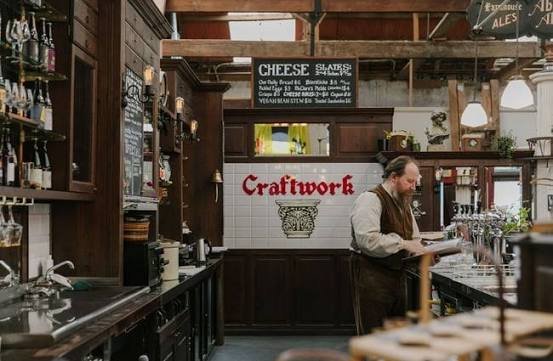
Craftwork’s tasting room is designed around the feeling of an old
Brussels café, while its physical location sits within Oamaru’s
Victorian Precinct. That combination reinforces the brewery’s old-world
inspiration.
Visitors can use the tasting room to compare styles that might
otherwise be difficult to understand from product descriptions alone. A
dry farmhouse ale, rich abbey-inspired beer and acidic barrel-aged
release become much easier to distinguish when tasted in sequence.
Pairing Beer With Food
Craftwork serves food intended to accompany its drinks, and Belgian
beer is particularly flexible at the table. Carbonation and dryness can
refresh the palate, malt sweetness can echo roasted or caramelized food,
and sourness can cut through rich dishes.
Rather than following rigid pairing rules, compare intensity and
contrast. A delicate dish can be overwhelmed by a strong dark ale, while
a robust cheese may disappear beside a very light beer. Staff
recommendations are valuable because the taps and food menu change.
What Beer
Enthusiasts Can Learn From Craftwork
Craftwork Brewery is a useful case study in specialization. Instead
of maximizing the number of styles produced quickly, the brewery has
committed to techniques that can be slow, labor intensive and difficult
to scale. That approach demonstrates how a small producer can
differentiate itself through process and identity.
It also shows why ‘craft’ is more meaningful when connected to
specific practices. Small batches alone do not define quality, but
hands-on production, deliberate fermentation choices, extended aging and
a coherent style focus create a clear story that visitors can
experience.
Planning Your Visit
Responsibly
Because Craftwork serves alcoholic beverages, visitors should plan
transport responsibly and follow local alcohol laws. A tasting flight is
about comparison, not quantity. Travelers driving later should choose
non-alcoholic options or arrange a designated driver or other
transport.
Opening hours, products and tour times can change. The brewery’s
official website should be treated as the primary source for current
visitor information, while tourism listings are useful for broader
destination context.
Quick Reference Table
| Brewing element | Why it matters |
|---|---|
| Small batches | Allows focused, limited production |
| Conditioning | Creates natural carbonation in bottle or keg |
| Barrel aging | Adds time and potential wood/fermentation complexity |
| Mixed fermentation | Supports complex acidity and fermentation character |
| Spontaneous fermentation | Uses a different fermentation approach inspired by tradition |
| Long maturation | Some releases can take years before they are ready |
External Authority Links
For another overview, read our Craftwork Brewery guide for more background and visitor information.
FAQs
When did Craftwork Brewery
start?
The brewery says it began in 2014.
Who founded Craftwork
Brewery?
Its official history names Michael O’Brien and Lee-Ann Scotti as the
brewing partners.
How large is Craftwork
Brewery?
It describes itself as a nano brewery and says its current Oamaru
brew day yields around 500 litres.
Why do some Craftwork
beers take years?
Barrel aging, mixed fermentation and slow maturation can require
extended time to develop the intended flavor profile.
What is
the best source for current visitor information?
Use Craftwork Brewery’s official website for current hours, beer
availability and tour details.