
Quick answer: The forex market is open 24 hours a day, five days a week, from about 5 p.m. Eastern time on Sunday to 5 p.m. Eastern on Friday. Trading moves through four main sessions: Sydney, Tokyo, London, and New York. The busiest window is usually 8 a.m. to noon Eastern, when London and New York overlap.
Over the past 10 years, EUR/USD (euro/U.S. dollar) moved about 30% more on a typical Thursday than on a typical Tuesday, according to our analysis of daily Federal Reserve exchange rates. When you trade can shape how much currencies move.
Forex trading hours stretch around the clock during the week, but activity is far from even. The U.K., mostly London, handled about 38% of all currency trading in April 2025, and the four hours when London and New York are both open usually bring the tightest spreads and biggest moves. Other hours can be quiet, thin, and expensive to trade.
This guide to forex trading hours explains when the market opens and closes, the four trading sessions and their overlaps, where trading actually happens, the best and worst times to trade, which days move most, and how daylight saving time shifts the schedule.
When Is the Forex Market Open?
The spot forex market runs nearly nonstop from Sunday evening to Friday afternoon, U.S. time:
- Opens: about 5 p.m. Eastern time on Sunday, when trading begins in Wellington and Sydney
- Closes: about 5 p.m. Eastern time on Friday, when New York trading ends
- Daily rollover: 5 p.m. Eastern time each weekday, when the trading day officially changes and overnight financing charges are applied
Because forex trades over the counter (OTC) through a global network of banks and dealers, no single exchange sets forex trading hours. The 5 p.m. Eastern cutoff is a market convention that most dealers follow. Many U.S. dealers also pause briefly around the daily rollover for maintenance.
Currency futures follow a similar schedule. On CME Group’s Globex platform, currency futures trade from 6 p.m. to 5 p.m. Eastern time, Sunday through Friday, with a one-hour break each day.
For an overview of how the market works, see our guide to forex trading.
What Are the Four Forex Trading Sessions?
Forex trading follows the business day around the world. Traders usually divide it into four sessions named after major financial centers. Times below are approximate and based on a local business day of roughly 8 or 9 a.m. to 5 or 6 p.m.
Session | Local hours | Eastern time, early November to early March | Eastern time, April to October |
| Sydney | 9 a.m. to 6 p.m. | 5 p.m. to 2 a.m. | 7 p.m. to 4 a.m. |
| Tokyo | 9 a.m. to 6 p.m. | 7 p.m. to 4 a.m. | 8 p.m. to 5 a.m. |
| London | 8 a.m. to 5 p.m. | 3 a.m. to noon | 3 a.m. to noon |
| New York | 8 a.m. to 5 p.m. | 8 a.m. to 5 p.m. | 8 a.m. to 5 p.m. |
Session times vary slightly by source. Australia’s daylight saving time runs opposite to that of the U.S. and U.K., and Japan doesn’t use daylight saving time, so Asian session times shift in Eastern time during the year.
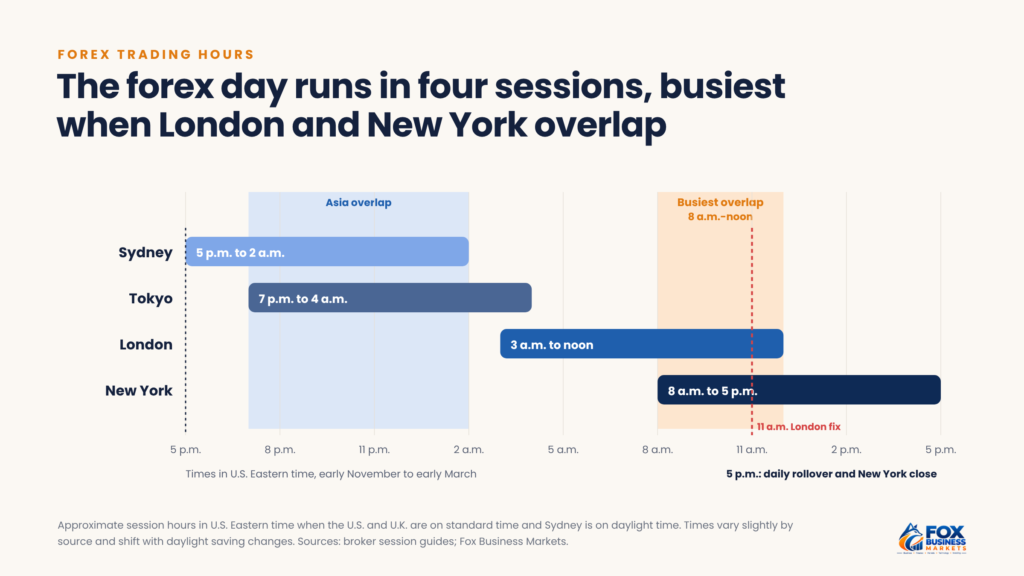
Forex trading sessions and overlaps across a 24-hour day in Eastern time
Each session has its own character:
- Sydney: The quietest session, which opens the trading week. The Australian and New Zealand dollars are most active.
- Tokyo: The main Asian session. The Japanese yen, Australian dollar, and Chinese renminbi see more trading, and USD/JPY (U.S. dollar/Japanese yen) often sees its first big moves of the day here.
- London: The largest session by far. Most major pairs, especially those with the euro, pound, and Swiss franc, see their heaviest trading.
- New York: The second-largest session. U.S. economic data and Federal Reserve news drive dollar pairs, and Canadian dollar trading picks up.
When Do Forex Sessions Overlap?
The busiest periods come when two major centers are open at once:
- London and New York, about 8 a.m. to noon Eastern time. This is the most active window of the day. The world’s two largest trading centers are both open, and major U.S. economic data comes out at 8:30 a.m. Eastern.
- Sydney and Tokyo, about 7 p.m. to 2 a.m. Eastern time in the U.S. winter months. Asian-Pacific currencies are most active, though trading is lighter than during the London–New York overlap.
- Tokyo and London, briefly around 3 to 4 a.m. Eastern time (to 5 a.m. in summer). The overlap is short, but European trading often picks up where Asian trading leaves off.
One time within the London–New York overlap stands out. At 4 p.m. London time, usually 11 a.m. Eastern, the WM/Reuters benchmark rates (now run by LSEG as WM/Refinitiv) are set. Pension funds and index funds use these rates to value currency holdings, so many large orders are executed around this time, often causing a brief spike in volume and price swings.
Where Does Forex Trading Actually Happen?
Most forex trading is concentrated in a handful of cities. In April 2025, the United Kingdom handled 37.9% of global forex turnover, according to Bank for International Settlements (BIS) data compiled by the Banque de France. The United States followed at 18.7%.
Trading center | Share of global turnover, 2025 | Share in 2022 | Main session |
| United Kingdom | 37.9% | 38.1% | London |
| United States | 18.7% | 19.4% | New York |
| Singapore | 11.9% | 9.4% | Tokyo/Asia |
| Hong Kong | 7.1% | 7.0% | Tokyo/Asia |
| Japan | 3.5% | 4.4% | Tokyo/Asia |
| Germany | 3.1% | 1.9% | London |
| Switzerland | 3.0% | 3.5% | London |
| France | 1.9% | 2.2% | London |
| China | 1.9% | 1.6% | Tokyo/Asia |
| Canada | 1.9% | 1.7% | New York |
Shares of gross turnover reported by each trading center, April of each year. Source: BIS Triennial Central Bank Survey 2025, via Banque de France.
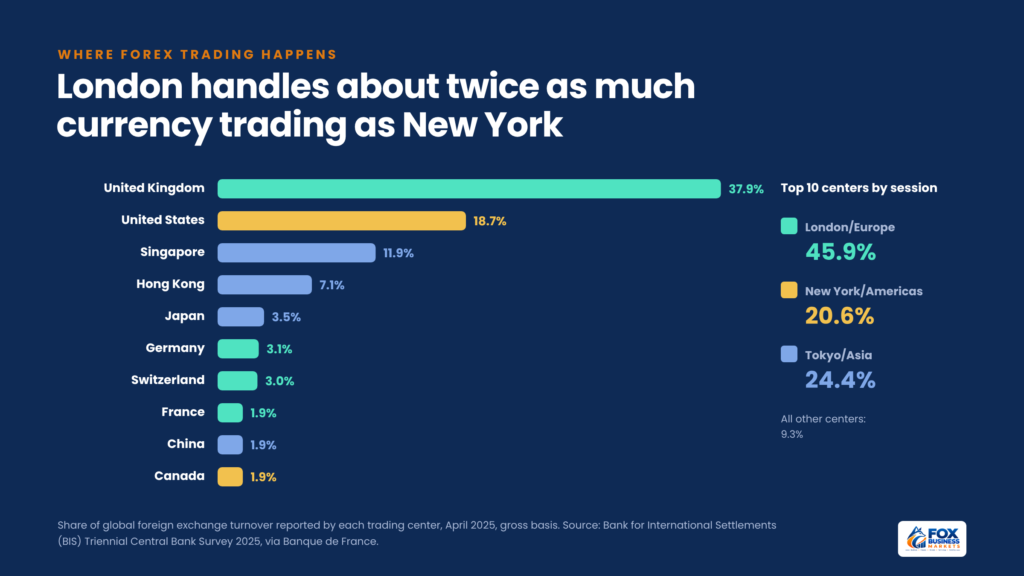
Share of global forex trading by trading center and session in 2025
Two trends stand out. Singapore gained the most ground, with trading up 60% from 2022, cementing it as Asia’s largest forex hub. Japan’s share slipped even as its turnover held steady, because trading grew much faster elsewhere.
The concentration in London explains why the London session is the busiest and why so many pairs see their biggest moves during European hours.
What Is the Best Time to Trade Forex?
For most traders, the best time to trade is when the pairs they follow are most active. More trading usually means tighter spreads and smoother price moves.
- Major dollar pairs: The London–New York overlap, 8 a.m. to noon Eastern, typically offers the most activity for EUR/USD, GBP/USD (British pound/U.S. dollar), USD/CHF (U.S. dollar/Swiss franc), and USD/CAD (U.S. dollar/Canadian dollar).
- Euro and pound crosses: The London session, starting around 3 a.m. Eastern.
- Yen pairs: The Tokyo session and the London open. USD/JPY also moves sharply around U.S. data releases.
- Australian and New Zealand dollars: The Sydney and Tokyo sessions, and during Australian data releases.
Scheduled news often sets the timing of the day’s biggest moves. Common release times, in Eastern time:
Event | Usual release time (Eastern) |
| Major U.S. economic data, including jobs and inflation reports | 8:30 a.m. |
| Canadian jobs and inflation data | 8:30 a.m. |
| Federal Reserve rate decisions | 2 p.m. |
| European Central Bank rate decisions | 8:15 a.m. |
| Bank of England rate decisions | 7 a.m. (noon in London) |
| Reserve Bank of Australia rate decisions | 2:30 p.m. in Sydney: 10:30 p.m. the night before from November to March, 12:30 a.m. from April to early October |
| Bank of Japan decisions | No fixed time, usually around midday in Tokyo (late evening Eastern) |
Times can shift by an hour or more when daylight saving time doesn’t line up between countries.
Spreads can widen sharply in the seconds around these releases. Our list of major news events traders watch explains what each report measures.
Which Days of the Week Move the Most?
To see how activity changes through the week, we measured how much four major pairs, EUR/USD, GBP/USD, USD/JPY, and AUD/USD (Australian dollar/U.S. dollar), moved each weekday from November 2016 to November 2026, using daily Federal Reserve noon rates in New York.
Pair | Monday | Tuesday | Wednesday | Thursday | Friday |
| EUR/USD | 0.32% | 0.30% | 0.32% | 0.38% | 0.33% |
| GBP/USD | 0.38% | 0.37% | 0.36% | 0.44% | 0.42% |
| USD/JPY | 0.38% | 0.35% | 0.38% | 0.45% | 0.40% |
| AUD/USD | 0.42% | 0.45% | 0.43% | 0.51% | 0.47% |
Average absolute change from the previous trading day’s noon rate. Monday compares with the previous Friday. Source: Federal Reserve H.10 data via the St. Louis Fed’s Federal Reserve Economic Data (FRED); Fox Business Markets analysis.
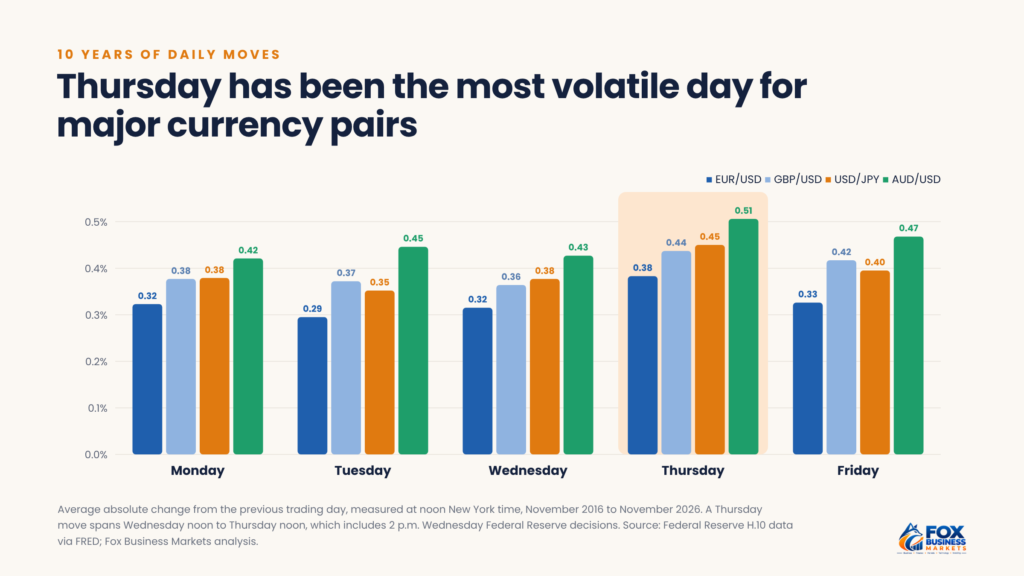
Average daily move of major currency pairs by day of the week, 2016 to 2026
Thursday was the most volatile day for all four pairs. EUR/USD moved more than 0.75% on 11.7% of Thursdays, compared with 6.4% of Tuesdays.
Timing may explain part of the gap. Because the data measure noon-to-noon changes, a “Thursday” move includes Wednesday afternoon, when the Federal Reserve announces its rate decisions at 2 p.m. Eastern on eight Wednesdays a year, and Thursday morning, when the European Central Bank usually announces its decisions. Fridays rank second for all four pairs, partly because the U.S. jobs report usually comes out on the first Friday of the month.
Tuesday was the calmest day for EUR/USD and USD/JPY. Monday, which includes the weekend gap, was the calmest day for AUD/USD and middle of the pack for the other three pairs.
These figures are averages of past daily moves, not a forecast. Because the Fed publishes one noon rate a day, the data can’t show which hours drove a move or how far prices swung within a day. They cover four pairs over one 10-year period, and a few big-news days can lift a weekday’s average.
When Should You Avoid Trading Forex?
Some periods carry higher costs or extra risk:
- Around the daily rollover: Spreads often widen around 5 p.m. Eastern, when liquidity briefly thins as the trading day changes.
- Late Friday: Activity fades after London closes, and positions held over the weekend face gap risk when trading resumes Sunday evening.
- Sunday evening open: Early trading is thin, and prices may open well away from Friday’s close if major news broke over the weekend.
- Holidays: Liquidity drops on major holidays. Most of the market is effectively closed on Christmas Day and New Year’s Day, and U.S. holidays such as Thanksgiving, which falls on Nov. 26 in 2026, thin out New York trading. Japan’s Golden Week holidays in late April and early May affect yen trading.
- Just before and after major news: Spreads can widen sharply, and orders can fill at worse prices than expected, an effect called slippage.
What Are Forex Trading Hours Around the 2026–27 Holidays?
Year-end holidays bring the thinnest trading of the year. The market rarely shuts completely, but most banks close, and many dealers shorten their hours or widen spreads. Typical patterns for the coming holidays:
Holiday | Date | What to expect |
| Thanksgiving | Thursday, Nov. 26, 2026 | U.S. banks closed; New York trading very light. Lighter trading on Friday, Nov. 27, too. |
| Christmas Eve | Thursday, Dec. 24, 2026 | Early closes at many dealers; thin trading across sessions. |
| Christmas Day | Friday, Dec. 25, 2026 | Most liquidity providers closed; many dealers halt trading. |
| New Year’s Eve | Thursday, Dec. 31, 2026 | Early closes at many dealers; thin year-end trading. |
| New Year’s Day | Friday, Jan. 1, 2027 | Most liquidity providers closed; many dealers halt trading. |
Dealers publish their own holiday schedules, which can differ. Check yours before the holiday weeks.
Thin markets can produce sudden, outsized moves on small orders, sometimes called “flash” moves. On Jan. 3, 2019, for example, the Japanese yen jumped sharply against several currencies within minutes during a Japanese holiday, when few traders were active. Holidays also change settlement dates, which can affect rollover charges on open positions.
If you trade through the holidays, consider smaller positions, so a wider stop-loss doesn’t raise your total risk, or staying flat until normal forex trading hours resume. Stop-loss orders may not protect you in a sudden gap.
How Does Daylight Saving Time Change Forex Hours?
Daylight saving time shifts session times by an hour, and countries change their clocks on different dates. In 2026:
- United States: clocks moved forward March 8 and back Nov. 1.
- United Kingdom: clocks moved forward March 29 and back Oct. 25.
- Australia (Sydney): clocks moved back April 5 and forward Oct. 4, because its seasons are reversed.
- Japan: no daylight saving time.
For a few weeks each year, the U.S. and U.K. are out of sync. From March 8 to March 28, 2026, and from Oct. 25 to Oct. 31, 2026, London was four hours ahead of New York instead of five. During those weeks, London’s open, the 4 p.m. London fix, and the London–New York overlap all shifted by an hour in Eastern time.
In 2027, the same mismatch will run from March 14 to March 27 and from Oct. 31 to Nov. 6. Check your platform’s clock against these dates so scheduled trades and alerts don’t fire an hour off.
How Do Forex Hours Compare With Stock Market Hours?
Forex trading hours are far longer than stock market hours. The New York Stock Exchange and Nasdaq hold regular trading from 9:30 a.m. to 4 p.m. Eastern time, Monday through Friday, plus extended sessions before and after. Forex runs roughly 120 hours a week, almost four times as long as regular stock trading.
The longer schedule gives forex traders more flexibility, especially those with day jobs. Both exchanges are now moving toward near-round-the-clock weekday trading, with Nasdaq planning to start in December 2026. The longer forex schedule also means currency prices can move sharply while you sleep. Stock traders can read more about trading sessions and extended hours in our guide to how to buy stocks.
Is It a Myth That the Forex Market Never Sleeps?
Partly. Forex is open 24 hours a day on weekdays, but that doesn’t mean every hour is equally good for trading.
Activity drops sharply in the hours after New York closes and before Tokyo gets busy, and on weekends the main market closes entirely. During thin periods, spreads widen, small orders can move prices, and stop-loss orders are more likely to fill at worse prices. The 24-hour schedule is useful for flexibility, but it can also tempt traders to trade too often and at poor times.
Longer forex trading hours also don’t change the risks of leverage. A position held over the weekend can lose far more than expected if prices gap. Our guide to forex leverage shows how quickly small moves add up.
How Can You Build a Trading Schedule Around the Sessions?
A schedule that fits both the market and your life helps you trade more consistently:
- Pick your pairs first. Choose pairs that are active when you’re available. Our guide to currency pairs explains how they differ.
- Find your best window. For U.S. traders with morning availability, the London–New York overlap is usually the most active window. Evening traders may prefer Asian session pairs.
- Mark the calendar. Note the times of central bank decisions and major data releases for your currencies each week.
- Avoid the thin hours. Skip the minutes around the 5 p.m. rollover, and trade lightly or not at all on major holidays.
- Set a stop time. Decide when your trading day ends, and close or protect open positions before you step away.
- Account for daylight saving shifts. Update alerts and routines during the weeks when U.S. and U.K. clocks don’t match.
- Use your platform’s tools. Platforms such as MetaTrader can display session times and set price alerts, and a written trading routine keeps you consistent.
Frequently Asked Questions
What time does the forex market open in Central and Pacific time?
The week opens at about 4 p.m. Central time and 2 p.m. Pacific time on Sunday, and closes at those same times on Friday. The London–New York overlap runs from about 7 to 11 a.m. Central time and 5 to 9 a.m. Pacific time. Tip: Set your trading platform or a world clock to Eastern time to avoid conversion mistakes.
Why does my trading platform show a different time?
Many platforms, including MetaTrader, display server time rather than your local time. Many brokers set their servers to GMT+2 in winter and GMT+3 in summer, seven hours ahead of New York, so each trading day starts at midnight on the chart. Tip: Check your broker’s server time zone before reading chart times or setting alerts.
What is the Asian session range?
The Asian session range is the high and low price a pair reaches during the quieter Tokyo session. Some traders watch whether the price breaks above or below that range once London opens. Tip: Treat any range-based strategy as a hypothesis, and test it on a demo account before using real money.
Do currency ETFs trade during forex hours?
No. Currency exchange-traded funds (ETFs) trade on stock exchanges, mainly from 9:30 a.m. to 4 p.m. Eastern, so their prices can’t react to overnight currency moves until the next session. Tip: Check an ETF’s premium or discount to its net asset value before trading at the open.
Plan Your Trading Around the Market’s Busiest Hours
Forex trading hours cover almost the whole week, but activity is highest and spreads are usually tightest in a few hours. The London–New York overlap, scheduled central bank decisions, and major data releases account for much of the action, while late Friday, holidays, and the daily rollover often bring thin trading and wider spreads.
Choose pairs that fit your schedule, mark the key release times, adjust for daylight saving shifts, and trade only when you can watch your positions and manage your risk.
This article is for general information only and isn’t financial, tax, legal, or investment advice. Consider your own situation or talk to a qualified professional before making decisions.

