Free Freight Cost Calculator: Calculate CBM, Dimensional Weight & Shipping Costs
International freight carriers do not invoice international cargo solely on gross scale weight. Carriers determine billable shipping rates using Chargeable Weight—billing on whichever metric is greater: actual deadweight or Volumetric (Dimensional) Weight. Bulky, low-density cargo consumes precious aircraft and container space, causing unexpected freight invoice spikes for unprepared shippers. Our free freight cost calculator computes total Cubic Meters (CBM), cubic feet, volumetric weight across standard IATA air and ocean freight divisors, and total estimated freight costs across metric and imperial measurements.
Who it's for: Logistics coordinators, warehouse dispatch managers, import/export operations specialists, e-commerce brand founders, and procurement teams optimizing packaging density and cross-border container loads.
Why use it:
- Avoid Carrier Dimensional Weight Penalties: Determine whether air express couriers (DHL, FedEx, UPS) will bill your cargo on physical weight or dimensional space using standard 5000/6000 divisors.
- Accurately Audit Ocean LCL CBM Charges: Calculate exact ocean freight revenue tons (w/m) to prevent unexpected ocean freight carrier consolidator surcharges.
- Optimize Packaging Dimensions: Identify how shaving a few centimeters or inches off master carton dimensions slashes chargeable shipping weight across thousands of units.
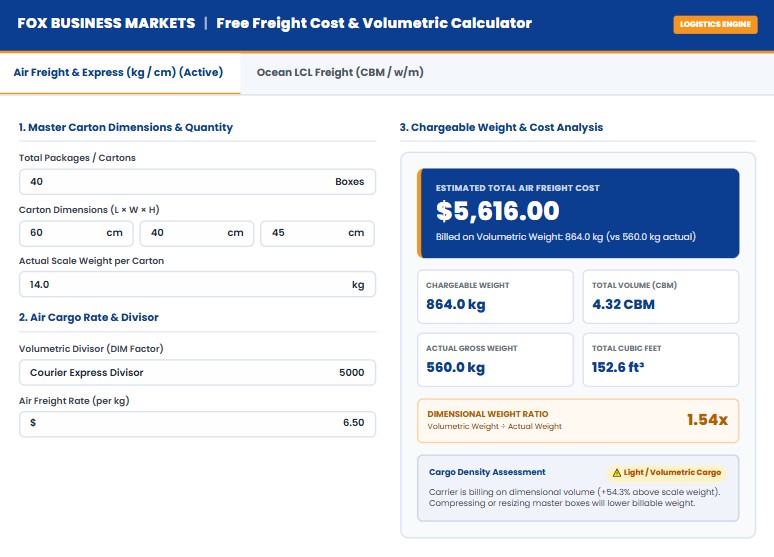
Your cargo is being billed on dimensional volume, adding +54.3% to your freight charges over actual scale weight. Optimizing master box space will immediately reduce costs.
How to Use the Free Freight Cost & Volumetric Calculator
International shipping lines and commercial air cargo carriers bill on whichever metric generates higher revenue: physical gross deadweight or volumetric (dimensional) space. Follow these steps to audit your chargeable weight and transport expenses:
- Select Your Freight Transportation Mode: Choose the Air Freight & Express (kg / cm) tab when shipping via air cargo lines, express couriers (DHL, FedEx, UPS), or air freight forwarders. Switch to the Ocean LCL Freight (CBM / w/m) tab when booking Less-than-Container Load ocean shipments.
- Enter Master Carton Quantity & Dimensions: Input the total number of cartons in the shipment alongside length, width, and height in centimeters (cm).
- Input Actual Deadweight per Package: Enter the physical scale weight per box in kilograms (kg) including inner packaging, protective foam, and external corrugated cardboard.
- Select Your Volumetric Divisor (Air Cargo): Select the 5000 divisor for express courier door-to-door shipments or the 6000 divisor for standard IATA commercial airline cargo.
- Set Carrier Freight Rates: Input quoted freight rates per chargeable kilogram ($/kg for air) or per cubic meter/revenue ton ($/CBM for ocean LCL) using the multi-currency selector in the top bar.
- Analyze Billable Chargeable Weight: Inspect your Chargeable Weight, Total Volume (CBM), and Dimensional Weight Ratio to determine whether carrier dimensional penalties apply.
How It Works & Core Mathematical Formulas
Commercial cargo aircraft and ocean transport vessels operate under dual physical constraints: total lift payload capacity (weight) and total cargo hold volume (cube). International logistics bodies (such as IATA) establish standardized dimensional divisors so light, bulky packages pay for the displacement space they occupy.
Volume per Carton (CBM) = [Length (cm) × Width (cm) × Height (cm)] / 1,000,000
Total Shipment Volume (CBM) = Volume per Carton × Total Packages
Total Volume in Cubic Feet (CFT) = Total CBM × 35.3147
2. Air Freight Volumetric & Chargeable Weight:
Volumetric Weight per Carton (kg) = [Length (cm) × Width (cm) × Height (cm)] / Divisor (5000 or 6000)
Total Volumetric Weight (kg) = Volumetric Weight per Carton × Total Packages
Total Actual Gross Weight (kg) = Scale Weight per Carton × Total Packages
Air Chargeable Weight (kg) = Maximum (Total Actual Weight, Total Volumetric Weight)
Total Air Freight Cost = Air Chargeable Weight × Carrier Rate per kg
3. Ocean LCL Weight / Measurement (w/m) Rule:
Actual Weight in Metric Tons (MT) = Total Actual Weight (kg) / 1,000
Ocean Revenue Tons (RT) = Maximum [Total CBM, Actual Weight in MT]
Ocean Chargeable Volume = Maximum [Ocean Revenue Tons, Carrier Minimum CBM Threshold]
Total Ocean LCL Cost = Ocean Chargeable Volume × Ocean Rate per CBM/RT
Fully Worked Numerical Example
Consider an e-commerce enterprise importing 40 master cartons of lightweight lifestyle goods via international air express courier from an overseas manufacturer.
Air Freight Logistics Case Study: Bulky Consumer Goods Shipment
- Total Carton Count: 40 master boxes
- Carton Dimensions: 60 cm (L) × 40 cm (W) × 45 cm (H)
- Scale Weight per Carton: 14.0 kg (Total deadweight = 560.0 kg)
- Courier Volumetric Divisor: 5000 (Express standard)
- Carrier Quoted Air Rate: $6.50 per chargeable kg
Step-by-Step Mathematical Execution:
- Calculate Volume per Carton: (60 × 40 × 45) / 1,000,000 = 0.108 CBM
- Calculate Total Shipment CBM: 0.108 CBM × 40 cartons = 4.32 CBM (152.56 ft³)
- Calculate Volumetric Weight per Carton: (60 × 40 × 45) / 5000 = 21.6 kg
- Calculate Total Volumetric Weight: 21.6 kg × 40 cartons = 864.0 kg
- Determine Chargeable Weight: Maximum (560.0 kg Actual vs. 864.0 kg Volumetric) = 864.0 kg (Billed on Volume)
- Calculate Total Air Freight Invoice: 864.0 kg × $6.50 = $5,616.00
- Calculate Volumetric Cost Penalty: ($5,616.00 billed) - (560.0 kg × $6.50 = $3,640.00 scale cost) = +$1,976.00 penalty (+54.3%)
Strategic Logistics Takeaway: Because the cargo density is light relative to box dimensions, the carrier bills on 864.0 kg rather than 560.0 kg, creating an unbudgeted $1,976.00 penalty. Reducing master carton height by just 10 cm would eliminate 192 kg of billable air freight volume, immediately saving $1,248.00 on a single dispatch.
Industry Benchmarks Comparison Table
Standard volumetric conversion factors, density benchmarks, and billable thresholds vary across international transport modes:
| Transport Mode | Standard Divisor | Density Threshold | Typical Rate Unit | Billing Logic |
|---|---|---|---|---|
| Air Express (DHL, FedEx, UPS) | 5,000 cm³/kg | 200 kg / CBM | Per kg ($4.00 – $10.00+) | Higher of Scale Wt vs. Dim Wt |
| IATA Commercial Air Cargo | 6,000 cm³/kg | 167 kg / CBM | Per kg ($2.50 – $6.50) | Higher of Scale Wt vs. Dim Wt |
| Ocean LCL (Consolidation) | 1,000 kg / CBM | 1,000 kg / CBM (1 MT) | Per CBM ($80 – $220) | Weight / Measurement (w/m Rule) |
| Domestic Road LTL (North America) | Freight Class / PCF | Pounds / ft³ (PCF) | Class 50 to Class 500 | Density & Stowability Classification |
| European Road Freight (CMR) | 3,000 – 4,000 cm³/kg | 250 – 333 kg / CBM | Per kg / Loading Meter (LDM) | 1 LDM = 1,750 – 1,850 kg |
Where to Find Your Numbers
Accurately calculating chargeable freight weight requires collecting verified packaging specifications from manufacturing and freight partner documents:
- Master Carton Dimensions & Gross Weight: Found on your supplier's Packing List (P/L) or Commercial Invoice. Compare total shipping cost allocations against factory prices using our Export Cost Calculator.
- Carrier Volumetric Divisors: Express couriers publish their divisor (almost universally 5000 cm³/kg or 139 in³/lb) in standard service guides, while commercial airlines follow IATA standard 6000 rules.
- All-In Freight Rates: Sourced from freight forwarder spot quotes or annual contract tariffs. Combine freight charges with destination tariffs using our Landed Cost Calculator.
- Container Utilization Targets: Standard 20ft ocean containers hold approximately 28 to 30 usable CBM, while 40ft High Cube containers accommodate 68 to 72 usable CBM.
- Cross-Border Margin Allocation: Evaluate the impact of logistics surcharges on final product profitability with our International Pricing Calculator.
What This Calculator Can and Cannot Tell You
What This Calculator Can Tell You:
- Whether your shipment will be penalized by carrier dimensional weight surcharges before booking transport.
- The exact billable weight (chargeable kg or ocean revenue tons) to audit carrier logistics invoices against billing errors.
- How much packaging redesign and carton nesting will save in bottom-line cross-border freight costs.
What This Calculator Cannot Tell You:
- Accessorial & Fuel Surcharges: Base air and ocean rates exclude fluctuating bunker adjustment factors (BAF), security surcharges, and emergency peak season surcharges (PSS).
- Pallet Overhang & Bulge Expansion: Packed cardboard cartons often bulge 1 to 2 cm under compression or strap tension, increasing actual laser-scanned carrier dimensions. Monitor working capital buffers with our Working Capital Calculator.
- Customs Duties and Port Drayage: Ocean and air freight covers line-haul transit only. Terminal handling, customs brokerage, and tariffs must be calculated via our Landed Cost Calculator.
Related Guides and Calculators
International freight optimization connects supply chain costing, inventory turnover, and commercial trade profitability. Explore these related business calculators:
Frequently Asked Questions (FAQ)
Actual Weight (Gross Deadweight) is the physical weight of your shipment placed on a certified scale. Volumetric Weight (Dimensional Weight) is a calculated figure representing the package's cubic space based on carrier density formulas ($L \times W \times H / Divisor$). Chargeable Weight is simply whichever of the two values is higher—and is the exact number the carrier uses to calculate your bill.
The 5000 divisor corresponds to a higher density requirement ($200\ kg\ per\ CBM$) used by dedicated express courier networks (DHL, FedEx, UPS) operating dedicated freighter fleets with automated sortation hubs. The 6000 divisor ($167\ kg\ per\ CBM$) is the traditional International Air Transport Association (IATA) commercial airline standard, reflecting belly-hold capacity on widebody passenger aircraft. A lower divisor increases billable weight.
In ocean Less-than-Container Load (LCL) consolidation, freight forwarders charge on a Weight or Measurement (w/m) basis. Under maritime standards, 1 Cubic Meter (CBM) equals 1,000 kilograms (1 Metric Ton). If a 3 CBM shipment weighs 500 kg, you pay for 3 CBM. If a 3 CBM shipment weighs 4,000 kg (4 MT), you pay for 4 Revenue Tons (RT).
Placing cartons on wooden or plastic pallets increases both dimensions and deadweight. Standard shipping pallets add approximately 15 to 20 kg of tare weight and 12 to 15 cm of height. Because carriers measure from the bottom of the pallet to the highest peak of the cargo, failure to account for pallet dimensions leads to unexpected chargeable weight inflation.
To eliminate volumetric penalties, shippers should eliminate void air space inside master cartons, transition to custom-fit packaging, vacuum-pack compressible soft goods (apparel and textiles), and design product packaging specifically to maximize container space utilization. Shaving 2 to 3 cm off master carton dimensions can reduce annual cross-border air freight expenditure by 15% to 30%.
The Bottom Line & Authoritative References
Mastering volumetric weight and cubic displacement calculation is essential for controlling cross-border shipping expenditure and preserving international unit economics. Factoring in dimensional weight formulas during product packaging design ensures goods transit through global air and ocean corridors at the lowest possible cost per unit.
Authoritative Logistics Standards & Industry Frameworks:
- International Air Transport Association (IATA): Air Cargo Tariff and Rules (TACT) - Volumetric Weight Standards
- Federal Maritime Commission (FMC): Ocean Freight Rate Tariffs and LCL Consolidation Rules
- International Federation of Freight Forwarders Associations (FIATA): Freight Forwarding Logistics Procedures Manual
- Council of Supply Chain Management Professionals (CSCMP): Supply Chain and Logistics Management Terms and Glossary