Quick answer: Financial statements are three core reports that show a business’s financial health. The income statement shows profit over a period, the balance sheet shows what you own and owe on one date, and the cash flow statement shows where cash came from and went. Review all three monthly, because each one reveals problems the others miss.
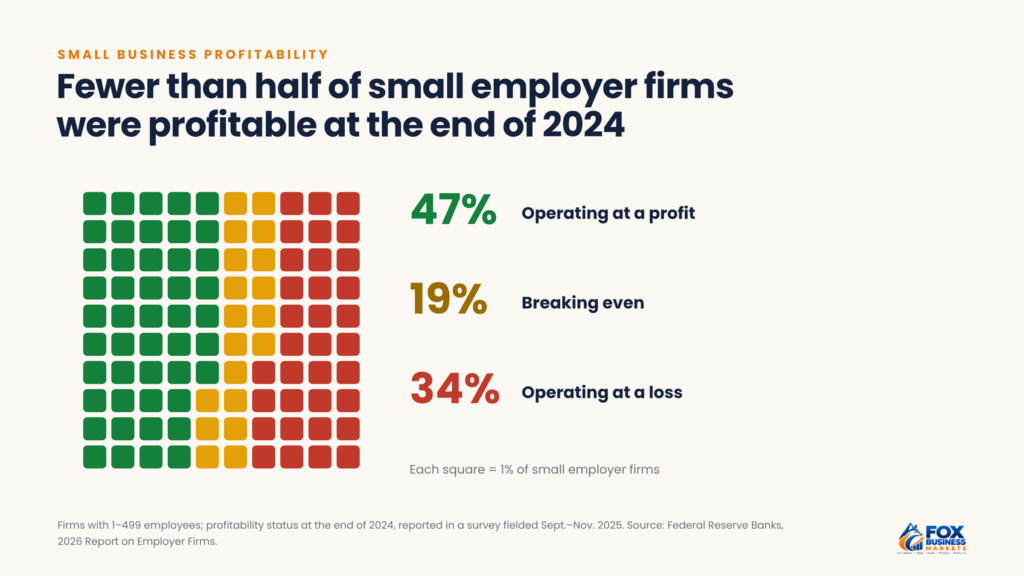
Only 47% of small employer firms were operating at a profit at the end of 2024, according to the Federal Reserve’s 2026 Report on Employer Firms. Another 19% were breaking even, and 34% were losing money.
It’s tempting to judge a business by its bank balance. A healthy balance can hide a shrinking margin, a pile of unpaid customer invoices, or a loan payment due next week. A thin balance can belong to a business that’s profitable but growing fast.
This guide walks through the three financial statements using one sample company’s numbers, shows how the reports connect, and explains which ratios to calculate, what lenders look for, and how to produce reliable statements every month.
What Are Financial Statements?
Financial statements are standardized reports that summarize a business’s transactions. Most small businesses work with three:
Statement | What it shows | Time frame | Question it answers |
| Income statement (profit and loss, or P&L) | Revenue, expenses, and profit | A period, such as a month or year | Did we make money? |
| Balance sheet | Assets, liabilities, and owner’s equity | A single date | What do we own and owe? |
| Cash flow statement | Cash coming in and going out | A period | Where did the cash go? |
The Securities and Exchange Commission’s Beginners’ Guide to Financial Statements is written for investors in public companies, but the same three reports form the core of a small business’s books.
To keep the examples concrete, this guide follows Greenline Landscaping, a fictional LLC with a crew of six, through its 2025 statements. The numbers are invented but realistic for a small service business.
What Does an Income Statement Show?
The income statement, often called the P&L, lists revenue at the top and subtracts costs in layers until it reaches net income, the profit left for the period.
Greenline Landscaping income statement, year ended Dec. 31, 2025
Line | Amount |
| Revenue | $480,000 |
| Cost of goods sold (materials, crew wages) | −$264,000 |
| Gross profit | $216,000 |
| Operating expenses (rent, office salary, insurance, marketing, vehicles, other) | −$148,000 |
| Depreciation | −$20,000 |
| Operating income | $48,000 |
| Interest expense | −$6,000 |
| Net income | $42,000 |
Each layer tells you something different:
- Gross profit shows whether your pricing covers the direct cost of doing the work. Greenline keeps 45 cents of every dollar after materials and crew pay.
- Operating income shows whether the business model works once you add overhead such as rent, insurance, and office staff.
- Net income is what’s left after interest. Greenline is an LLC taxed as a pass-through, so income tax is paid on the owner’s personal return and doesn’t appear here. A C corporation would subtract its own income tax.
Depreciation is a non-cash expense: it spreads the cost of trucks and mowers over their useful lives rather than charging the full price in the year you buy them. That’s one reason profit and cash rarely match.
Read the P&L as a trend, not a single number. Compare each month with the same month last year, and watch whether expenses grow faster than revenue.
How Do You Read a Balance Sheet?
The balance sheet is a snapshot of the business on one date. It always follows the accounting equation:
Assets = Liabilities + Owner’s equity
Greenline Landscaping balance sheet, Dec. 31, 2025
Assets | Amount | Liabilities and equity | Amount |
| Cash | $38,000 | Accounts payable | $18,000 |
| Accounts receivable | $52,000 | Credit card balance | $7,000 |
| Supplies inventory | $10,000 | Accrued payroll | $10,000 |
| Current portion of loan | $15,000 | ||
| Current assets | $100,000 | Current liabilities | $50,000 |
| Equipment and trucks (net of depreciation) | $140,000 | Long-term loan | $70,000 |
| Total liabilities | $120,000 | ||
| Owner’s equity | $120,000 | ||
| Total assets | $240,000 | Total liabilities and equity | $240,000 |
A few terms to know:
- Current assets are cash or items expected to turn into cash or be used up within a year, such as accounts receivable (money customers owe you).
- Current liabilities are bills due within a year, including the part of a long-term loan due in the next 12 months.
- Owner’s equity is what would be left for the owner if the business sold its assets at book value and paid off every debt. It grows with profit and owner contributions and shrinks with losses and owner withdrawals.
Greenline’s $52,000 in receivables is more than its $38,000 in cash, and it grew by $14,000 during the year. That’s money the business has earned but can’t spend yet. Our guide to cash flow management covers ways to collect faster.
What Does the Cash Flow Statement Tell You?
The cash flow statement explains why your cash balance changed. It sorts every cash movement into three groups:
- Operating activities: cash from running the business, such as collecting from customers and paying suppliers and staff.
- Investing activities: buying or selling long-term assets, such as equipment or vehicles.
- Financing activities: borrowing, repaying loans, owner contributions, and owner withdrawals.
Most small businesses use the indirect method, which starts with net income and adjusts for items that didn’t move cash.
Greenline Landscaping cash flow statement, 2025
Line | Amount |
| Net income | $42,000 |
| Add back depreciation | +$20,000 |
| Increase in accounts receivable | −$14,000 |
| Increase in supplies inventory | −$2,000 |
| Increase in accounts payable | +$4,000 |
| Cash from operations | $50,000 |
| Purchase of a new truck | −$35,000 |
| Cash from investing | −$35,000 |
| Loan principal repaid | −$15,000 |
| Owner draws | −$30,000 |
| Cash from financing | −$45,000 |
| Net change in cash | −$30,000 |
| Cash at start of year | $68,000 |
| Cash at end of year | $38,000 |
Accrued payroll and the credit card balance were unchanged from the prior year, so they don’t appear as adjustments.
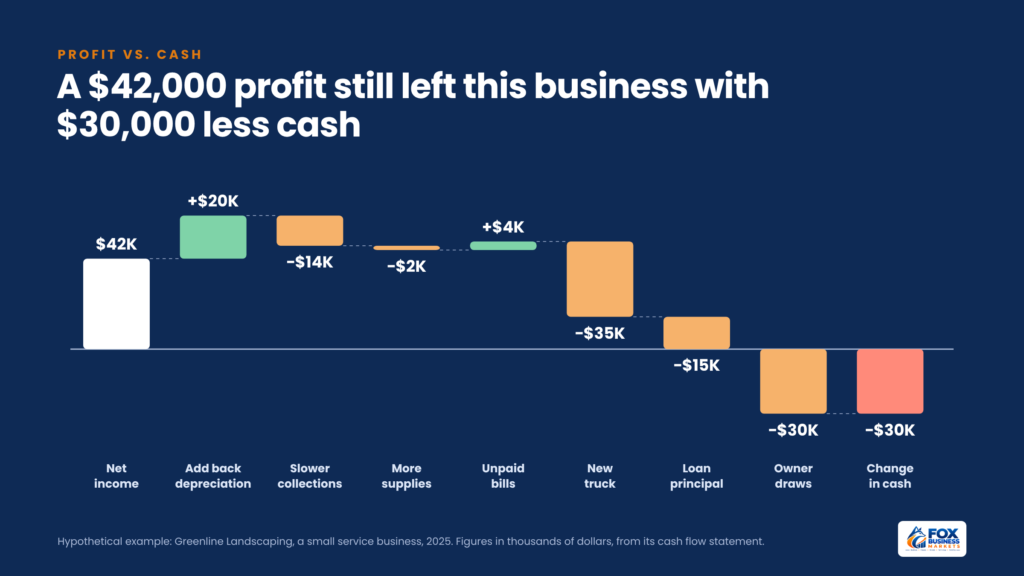
Greenline earned $42,000 in profit, yet its bank balance fell by $30,000. The truck, loan payments, owner draws, and slower customer payments explain the gap. Without this statement, the owner would see a profitable year and a shrinking bank account and have no clear idea why.
Watch cash from operations closely. A business that consistently produces cash from its core work can fund equipment and debt payments; one that borrows to cover day-to-day costs will eventually run out of lenders.
How Do the Three Statements Connect?
The three statements share numbers, which is how accountants check that the books are complete:
- Net income from the income statement is the first line of the cash flow statement under the indirect method.
- Net income also flows into owner’s equity on the balance sheet. Greenline started 2025 with $108,000 in equity, added $42,000 of profit, and subtracted $30,000 in draws to end at $120,000.
- Ending cash on the cash flow statement must equal cash on the balance sheet: $38,000.
- Changes in balance sheet accounts, such as receivables, inventory, and payables, become the adjustments in the operating section of the cash flow statement.
If any of these links don’t tie out, something is missing or misclassified in the books. Good accounting software keeps them in sync automatically, as long as every transaction is recorded and categorized.
Each statement also feeds the rest of your financial planning. Our small business finance guide shows how the statements fit with bookkeeping, budgeting, and funding.
Are Financial Statements Only for Big Companies?
No. Many owners assume formal statements are only for public companies or loan applications, but the statements are the only reliable way to answer everyday questions:
- Can I afford to hire another person?
- Should I raise prices, or are costs the problem?
- Why is the account low when we had a record month?
- How much can I safely take out of the business?
A small business doesn’t need audited statements or a finance team to get these answers. It needs accurate books and the three reports your accounting software already produces. For the 19% of firms at break-even in the Fed survey, a two- or three-point change in margin can be the difference between a loss and a profit.
There’s also a tax link. The figures on your business tax return come from the same books (see how taxes work for the basics). Corporations report a balance sheet to the IRS on Schedule L unless their total receipts and total assets are both under $250,000; partnerships have a similar test with a $1 million asset limit. Sole proprietors and single-member LLCs filing Schedule C don’t file a balance sheet, but clean statements still make tax season faster and cheaper.
Which Ratios Should You Calculate From Your Statements?
Ratios turn raw numbers into signals you can track month to month and compare with businesses in your industry. Start with these:
Ratio | Formula | Greenline result | What it tells you |
| Gross margin | Gross profit ÷ Revenue | 45% | Whether prices cover direct costs |
| Net profit margin | Net income ÷ Revenue | 8.8% | How much of each sales dollar you keep |
| Current ratio | Current assets ÷ Current liabilities | 2.0 | Ability to pay bills due within a year |
| Quick ratio | (Cash + Receivables) ÷ Current liabilities | 1.8 | Same, without counting inventory |
| Debt-to-equity | Total liabilities ÷ Owner’s equity | 1.0 | How much the business relies on borrowed money |
| Days sales outstanding | Receivables ÷ Revenue × 365 | 40 days | How long customers take to pay |
A current ratio below 1.0 means current liabilities exceed current assets, a warning sign that the business may struggle to pay bills on time. Greenline’s 2.0 is comfortable, but its 40-day collection period is long for a business that bills on completion, and the $14,000 rise in receivables tied up cash that could have covered almost half of the year’s owner draws.
Healthy ranges vary widely by industry. A restaurant might run a gross margin far below a consulting firm’s and still be well managed. Industry associations, your accountant, and lenders who serve your field can tell you what’s typical.
What Do Lenders Look for in Your Financial Statements?
When you apply for a business loan or line of credit, lenders typically ask for:
- Business tax returns, often for the past two or three years.
- A recent year-to-date income statement and balance sheet, often no more than 90 to 180 days old.
- Business bank statements, often for the past several months.
- An accounts receivable and accounts payable aging report.
- A debt schedule listing current loans, balances, and payments.
- Personal tax returns and a personal financial statement from each major owner.
They read the statements for the same signals you should: steady revenue, positive cash from operations, enough cash flow to cover loan payments, and manageable existing debt.
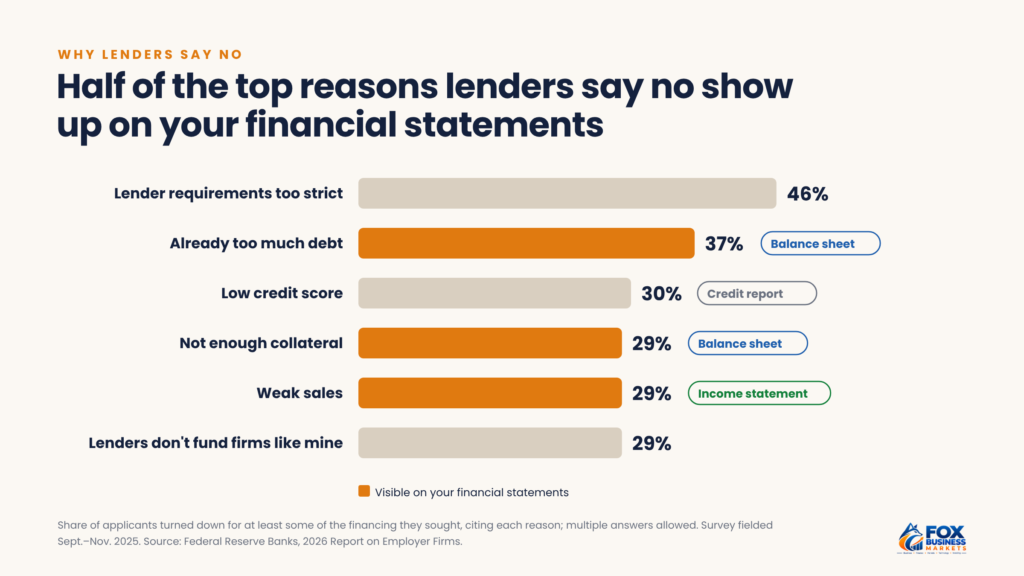
The reasons lenders turn down small businesses line up closely with what the statements show. Among applicants in the Fed survey that were turned down for at least some of the financing they sought, the most common reasons were strict lender requirements (46%), too much existing debt (37%), a low credit score (30%), and, at 29% each, insufficient collateral, weak sales, and lenders not financing businesses like theirs. Among owners who didn’t apply because they expected to be turned down, 63% pointed to weak business financials.
Three of those reasons appear directly on your financial statements: existing debt and available collateral on the balance sheet, and sales on the income statement. For more data on how often small firms borrow and get approved, see our business finance statistics. Reviewing the statements before you apply lets you fix what you can, such as paying down a credit card balance or waiting for a stronger quarter. Our guides to small business loans and business credit cover the rest of the approval picture.
How Do You Prepare Financial Statements?
Most small businesses produce statements from accounting software rather than building them by hand. The work is in the inputs:
- Record every transaction. Connect your business bank and credit card accounts to the software, and categorize transactions at least weekly.
- Use a consistent chart of accounts. Keep cost of goods sold separate from operating expenses so gross margin means something.
- Choose cash or accrual accounting. Accrual statements record income when earned and expenses when incurred, which gives a truer picture of profit. Cash-basis statements are simpler but can swing with the timing of payments.
- Reconcile accounts monthly. Match the software to bank, credit card, and loan statements so balances are correct.
- Record month-end adjustments. Include depreciation, accrued payroll, and prepaid expenses such as annual insurance.
- Run and review the reports. Generate the income statement, balance sheet, and cash flow statement for the month and year to date, and compare them with the budget and the prior year.
U.S. public companies must follow generally accepted accounting principles (GAAP). Many private small businesses instead use a cash, modified-cash, or tax basis, which CPAs call special purpose frameworks. These are common for small loans, but some lenders and loan agreements require GAAP, so check before you choose, use the same method consistently, and label it on the statements.
Do You Need Compiled, Reviewed, or Audited Statements?
When a lender, investor, or buyer wants outside assurance on your statements, a CPA firm can provide three levels of service:
Level | What the CPA does | Assurance | When it’s typically requested |
| Compilation | Assembles statements from your records without verifying them | None | Smaller loans, internal use |
| Review | Asks questions and runs analytical procedures | Limited | Mid-size loans and lines of credit |
| Audit | Tests records, confirms balances with third parties, and studies internal controls (without giving an opinion on them) | Reasonable (highest) | Large loans, outside investors, selling the business |
Each level costs more and takes longer than the one before it. Most very small businesses never need an audit. Ask your lender which level its loan requires before you hire a firm.
What Mistakes Make Financial Statements Unreliable?
Statements are only as good as the bookkeeping behind them. Watch for these common problems:
- Mixing personal and business spending. Personal charges inflate expenses and distort profit.
- Recording loan payments as expenses. Only the interest is an expense; the principal reduces the loan balance on the balance sheet.
- Expensing equipment purchases that should be recorded as assets and depreciated, which understates profit in the purchase year.
- Ignoring owner draws or recording them as wages in a sole proprietorship or partnership.
- Leaving an “uncategorized” or “ask my accountant” account with a large balance.
- Skipping reconciliations, so duplicate or missing transactions go unnoticed.
- Reviewing only once a year at tax time, when it’s too late to change the year’s results.
A quick monthly review catches most of these before they compound. If the books feel unreliable, hire a bookkeeper to clean them up before you use them to price jobs or apply for credit.
Frequently Asked Questions
What is a pro forma financial statement?
A pro forma statement is a projected income statement, balance sheet, or cash flow statement showing how the business would look under assumptions, such as a new location, a large contract, or a loan. Lenders often ask for one with a business plan. Build it from your actual statements and list every assumption on a separate page so a reader can test them.
What’s the difference between a business and a personal financial statement?
A business financial statement covers the company’s own assets, debts, and results. A personal financial statement lists an owner’s personal assets, liabilities, and income; SBA lenders typically use SBA Form 413 for each owner of 20% or more and any guarantor, though some accept an equivalent form. Update yours once a year so it’s ready when a lender asks.
Can I prepare financial statements in a spreadsheet?
Yes, especially when the business is very small, but spreadsheets make it easy to break the links between statements with a single formula error. If you start in a spreadsheet, add a check cell that confirms total assets equal liabilities plus equity every month.
What is EBITDA, and should I track it?
EBITDA stands for earnings before interest, taxes, depreciation, and amortization. It’s a rough measure of operating earnings that is common in loan covenants and business valuations, but it ignores changes in receivables, equipment purchases, and debt payments. Greenline’s EBITDA would be its $48,000 operating income plus $20,000 of depreciation, or $68,000, well above its $50,000 cash from operations. Calculate it once a quarter if you plan to borrow or sell the business.
Schedule a Monthly Financial Statement Review
Pick a date early each month, after your books are reconciled. Pull the income statement, balance sheet, and cash flow statement for the prior month and year to date. Calculate the six ratios in the table above, write them in a simple tracker, and note one action for the month ahead, whether that’s chasing an overdue invoice, trimming an expense, or adjusting prices.
This article is for general information only and isn’t financial, tax, legal, or investment advice. Consider your own situation or talk to a qualified professional before making decisions.

