Quick answer: Credit card processing fees usually cost businesses about 1.5% to 3.5% of each sale. Every fee has three parts: interchange paid to the card-issuing bank, network fees paid to Visa or Mastercard, and your processor’s markup. Only the markup is negotiable, so compare pricing models and track your effective rate.
U.S. merchants paid $198.25 billion in card processing fees in 2025, about 1.6% of everything customers spent on cards, according to the Nilson Report. For many small businesses, card fees are a significant recurring expense.
Yet two sales of the same size can cost very different amounts. A $100 purchase on a big bank’s regulated debit card carries about 27 cents in interchange, while the same purchase on a premium rewards credit card can carry more than $2. The card your customer pulls out, how they pay, and the pricing model your processor uses all change what you keep.
This guide breaks down each part of a credit card processing fee, explains interchange and the main pricing models, compares published rates from popular processors, and shows how to calculate your effective rate and lower it. For how the whole payment system fits together, start with our guide to payment processing.
What Are Credit Card Processing Fees?
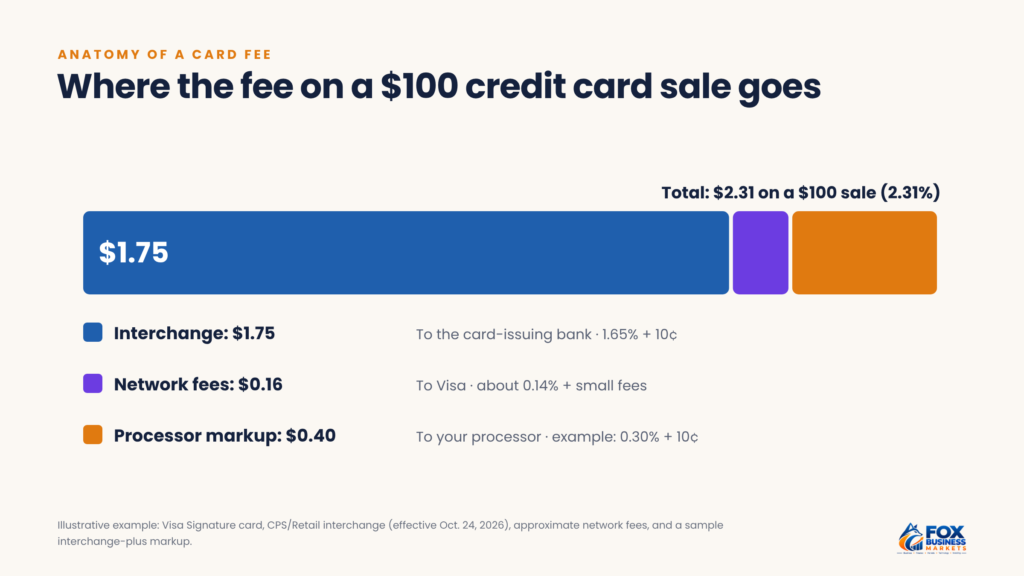
Credit card processing fees are the charges a business pays to accept card payments. Every transaction includes three layers:
Fee | Who gets it | Typical size | Negotiable? |
| Interchange | The customer’s card-issuing bank | The largest share; often 1.4% to 2.6% plus a few cents for consumer credit cards | No |
| Network (assessment) fees | Visa, Mastercard, Discover, or American Express | Roughly 0.13% to 0.15% plus small per-transaction fees | No |
| Processor markup | Your payment processor or merchant services provider | Varies widely by pricing model | Yes |
Interchange and network fees together are often called the “wholesale” cost of a card payment. Your processor adds its markup on top and bills you either as one bundled rate or line by line, depending on your pricing model.
What Is Interchange, and Why Does It Vary?
Interchange is the fee the merchant’s bank pays the cardholder’s bank on each transaction, and your processor passes it on to you. Visa and Mastercard publish hundreds of interchange categories and update them twice a year, typically in April and October. Rates depend on:
- Card type: rewards, premium, and business cards cost more than basic consumer cards. Debit cards usually cost less than credit.
- How the card is used: card-present sales (chip or tap) cost less than card-not-present sales online or by phone, because fraud risk is lower.
- Business type: your merchant category code (MCC) places you in categories such as retail, restaurant, or supermarket, each with its own rates.
- Transaction size: small-ticket categories charge lower percentages on small card-present purchases, generally $15 or less.
- Data you send: business-to-business sales that include extra details (Level 2 and Level 3 data) can qualify for lower commercial card rates.
A few examples from Visa’s U.S. interchange schedule, effective October 24, 2026:
Visa card and transaction | Interchange rate |
| Regulated debit (issuers with $10 billion or more in assets) | 0.05% + 21 cents, plus 1 cent for fraud prevention |
| Exempt debit, card present, retail | 0.80% + 15 cents |
| Exempt debit, card not present | 1.65% + 15 cents |
| Visa Signature credit, CPS/Retail | 1.65% + 10 cents |
| Visa Infinite (spend qualified), CPS/Retail | 2.30% + 10 cents |
| Restaurant credit, premium cards | 2.60% (minimum 4 cents) |
| Small ticket, traditional credit ($15 or less) | 1.90% (minimum 4 cents) |
The regulated debit rate comes from the Durbin Amendment and the Federal Reserve’s Regulation II. A federal court in North Dakota struck down the 21-cent cap in August 2025, and on October 26, 2026, the U.S. Court of Appeals for the Eighth Circuit upheld that ruling and sent the rule back to the Fed to rewrite. The appeals court didn’t set a new rate, and the existing cap stays in place until its ruling formally takes effect, or later if there are further appeals or stays. A 2023 Fed proposal to lower the cap to 14.4 cents plus 0.04% hasn’t been finalized, and a separate challenge is pending in the Sixth Circuit. For now, the 21-cent cap still applies, but debit costs could change in 2027.
What Does Your Processor Charge?
Your processor’s markup is the part you control. How it’s billed depends on your pricing model:
Pricing model | How it works | Best for | Watch out for |
| Flat-rate | One rate for most cards, such as 2.6% + 15 cents in person | New and low-volume businesses that want simplicity | You pay the same rate on cheap debit cards as on premium rewards cards |
| Interchange-plus | Actual interchange and network fees plus a fixed markup, such as 0.30% + 10 cents | Businesses with steady volume, often $10,000 a month or more | Statements are longer and harder to read |
| Tiered | Sales sorted into “qualified,” “mid-qualified,” and “non-qualified” rates | Rarely the best choice | Processors decide which tier a card falls into, and many land in costly tiers |
| Subscription (membership) | Monthly fee plus interchange at cost and a small per-transaction fee | High-volume businesses | The monthly fee can outweigh savings at low volume |
Flat-rate pricing is easy to understand, but on a mix of low-cost debit cards it often costs more than interchange-plus. Interchange-plus shows exactly what the processor earns, which makes it easier to compare offers. Tiered pricing hides the markup and is the model to avoid.
How Much Do Popular Processors Charge?
Payment facilitators publish standard flat rates. These are the headline U.S. rates reported in October 2026; confirm current pricing with each provider before you sign up:
Processor | In-person | Online | Keyed-in |
| Square (free plan) | 2.6% + 15 cents | 3.3% + 30 cents | About 3.5% + 15 cents |
| Stripe | 2.7% + 5 cents (Terminal) | 2.9% + 30 cents | About 3.4% + 30 cents |
| PayPal | 2.29% + 9 cents (Zettle reader) | 2.99% + 49 cents (card); 3.49% + 49 cents (PayPal Checkout) | Varies |
Traditional merchant service providers usually quote custom interchange-plus or tiered pricing instead, often with monthly fees. Volume discounts, custom rates, and add-on fees vary, so compare offers using your own sales history.
How Do You Calculate Your Effective Rate?
Your effective rate turns all your credit card processing fees into one number you can compare across processors:
Effective rate = total processing fees ÷ total card sales × 100
Include every charge on your statement: transaction fees, monthly fees, PCI fees, chargeback fees, and equipment rentals.
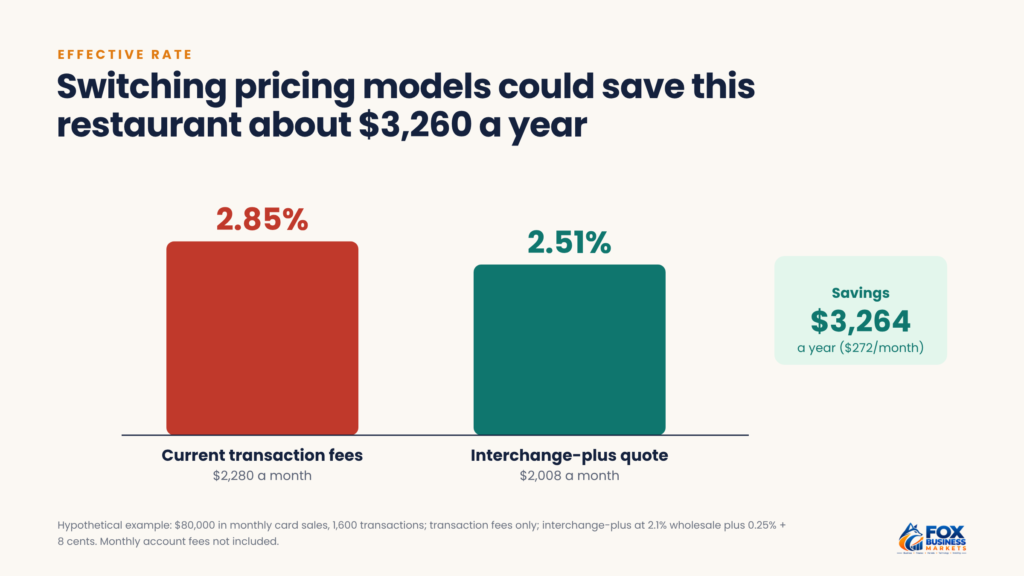
Example: a restaurant processes $80,000 in card sales in a month with an average ticket of $50, or 1,600 transactions. Its statement shows $2,280 in transaction fees, a $25 monthly fee, and a $15 PCI fee, for $2,320 in total. The effective rate is $2,320 ÷ $80,000 = 2.9%.
If the restaurant’s wholesale costs (interchange plus network fees) average 2.1% and an interchange-plus quote adds a markup of 0.25% + 8 cents, its transaction fees would be about $1,680 + $200 + $128 = $2,008 a month, or 2.51%. That’s $272 a month less than its current $2,280 in transaction fees, or about $3,260 a year, before you compare each contract’s monthly fees.
Track your effective rate every month. A rising rate can signal more rewards cards, more online sales, new fees, or a processor quietly raising its markup.
When Does Interchange-Plus Beat Flat-Rate Pricing?
Compare the two models on the same $50 sale. A flat rate of 2.6% + 15 cents costs $1.45. On interchange-plus, with wholesale costs averaging 2.1% and a markup of 0.25% + 8 cents, the same sale costs about $1.26. Interchange-plus saves about 19.5 cents per transaction, or 0.39% of sales.
That saving has to cover any fixed charges that come with the interchange-plus account. If those add up to $40 a month, like the restaurant’s monthly and PCI fees above, the breakeven is about 206 transactions, or roughly $10,300 a month in card sales at a $50 average ticket. Below that, flat-rate pricing is likely cheaper. Above it, interchange-plus pulls ahead.
Your card mix moves that line. In this example, flat-rate pricing costs less per sale once wholesale costs average about 2.5% or more, which can happen when most customers use premium rewards cards. A debit-heavy mix lowers wholesale costs and makes interchange-plus pay off sooner. Run the math with your own average ticket and the wholesale rate on your statement, then use our business revenue calculator to see how the savings change your net revenue.
Is Debit Always Cheaper Than Credit to Accept?
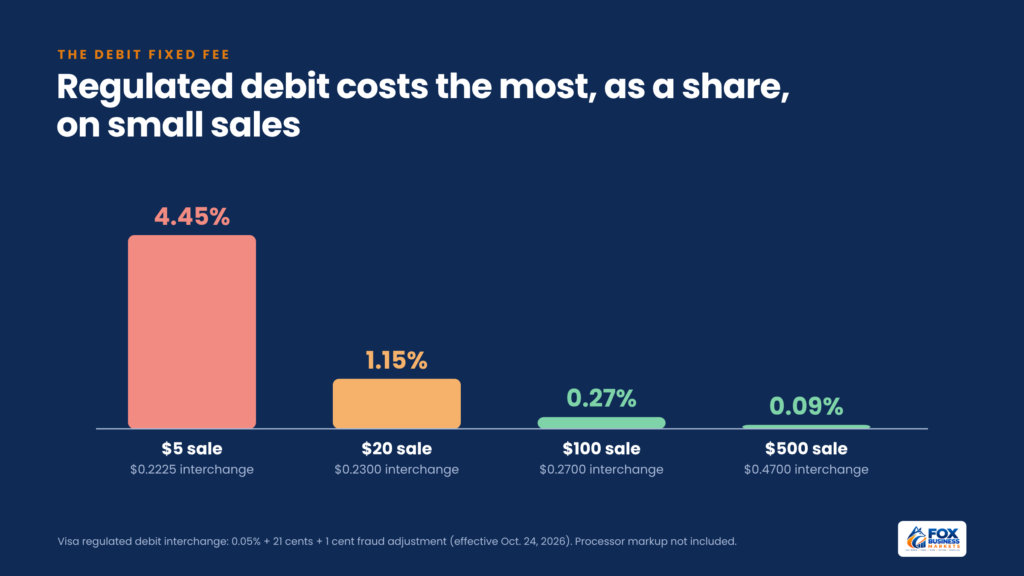
No. A common belief is that debit is always the cheaper card to accept. Debit usually costs less than credit on mid-size and large purchases, but the fixed part of regulated debit interchange can make it more expensive on small sales.
Under Visa’s current schedule, regulated debit carries 0.05% plus 22 cents (with the fraud adjustment) no matter how small the purchase. On a $5 coffee, that’s about 22 cents, or 4.45% of the sale. The same $5 card-present sale on a traditional Visa credit card under the small-ticket rate of 1.90% carries about 10 cents in interchange.
Sale size | Regulated debit interchange | Rate |
| $5 | $0.2225 | 4.45% |
| $20 | $0.2300 | 1.15% |
| $100 | $0.2700 | 0.27% |
| $500 | $0.4700 | 0.09% |
For businesses with very small average tickets, such as coffee shops and vending, ask your processor about small-ticket pricing and whether your rates are applied correctly. On interchange-plus pricing, you see these differences directly; on flat-rate pricing, they’re blended into one rate.
Does Accepting Cards Online Cost More Than In Person?
Usually, yes. Online and keyed-in sales carry higher interchange because the card isn’t present, and payment facilitators charge more for them too. On a $50 sale:
$50 sale | In person | Online | Keyed in |
| Square (free plan) | $1.45 (2.9%) | $1.95 (3.9%) | About $1.90 (3.8%) |
| Stripe | $1.40 (2.8%) | $1.75 (3.5%) | About $2.00 (4.0%) |
Interchange alone shows the same gap. Exempt debit costs about 55 cents on a $50 card-present sale and about 98 cents online. Online sellers also pay gateway fees and face more chargebacks. To narrow the gap, use address verification and security codes, and have in-person customers tap or insert their card instead of keying it in.
What Other Fees Show Up on Your Statement?
Beyond per-transaction costs, look for:
- Monthly or annual account fees, sometimes called statement or service fees
- PCI compliance or non-compliance fees, charged until you complete your annual security questionnaire
- Chargeback fees, often $15 to $25 per dispute, plus the lost sale
- Monthly minimums, which charge you the difference if your fees fall below a set amount
- Gateway fees for online payments
- Equipment leases, which can cost far more over a multiyear contract than buying a terminal
- Early termination fees, sometimes hundreds of dollars or more
- Batch and authorization fees, small per-batch or per-attempt charges that add up at high volume
Many of these are negotiable or avoidable. Ask for a complete fee schedule before you sign.
How Do You Read a Processing Statement?
Most statements follow the same order, even when the labels differ:
- Summary: total card sales, number of transactions, total fees, and the net amount deposited. Divide total fees by total sales to get your effective rate.
- Interchange or pass-through charges: on interchange-plus pricing, sales are grouped by card category with the rate each paid. Watch for card-not-present or “standard” categories on in-person sales, which can point to keyed-in cards or late batches.
- Network fees: often labeled “assessments” or “dues.” These should run close to 0.13% to 0.15% of volume, plus small per-item charges.
- Processor fees: the markup, per-transaction fees, and account charges such as PCI, gateway, and monthly fees.
If you see “qualified,” “mid-qualified,” and “non-qualified” headings, you’re on tiered pricing. Lay two months of statements side by side. A new line item or a rate change you weren’t told about is the first thing to question.
What Does the Visa and Mastercard Settlement Change?
Visa and Mastercard reached a settlement with U.S. merchants that the merchant plaintiffs’ experts estimate would save merchants about $38 billion through 2031. A federal judge granted preliminary approval on June 9, 2026, and a final approval hearing is set for November 16, 2026, according to Payments Dive. If approved, the deal would:
- Cut credit card interchange by 0.10 percentage point for five years.
- Hold standard consumer credit cards at 1.25% for eight years.
- Let merchants decline some premium and commercial cards, loosening the “honor all cards” rule.
- Expand surcharging and discount rights, so merchants can steer customers toward lower-cost payments.
Many merchant groups oppose the deal, and appeals could delay it. If it takes effect, businesses on interchange-plus pricing should see the cut passed through directly; on flat-rate plans, ask your processor whether it will lower your rate.
How Do Credit Card Processing Fees Differ by Business Type?
Your industry shapes your average ticket, card mix, and how customers pay:
- Coffee shops, quick service, and vending: small tickets make fixed per-transaction fees the biggest cost. Compare per-item fees, not just percentages, and ask about small-ticket interchange.
- Restaurants: premium cards are common, and premium restaurant credit can carry 2.60% interchange.
- E-commerce and phone orders: every sale is card-not-present, so expect higher interchange plus gateway fees.
- B2B and wholesale: business cards cost more, but Level 2 and Level 3 data can lower interchange, and ACH often costs less on large invoices.
- Retail: mostly chip and tap sales with a debit-and-credit mix, which tends to favor interchange-plus as volume grows.
For more on managing costs as you grow, see our small business finance guide.
How Can You Lower Credit Card Processing Fees?
- Switch to interchange-plus pricing once your volume supports it, and negotiate the markup.
- Get at least three written quotes based on your last three statements.
- Reduce card-not-present risk by using address verification and card security codes, and by encouraging tap or chip payments in person.
- Settle batches daily, because delayed settlement can push transactions into higher-cost categories.
- Send Level 2 and Level 3 data if you sell to businesses and government agencies.
- Steer large invoices to ACH, which typically costs a flat fee instead of a percentage. Our guide to ACH payments explains how.
- Cut avoidable fees by staying PCI compliant, fighting chargebacks with documentation, and buying rather than leasing equipment.
- Consider a compliant surcharge or cash discount program, where state law and card rules allow it.
Card fees also affect your cash flow, because they reduce every deposit. Our guide to cash flow management shows how to plan for them.
Can You Pass Card Fees On to Customers?
Sometimes. Businesses have three main options:
- Surcharging: adding a fee to credit card sales. Card rules cap it (Visa allows the lesser of 3% or your actual cost) and require advance notice to your processor and clear disclosure to customers. You can’t surcharge debit or prepaid cards, and Connecticut, Maine, and Massachusetts ban surcharges.
- Cash discounting: posting one price and giving a discount to customers who pay with cash or another lower-cost method. It’s generally allowed in more places than surcharging.
- Dual pricing: showing both a cash price and a card price. Rules vary by state, so check before you switch.
Whichever you choose, display prices clearly, train staff to explain them, and watch how customers react. A surcharge that drives away repeat customers can cost more than the fees it recovers.
Frequently Asked Questions
Do you get processing fees back when you refund a sale?
Often not. Stripe and Square keep their processing fees on refunds, and PayPal returns the percentage portion but keeps the fixed fee. Check your processor’s refund policy, and factor non-refundable fees into your return policy.
Do you pay processing fees on tips?
Yes. Fees apply to the full amount charged to the card, including any tip the customer adds. Restaurants and service businesses should budget for fees on total card volume, not just menu prices. Review your state’s rules before deducting card fees from employees’ tips, because some states restrict it.
Does American Express cost more to accept?
American Express has historically charged higher fees than Visa and Mastercard, though the gap has narrowed. Most small businesses accept Amex through the OptBlue program, which lets their regular processor set the rate. Compare your effective rate on Amex sales with other cards before deciding whether to promote or limit it.
Are credit card processing fees tax-deductible?
Generally, yes. Processing fees are an ordinary business expense for most businesses. Processors usually deposit your sales minus fees and report your gross payments on Form 1099-K. Record your gross card sales as revenue and the fees as a separate expense, not just the net deposits, so your books match the 1099-K. Download your processor’s annual summary each January and give it to your tax preparer.
Calculate Your Effective Rate Today
Pull your last three months of processor statements, add up all your credit card processing fees, and divide by your total card sales. If your effective rate is above about 3% for an in-person business, request interchange-plus quotes from at least three providers and ask your current processor to match the best offer. Cut any avoidable charges you find, and send large invoices by ACH. For where card payments fit among all the ways Americans pay, see our payment statistics and credit card statistics roundups, and use our guide on how to invoice to get paid faster.
This article is for general information only and isn’t financial, tax, legal, or investment advice. Consider your own situation or talk to a qualified professional before making decisions.

